


Every major global enterprise today operates under a strict mandate to integrate artificial intelligence into its core operations. Yet, behind boardrooms and engineering dashboards, a quiet anxiety persists. Very few organizations truly understand what happens the exact moment an autonomous AI agent is granted direct access to enterprise systems and internal data repositories. Executives and security leaders are left grappling with fundamental questions: What systems will the agent be able to reach? How will the organization track and audit what the agent actually did with that access?
According to industry insiders and venture capital backers, these critical questions—rather than model quality, infrastructure costs, or talent shortages—are the primary reasons why so many enterprise artificial intelligence programs remain permanently stuck in the pilot phase. Cymphony was built specifically to answer these exact challenges, providing a way forward for companies paralyzed by security uncertainty.
Agent Data Access is the Primary Constraint
Modern employees increasingly work side-by-side with AI agents to execute day-to-day administrative, analytical, and operational workflows. However, the typical autonomous agent bears little resemblance to a human worker. An AI agent can be provisioned in a matter of minutes, contrasting sharply with the weeks or months required to hire, vet, and onboard human personnel. Once active, these agents operate continuously around the clock. More importantly, they can reach across vastly more systems, sensitive data troves, and technical capabilities than any individual person could manage in a standard workday.
Every single one of these powerful properties is precisely what makes deploying an AI agent valuable to a business in the first place—and, conversely, every one of them is what causes corporate security teams to immediately say no.
Governance and security are already proving to be major structural barriers to broader artificial intelligence adoption. Industry analysts at Gartner expect that as many as 40 percent of enterprises will actively demote or decommission their autonomous AI agents due to governance concerns. This projection does not stem from a failure of the underlying artificial intelligence models to perform their assigned tasks. Instead, it highlights a scenario where enterprises are forced to pull back working agents simply because they lack the visibility and control required to monitor where those agents are roaming and what data they are touching. The fundamental challenge facing modern businesses is not a lack of utility, but a profound crisis of accountability.
For decades, enterprise security teams have built their tools around two entirely separate concerns: determining where sensitive data actually lives, and verifying who has authorized access to it. The first focus produced sophisticated tools designed to watch files, email inboxes, and backend databases for leaks or unauthorized exfiltration. The second focus built the massive corporate identity management industry. However, both of these legacy approaches share a foundational assumption: that the "who" accessing the system is always a human employee.
Artificial intelligence fundamentally broke that long-standing security assumption. A traditional identity tool can tell you that an agent exists within the network architecture. A data loss prevention tool can tell you that a specific file contains sensitive corporate intellectual property. Yet, neither tool can reliably tell you whether a given agent, acting on behalf of a specific employee, has the capability to reach and ingest that file at any given moment. In the era of autonomous workflows, traditional identity security and data security are no longer separable domains.
Cymphony Emerges to Solve the Visibility Gap
To bridge this dangerous security divide, Cymphony continuously maps both human employees and autonomous agents across an entire enterprise ecosystem. The platform builds a dynamic graph illustrating precisely who and what can reach specific systems and underlying pieces of information. Solving this challenge represents a formidable engineering problem. A single human employee routinely holds a dozen different user accounts scattered across disparate software systems that were never originally designed to communicate with one another. Furthermore, AI agents inherit their access permissions dynamically from the humans and parent applications that spawned them. Stitching all of these complex relationships back together into one accurate, real-time picture requires far more than a basic dashboard that simply aggregates raw security alerts.
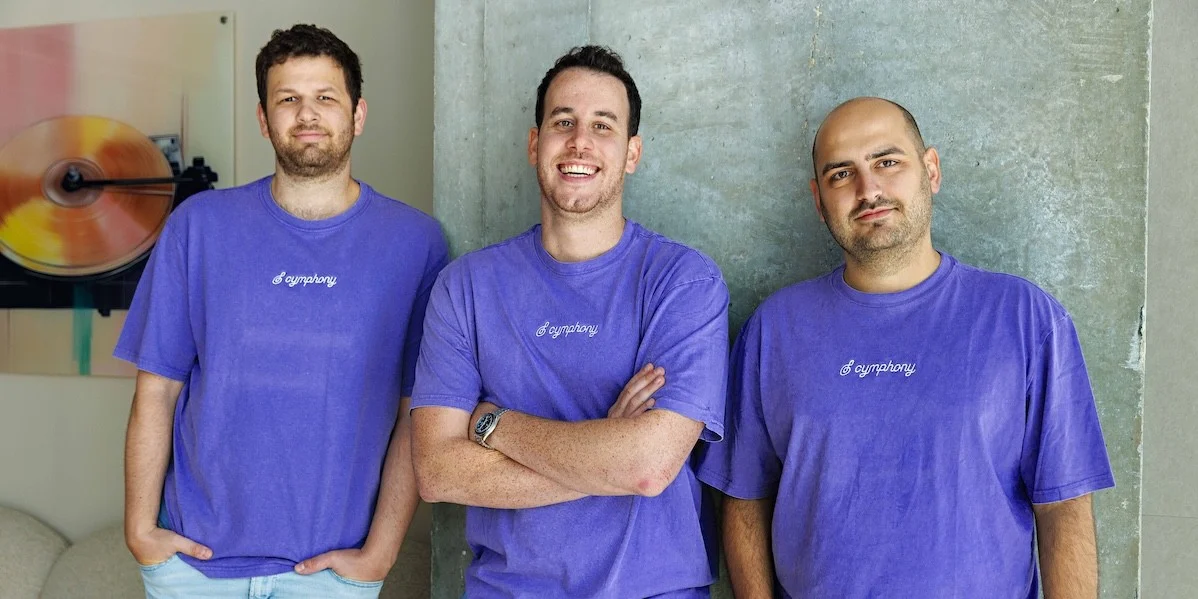
Industry observers note that the distinguishing characteristic of Cymphony’s founding team—comprising co-founders Shy Dekel, Idan Berkovits, and Edi Gotlieb—is their instinct to build software designed for complete workflows rather than isolated alerts. Instead of stopping at mere detection and leaving a security analyst to manually figure out what to do next, Cymphony pushes the operational process further. The platform recommends and even automates necessary remediation steps, actively coordinating with the exact human stakeholders who need to take action to secure the environment.
Enterprise customers, including major global organizations such as Syngenta, KKR, Cass Information Systems, and Athennian, are already reporting tangible results from deploying the technology. Sequoia Capital, itself an enterprise user of the platform, has demonstrated confidence in the company’s trajectory. Following an initial investment in Cymphony’s seed round, the venture firm has stepped forward to co-lead the startup’s Series A financing round.
The Journey of the Founders and the Evolution of Enterprise Software
The founding trio behind Cymphony brought deep technical expertise to the table when they launched the company. Shy Dekel, Idan Berkovits, and Edi Gotlieb all emerged from Israel’s elite Talpiot military program and spent their careers tackling complex, unglamorous security problems that many other founders routinely avoid. Their professional backgrounds are distinguished: Shy led the cyber department for Unit 8200, Idan managed a specialized research group within the Office of the Prime Minister and earned the prestigious Israel Defense Prize, and Edi built hardware systems at Apple as well as the Israeli Ministry of Defense.
Historically, every major enterprise software category has been built on a generational transition where the underlying unit of work changes, rendering older security categories obsolete. When cloud computing arrived, it fundamentally altered where software ran, and the security industry completely rebuilt itself around that shift. When mobile devices transformed what constituted a corporate endpoint, security adapted once again. During each of these structural transformations, the companies that successfully provided comprehensive visibility and control over the new paradigm eventually became foundational infrastructure that everyone else took for granted.
Artificial intelligence represents a similar historical inflection point, marking the first major technological shift where the new unit of work possesses the capability to act entirely on its own. The company that successfully provides enterprises with the confidence to say yes to autonomous agents—operating at scale with a verifiable record of their actions—will not merely function as an optional feature tucked inside the artificial intelligence stack. Instead, it will serve as an absolute precondition for enterprise AI adoption. Backers believe Cymphony is actively constructing that vital security layer.





Comments (0)