


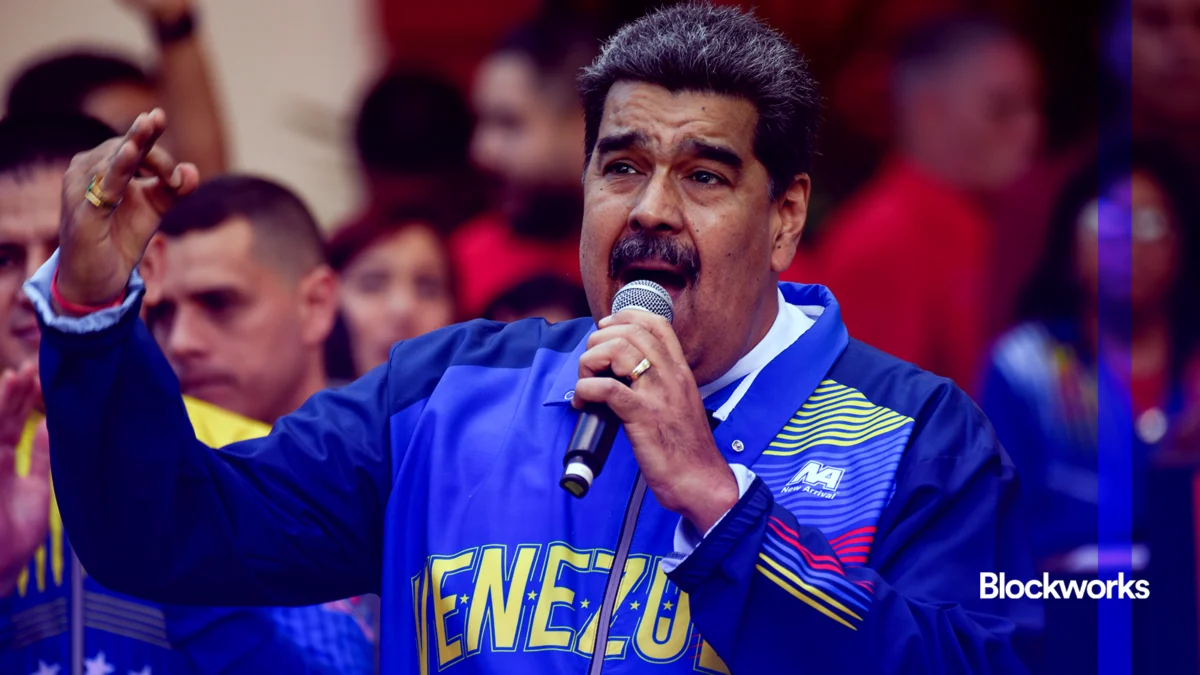
“I don’t see it as a bad thing, this process that they call ‘dollarization’… Thank god it exists.” These were the words of Nicolás Maduro, reflecting a reality that has unfolded across Venezuela over the past few years. Recent reporting by The New York Times highlighted that Venezuela has effectively become the first nation to manage a remarkably large share of its everyday finances and national commerce using cryptocurrencies.
Yet, this transformation was born entirely out of necessity rather than ideological preference or proactive financial innovation. Roughly half of Venezuela’s national revenue historically comes from oil sales denominated in U.S. dollars. Because the country has long been subjected to sweeping and crippling international economic sanctions imposed by the United States, the Venezuelan government cannot legally send or receive traditional wire transfers or standard banking transactions through conventional global financial channels.
Historically, governments facing similar regimes of comprehensive economic isolation had to resort to complex, high-friction workarounds to monetize their natural resources. They would typically sell their crude oil through an intricate web of opaque shell companies, obscure offshore banks, and shadowy intermediaries, or they would engage in direct bilateral bartering of oil in exchange for physical goods, basic commodities, or foreign infrastructure investments.
Today, however, sanctioned states have discovered a far more frictionless option: accepting payments in stablecoins. According to estimates by economist Asdrúbal Oliveros, Tether’s USDT stablecoin has quietly become the primary medium of exchange for roughly 80% of all Venezuelan oil sales. This represents a staggering reversal of official policy. The Venezuelan government once outright banned commercial transactions utilizing stablecoins and digital assets, viewing them as a direct, existential threat to the stability of the domestic fiat currency, the bolivar. But as the crushing economic effects of U.S. sanctions compounded over time, the government was left with virtually no alternative but to embrace the very digital tokens it once criminalized.
Delcy Rodriguez, now serving as the interim president of Venezuela, recognized the absolute inevitability of this crypto-enabled dollarization. Last August, she explicitly signaled to domestic business leaders that “non-traditional mechanisms of management” were actively being deployed by the state to better navigate and stabilize the bolivar exchange rate. Shortly thereafter, Reuters reported that the Venezuelan government had officially permitted a much wider circulation and utilization of USDT within the domestic economy.
With formal state approval, domestic commercial banks now routinely take the USDT earned directly from international oil sales and sell those digital assets to local businesses. These enterprises then use the stablecoins to pay both domestic vendors and international suppliers for goods and services. The integration has even trickled down to the consumer level. The head of the country’s National Association of Supermarkets recently confirmed to state television networks that grocery store chains throughout Venezuela are actively working to implement point-of-sale systems capable of accepting direct payments in USDT.
In practical terms, the Venezuelan government is now actively encouraging its citizens and corporations to use digital dollars issued by Tether in place of the official bolivars printed by the central bank. Consequently, USDT—widely referred to by everyday Venezuelans as “Binance dollars”—has permeated daily life. It is now routinely used for everything from purchasing basic groceries and paying condominium maintenance fees to disbursing monthly salaries and settling vendor invoices.
Given this massive state-level pivot toward stablecoins, it came as a notable surprise to digital asset enthusiasts that neither cryptocurrency nor stablecoins were deemed worthy of mention in the U.S. Department of Justice’s formal indictment of Nicolás Maduro. Instead, federal prosecutors detailed illicit money laundering and sanctions evasion operating in the most traditional, old-fashioned ways imaginable. The indictment described private airplanes returning from Mexico physically loaded with drug proceeds, military-grade hardware like grenades and grenade launchers being directly bartered in exchange for shipments of cocaine, protection services being compensated with a direct cut of the transported narcotics, and a staggering $2.5 million bribe paid out entirely in physical cash U.S. dollars.
This glaring omission raises a fundamental question: Why was crypto absent from the federal indictment of a leader whose country relies so heavily on digital tokens for its national oil trade?
Industry analysts generally point to two main possibilities. The first, more tongue-in-cheek explanation is that the U.S. government has softened its public rhetoric regarding the crypto sector, leading prosecutors to judiciously omit it from high-profile charging documents. The second, and far more likely, explanation is that cryptocurrency and stablecoin networks are still not entirely capable of smoothly moving capital in the massive, institutional volumes that Maduro and his elite associates required for their large-scale operations.
Asdrúbal Oliveros elaborates on this operational bottleneck, noting that the Venezuelan state frequently struggles to liquidate these digital assets expeditiously. Moving crypto funds of that magnitude often requires navigating complex regulatory controls, compliance checks, and liquidity hurdles that illicit state actors cannot always meet without raising immediate red flags.
A comprehensive investigative report published by blockchain analytics firm TRM Labs reaches a remarkably similar conclusion regarding illicit finance on a global scale. The report notes that large-scale drug trafficking organizations continue to rely overwhelmingly on physical cash, sophisticated trade-based money laundering schemes, and direct state or quasi-state protection to move core illicit proceeds. In these sprawling criminal networks, cryptocurrency generally plays a secondary, complementary role rather than serving as a total replacement for traditional cash pipelines.
National security analysts writing for the legal journal Lawfare echo this assessment, concluding that cryptocurrency-based sanctions evasion still represents only a fraction of a percent compared to traditional illicit financial pathways and legacy banking loopholes.
At the same time, other observers maintain a much more bullish—if illicit—view of the practical utility of stablecoins and decentralized networks in cross-border payments. Investigative journalism organization InSight Crime has reported that Mexican drug cartels are increasingly sustained by an industrial-scale cryptocurrency laundering pipeline. This system moves dirty cash rapidly through decentralized digital networks directly to Chinese chemical suppliers who provide the precursor ingredients for illicit drugs.
As investigators detail, stablecoins have found a uniquely efficient niche by acting as a matchmaking mechanism between Chinese underground money brokers who desperately need clean dollars to sell to domestic clients evading China’s stringent capital controls, and Mexican cartels who urgently need to pay overseas suppliers for chemical components. While this is certainly not the specific kind of mainstream product-market fit that early crypto advocates envisioned or hoped for, revealed preferences in the global economy suggest it is a remarkably powerful one.
The U.S. Drug Enforcement Administration (DEA) has pointed out in its national threat assessments that direct law enforcement seizures of physical illicit cash have dropped sharply because organized criminal syndicates are increasingly prioritizing digital currencies and crypto-based schemes over traditional cash-based laundering networks. Corroborating this shift, direct seizures of virtual currency by the DEA have risen significantly. Between 2020 and 2024, the agency seized approximately $2.5 billion worth of cryptocurrency, compared to just $2.2 billion in physical cash over the same timeframe.
This dynamic helps explain why high-level actors like Maduro and his close associates have largely stuck to more traditional, physical means of payment. Fully traceable cryptocurrencies and easily freezeable stablecoins carry inherent risks that make them less than ideal for the most clandestine, multi-million-dollar money-laundering operations.
Nevertheless, Venezuela’s aggressive, state-backed embrace of digital dollars is undeniably breaking new ground in the global financial landscape. As analysts at Lawfare observe, U.S. adversaries have successfully established an operational proof of concept for bypassing traditional financial blockades using blockchain technology, and emerging financial innovations will likely only further solidify these methods over time.
Ironically, this digital workaround may ultimately serve to reinforce the global dominance of the U.S. dollar rather than weaken it. Being effectively locked out of the traditional U.S. banking system did not compel the Venezuelan government to pivot toward alternative geopolitical fiat currencies like the Chinese yuan to price and sell its oil. Instead, it simply forced the state to bypass the legacy banking system entirely by adopting digital representations of the dollar itself.





Comments (0)