



As traditional financial benchmarks and global markets transition into the New Year following the Christmas holiday, the digital asset ecosystem is experiencing a notable divergence in performance. While macroeconomic indicators and traditional risk-on sentiment lifted mainstream equities and commodities—with gold leading the charge—major cryptocurrencies like Bitcoin experienced a slight retreat. At the same time, sector-specific movements within decentralized finance and the Solana ecosystem highlight shifting investor preferences, evolving protocol dominance, and intense competition among perpetual contract trading platforms.
Traditional markets drifted slowly upward over the past week, supported by a general risk-on mood across global exchanges. Gold led the traditional benchmarks with a solid 3.57% advance, reflecting continued demand for safe-haven assets alongside steady gains in equities. The S&P 500 posted a 1.15% increase, while the Nasdaq 100 moved up by 0.84%.
In contrast, Bitcoin bucked this broader macroeconomic momentum, slipping approximately 0.90% over the same period. The world’s leading cryptocurrency diverged from traditional risk assets, experiencing minor downward pressure as traders rebalanced portfolios ahead of the year-end holiday lull.

Sector Divergence: Solana Ecosystem Outperforms While L2s and Lending Bleed
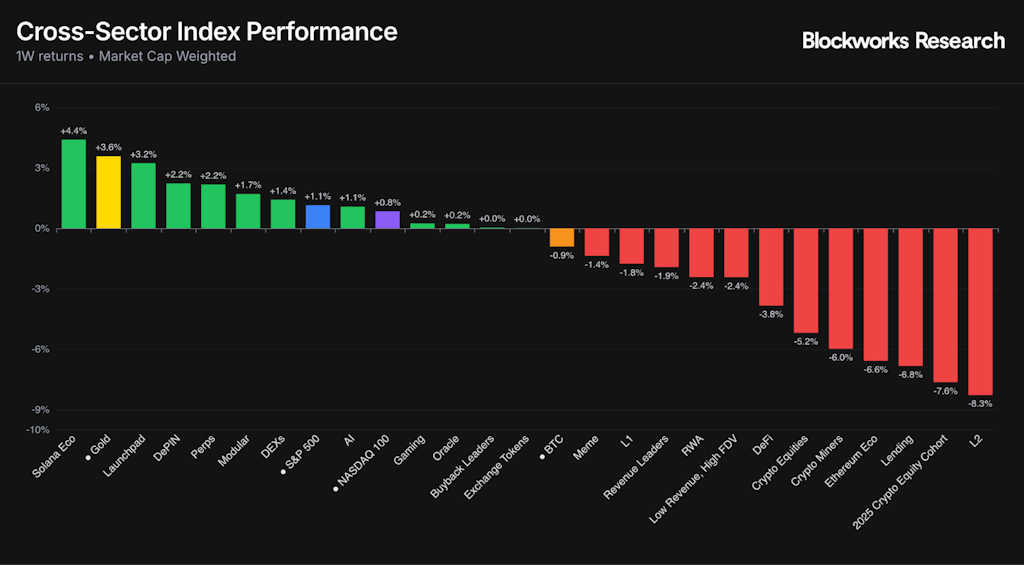
Crypto sector indices painted a fragmented picture of market health over the week. The Solana ecosystem emerged as a clear leader, jumping 4.4% on the back of renewed interest in liquid staking and derivatives narratives. Other pockets of the market also found modest green territory, including launchpads up 3.23%, decentralized physical infrastructure networks climbing 2.23%, perpetual protocols advancing 2.17%, and modular architecture gaining 1.7%. Decentralized exchanges and artificial intelligence tokens posted more modest advances of 1.42% and 1.07%, respectively.
On the other hand, several sectors faced heavy selling pressure. Layer-2 scaling solutions suffered the steepest declines, plunging 8.27%, closely followed by the lending sector, which dropped 6.82%. The broader Ethereum ecosystem fell 6.57%, while crypto mining stocks underperformed with a 5.97% slide, reflecting sector-specific headwinds and capital rotation toward higher-beta altcoin narratives.
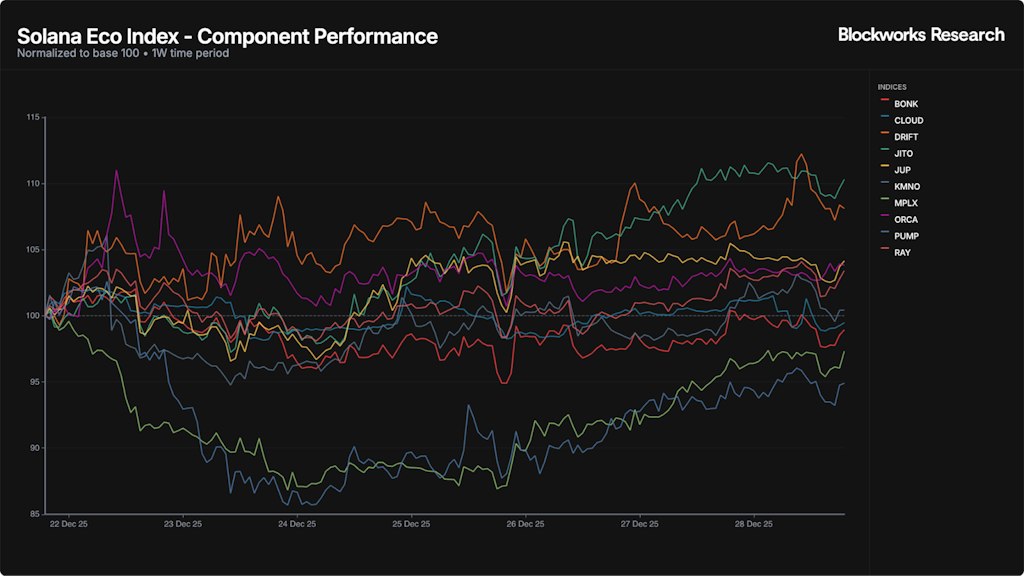
Within the booming Solana ecosystem, specific tokens stood out. JTO led the charge with a 10.30% gain, closely followed by DRIFT, which rallied 8.10% as demand for decentralized derivatives and liquid staking solutions surged. Jupiter, Orca, and Raydium also posted solid advances ranging from 3.40% to 4.14%, demonstrating broad-based strength across Solana-based decentralized exchanges.
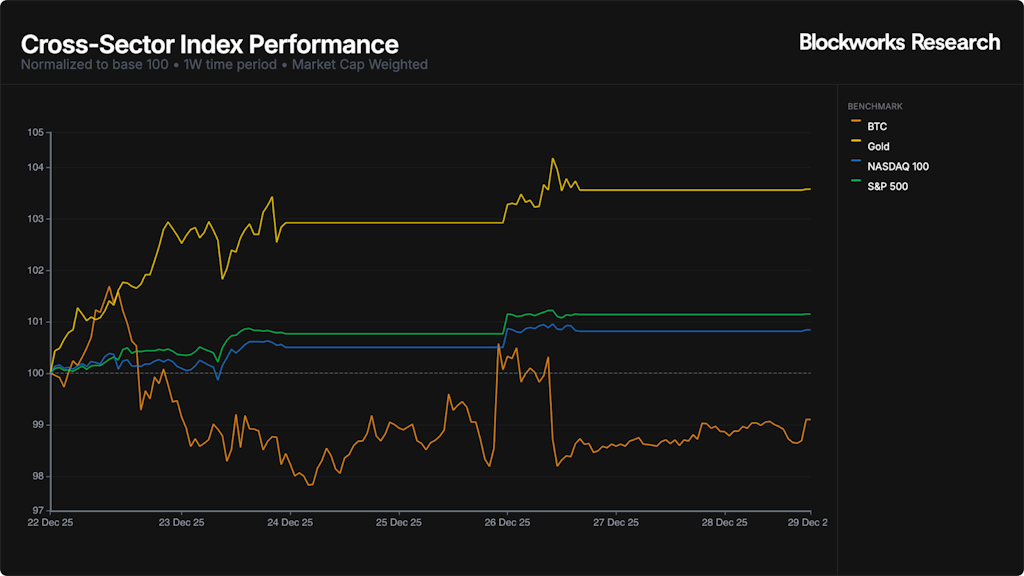
Conversely, some Solana-adjacent assets struggled to maintain momentum. MPLX dipped 2.68%, while the token performance for PUMP lagged significantly, tumbling 5.11%. Market participants noted that the ongoing decline in PUMP reflects broader fatigue setting in around memecoin launchpads as liquidity rotates toward more established foundational primitives.
Evolving Dynamics in DeFi Lending: Aave Faces Mounting Competition
A detailed look at decentralized finance reveals subtle shifts in market dominance among lending protocols. Throughout 2025, Aave has maintained an undisputed leadership position in the DeFi lending sector, capturing 86% of total protocol revenue and generating an impressive $120.9 million year-to-date. However, a closer examination of the data indicates that Aave’s absolute grip on the market has loosened slightly over the course of the year, sliding from a 91% revenue market share in January down to 86% by December.
This slight contraction in market share has not gone to waste; it has been absorbed by agile new entrants and fast-growing competitors. Protocols such as HyperLend, which launched in March, and Jupiter Lend, which debuted in July, have successfully carved out a combined 3.4% slice of the revenue market. Meanwhile, Fluid has emerged as one of the most aggressive growth stories among established alternatives, more than doubling its market share from 2.4% to 4.9% over the same timeframe.
A similar narrative plays out when examining outstanding loans across the lending landscape. Aave currently holds $21.3 billion in outstanding loans, representing 74.7% of the total market—a metric that has remained relatively flat since January. The meaningful market share movements have occurred among competing protocols. Morpho expanded its footprint, growing its share of outstanding loans from 10.6% to 12.8%. Spark experienced a sharp contraction, with its loan share collapsing from 11.5% down to just 4.7%. Fluid nearly doubled its share of outstanding loans from 3.6% to 5.0%, while newer participants like Jupiter Lend and HyperLend secured smaller but recognizable positions at 2.1% and 0.7%, respectively.
Network Revenues Contract as Perp DEX Volume Wars Intensify
Network revenues across major blockchain ecosystems continued a broader downtrend, with total weekly revenue dropping 21% to $26.4 million, marking one of the lowest weekly totals in over a month. Hyperliquid experienced the sharpest absolute revenue decline among major chains, falling 40% from $11.8 million to $7.1 million. Ethereum saw a comparable 38% drop, bringing its weekly revenue down to $2.2 million.
Solana demonstrated relative resilience compared to its peers, slipping just 2% to $4.7 million in weekly revenue. Tron maintained its position as a top revenue generator trailing just behind Hyperliquid, pulling in $6.1 million despite an 11% decline. The only notable top-line gainers were smaller Layer-1 and Layer-2 networks—including Arbitrum, Polygon, and Binance Smart Chain—which posted increases ranging from 2% to 50%, though these percentage gains represent relatively small absolute dollar amounts.
The competitive landscape among perpetual contract decentralized exchanges remains intensely fluid. Earlier in the year, particularly in August 2025, Hyperliquid dominated the sector, recording $396 billion in volume and $121 million in revenue, with a trailing 30-day volume peak of $395 billion and a market share exceeding 80% in decentralized perpetuals.
Recent weekly metrics, however, show aggressive challengers eating into Hyperliquid’s volume dominance. Lighter recorded $30.9 billion in perpetual volume over the past seven days and $203.7 billion over the past month, backed by $1.48 billion in open interest. Aster similarly posted robust activity with $26 billion in weekly volume and $160.6 billion over 30 days, alongside a much larger open interest pool standing at $7.4 billion.
Meanwhile, Hyperliquid slipped behind on weekly volume, recording $21.5 billion, though it maintained a commanding lead in open interest at $2.4 billion—more than double the combined open interest of its emerging rivals. Industry analysts are closely monitoring these volumes, noting that upcoming token airdrops and incentive points programs from newer platforms like Lighter may be temporarily inflating activity, raising questions about whether these trading volumes will sustain once incentive structures conclude.




Comments (0)