


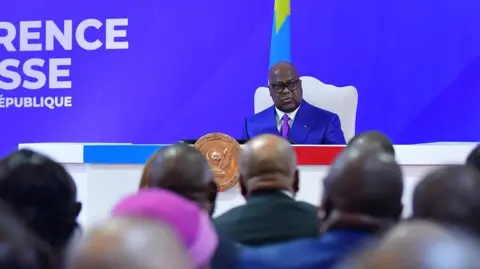
Democratic Republic of Congo President Félix Tshisekedi has signaled a willingness to pursue a third presidential term, provided the nation’s electorate approves the move through a constitutional referendum. Speaking to reporters on May 6, Tshisekedi outlined a path that would require rewriting the country’s foundational laws while his current mandate is still underway.
The current constitution of the Democratic Republic of Congo strictly limits presidents to two terms in office. With Tshisekedi’s second and final mandate scheduled to expire in 2028, any viable pathway toward an extended stay in power necessitates altering the rules of the game midstream. The remarks have immediately drawn intense scrutiny from political analysts, opposition factions, and regional observers, injecting a fresh wave of volatility into an already fragile domestic landscape.
The Statement and What It Actually Means
During a press conference that was closely monitored and covered by Africanews, Tshisekedi framed the proposition of a third term as a grassroots mandate originating from the citizenry rather than an ambition of his own making.
"I did not seek a third term, but I’m telling you: if the people want me to have a third term, I will accept," Tshisekedi told reporters.
This rhetorical maneuver carries a rich and controversial history across global politics. Leaders in Africa, Latin America, and other regions have frequently deployed the "the people demand it" narrative to justify sweeping constitutional amendments designed to consolidate and extend their executive authority. In political science circles, this recurring phenomenon is widely recognized and studied under the heading of the third-term problem.
On the surface, invoking a public vote through the phrase "if voters approve" appears to align with democratic principles. However, the operational mechanics of organizing a referendum reveal profound challenges. The identity of the entity organizing the vote, the formulation of the referendum question, and the transparency of the vote-counting process are critical variables. In a nation grappling with the DRC’s deep-seated governance challenges, these administrative details are far from minor footnotes.
Executing a credible constitutional referendum requires monumental logistical capabilities in a country roughly the size of Western Europe. The DRC faces severe infrastructure limitations, ongoing armed conflict in its eastern territories, and a historical legacy of contested electoral outcomes. Attempting a nationwide vote under these conditions represents an extraordinarily complex undertaking.
The Political Backdrop Is Messy
Félix Tshisekedi first assumed the presidency in December 2018 following an electoral process that was mired in controversy and deeply contested. His victory over the political machinery of outgoing long-serving leader Joseph Kabila was questioned vigorously by both domestic opposition candidates and international election monitors. According to comprehensive analysis published by the Institute for Security Studies, this disputed electoral mandate left Tshisekedi with remarkably limited parliamentary influence during the formative years of his administration. Consequently, he was compelled to govern through fragile and uneasy political alliances.
Although Tshisekedi secured a second term in subsequent elections, the foundational questions surrounding his political legitimacy were never entirely dispelled. The recent decision to float the possibility of a third term introduces an additional layer of severe tension into an already precarious political environment.
Opposition groups have reacted swiftly and vocally to the president’s remarks. According to reports from Africa Briefing, various opposition factions have publicly accused Tshisekedi of attempting a calculated power grab aimed at permanently entrenching his administration. They have issued stern warnings that pursuing a constitutional amendment could spark widespread civil unrest in a nation that has historically endured severe political violence.
The DRC has rarely experienced smooth political transitions since gaining independence in 1960, having weathered numerous coups, devastating civil wars, and disputed successions. Each instance in which a sitting head of state signals an intent to remain in power beyond established term limits serves to elevate political temperatures nationwide.
Compounding these domestic political hurdles is a severe and protracted military crisis. Eastern Congo remains deeply engulfed in a complex armed conflict involving dozens of domestic militia groups, foreign-backed rebel factions, and official government forces. This relentless violence has displaced millions of citizens and generated a catastrophic humanitarian emergency that consistently ranks among the most severe worldwide.
This ongoing security crisis introduces profound practical complications for any upcoming election timeline. As Africanews highlighted, the persistent fighting in the eastern provinces could easily be leveraged as justification for postponing the scheduled 2028 presidential elections. If a nationwide constitutional referendum is introduced onto the calendar prior to those polls, the logistical burden multiplies exponentially.
Opposition leaders have already flagged a concerning potential scenario: the eastern conflict could be utilized as a convenient pretext to delay the presidential elections indefinitely while the machinery of state quietly forces through constitutional modifications. Whether such an outcome aligns with Tshisekedi’s explicit intentions remains unknowable, but the structural incentives for such a delay are unmistakable, drawing intense vigilance from domestic and international watchers alike.
Why This Matters Beyond the DRC
The geopolitical and economic significance of the Democratic Republic of Congo extends far beyond its national borders. As the largest country in sub-Saharan Africa by total land area and one of the most resource-abundant nations on the planet, its stability is of global importance. Its vast reserves of cobalt, in particular, render the DRC a cornerstone of the global economy, as cobalt is an indispensable component in the lithium-ion batteries that power electric vehicles and modern consumer electronics.
Consequently, political instability within the DRC rarely remains localized. The tremors of domestic turmoil ripple outward, impacting regional security across Central and East Africa, disrupting global commodity supply chains, and influencing international diplomatic and aid flows. Whenever the trajectory of Congolese governance appears uncertain, international markets and neighboring governments take immediate notice.
For observers tracking broader trends in African governance, Tshisekedi’s remarks mirror a familiar playbook. Over recent years, multiple African leaders have actively sought, and in certain instances successfully secured, constitutional revisions designed to prolong their tenure. While some transitions occurred peacefully, others ignited the precise political instability and civil strife that opposition leaders had urgently predicted.
The impending 2028 election cycle in the DRC was already projected to draw intense global observation. It now bears the heavy weight of entirely new uncertainties: whether elections will proceed on schedule, whether the foundational constitutional framework will be altered before citizens reach the ballot box, and whether the ultimate process will command domestic and international legitimacy.
With roughly two years remaining before his current mandate expires, Tshisekedi possesses sufficient time to organize a constitutional referendum should the requisite political will materialize. Concurrently, that same timeframe affords opposition movements ample opportunity to mobilize public sentiment, enables international actors to voice diplomatic positions, and leaves a window for the security situation in the east to either improve or deteriorate further.
With none of these critical variables offering predictability, the political reality is that the next two years in Congolese politics have grown markedly more contentious. Tshisekedi’s willingness to entertain a third term, couched in the democratic rhetoric of a popular mandate, sets the stage for a high-stakes constitutional confrontation within a nation already burdened by armed conflict, governance deficits, and profound public skepticism toward state institutions.




Comments (0)