



As the cryptocurrency market navigates the final stretch of the year, a comprehensive look at capital flows reveals a decisive shift in investor sentiment. Market participants are increasingly rotating out of speculative ventures and consolidating positions into large, proven crypto infrastructure. At the same time, an examination of tokens introduced over the course of the year lays bare the extent of the damage inflicted on new asset launches, highlighting a brutal reality for venture-backed and high-profile listings alike.
This year-end reassessment underscores a growing preference for established utility and battle-tested sectors, while high-beta tokens and speculative narratives face a severe reckoning. The divergence between macroeconomic optimism and digital asset performance has become increasingly pronounced, leaving many alternative crypto sectors struggling to find a footing as liquidity concentrates at the top.

Indices and Market Divergence
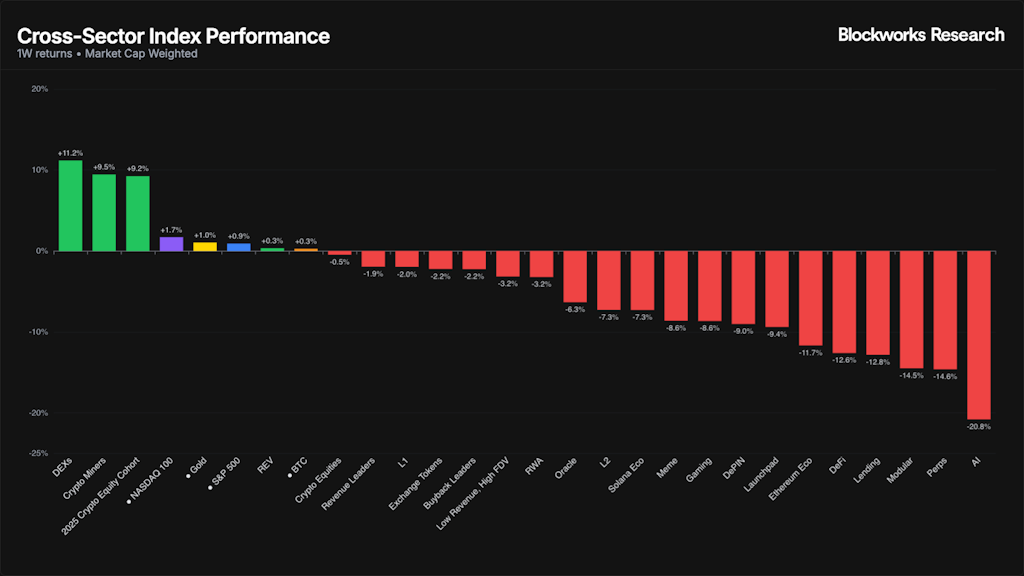
Over the past week, flagship digital assets experienced notable relative weakness. Bitcoin remained essentially flat, registering a negligible change of plus 0.3%. This sluggish performance marked a clear underperformance compared to traditional financial benchmarks over the same period. The tech-heavy NASDAQ advanced 1.7%, safe-haven Gold gained 1.1%, and the broad-based S&P 500 rose 0.9%.
This divergence accelerated notably around December 18, when the majority of crypto sectors experienced a sharp sell-off while traditional equities held their ground. Market analysts point to this dynamic as a crypto-specific risk-off event rather than a reaction to broader macroeconomic weakness, signaling that internal market dynamics and sector-specific liquidations were the primary drivers of the downward pressure.
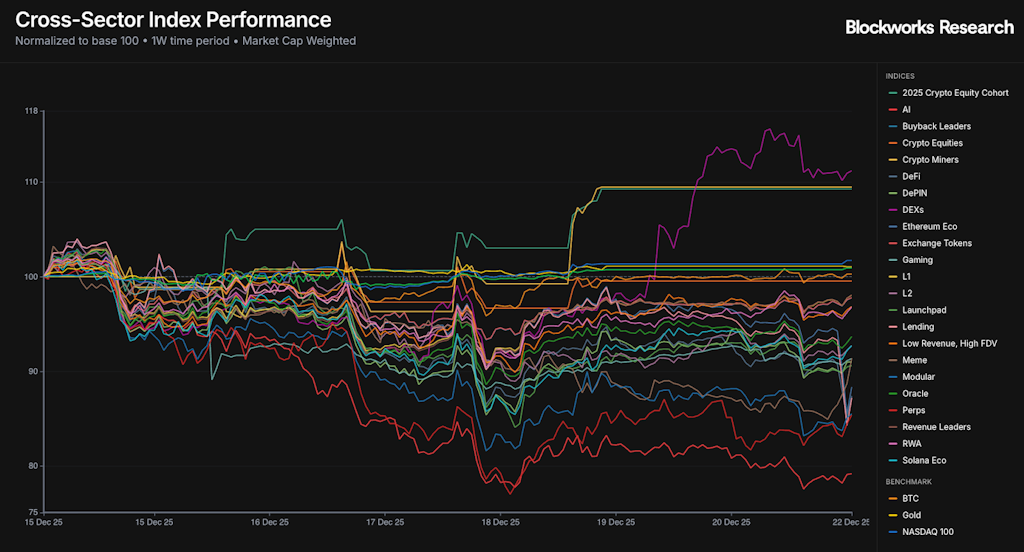
Despite the broader stagnation, specific pockets of the digital asset ecosystem managed to register positive momentum. Decentralized exchanges led all indices with an 11% gain, followed closely by crypto miners up 9.5% and the 2025 crypto equity cohort advancing 9.2%. The outperformance among decentralized exchanges was heavily propelled by Uniswap’s native asset, UNI, which surged 15.4%. This rally followed the successful passage of the UNIfication vote onchain, which saw overwhelming participation as 69 million UNI tokens voted in favor, comfortably surpassing the 40 million quorum requirement.
Conversely, layer-1 blockchains and exchange tokens posted modest losses, sliding 2% and 2.2% respectively. The most severe underperformance, however, was concentrated in the artificial intelligence sector, which plummeted 21%. This steep decline was largely dictated by the performance of TAO, the native token of the Bittensor network, which also fell 21%. The weakness in TAO and the broader AI token complex likely reflects a classic sell-the-news unwind surrounding Bittensor’s inaugural halving event, which occurred around December 14. While the halving successfully cut daily token issuance in half, it failed to immediately catalyze incremental demand, leaving the sector vulnerable to broader de-risking trends.
Negative Returns Plague 2025 Token Launches
As the market prepares to turn the page on the year, zooming out on the performance of 2025’s newly minted tokens reveals a punishing landscape. Hard numbers now quantify what many market participants had long felt intuitively throughout the year: across a cohort of 117 tokens launched in 2025, investment returns have been overwhelmingly negative.
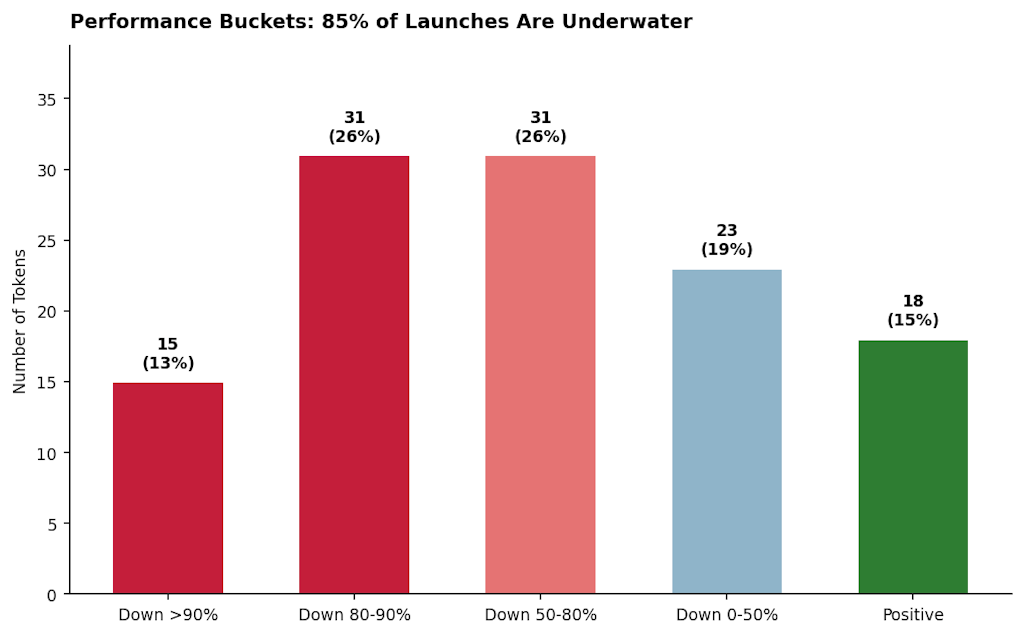
Data compiled across these listings shows that the median token is currently down approximately 71% compared to its fully diluted valuation at the time of listing. Out of the 117 tokens tracked, a mere 17 assets, representing just 15% of the total cohort, are currently trading above their initial launch valuations. Meanwhile, roughly 40% of the newly launched tokens have suffered drawdowns exceeding 80% from their initial listing marks.
The downside pressure has been both broad-based and severe, with 100 out of the 117 tokens, or 85%, currently underwater. Losses are heavily concentrated in the 50% to 90% drawdown range, which accounts for the largest share of overall launches. At the extreme tail end of the distribution, 15 individual tokens have experienced catastrophic declines of more than 90%. This group of severe laggards includes several high-profile listings that generated significant hype upon arrival, such as Berachain, which tumbled 93%, Animecoin, down 94%, and Bio Protocol, which also saw a 93% decline.
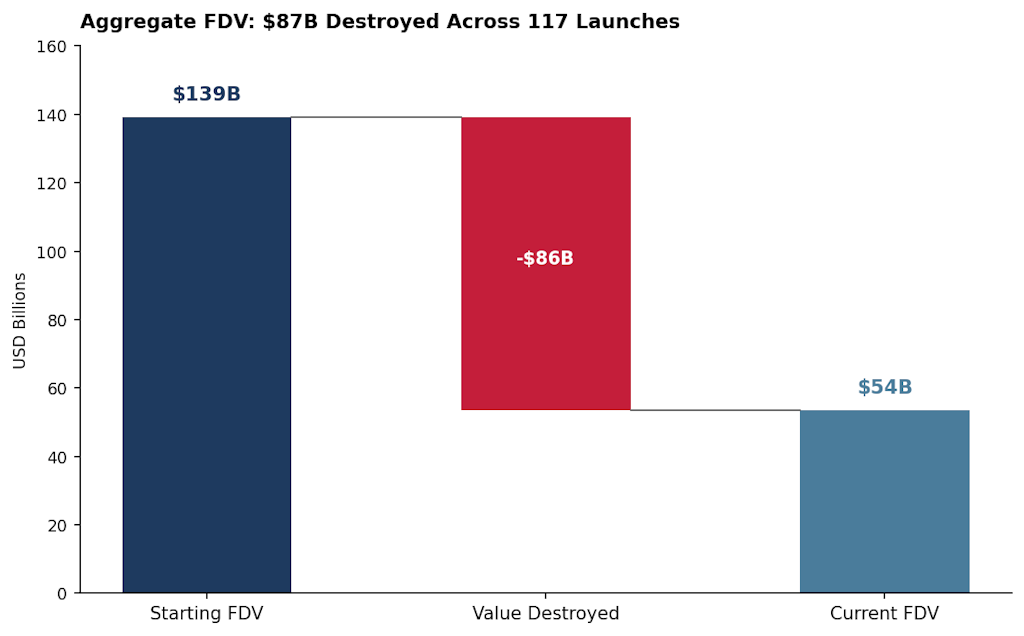
In aggregate, the financial impact of these downward revisions is staggering. The total fully diluted valuation of the entire cohort has compressed from a towering $139 billion at the time of listing down to just $54 billion. This massive contraction implies approximately $87 billion, or 59%, of paper fully diluted valuation destruction across the asset class, a figure that does not even account for projects that have effectively traded down to zero value.
While dispersion on the positive end of the tail does exist, it remains heavily concentrated. The worst-performing categories skew predominantly toward infrastructure and gaming sectors, with projects like Syndicate and Animecoin sitting among the worst laggards with declines of 93.6%. In contrast, the standout winners that managed to defy the broader downward trend are largely characterized as later-stage, second-half launches that debuted with much more conservative starting valuations. These outliers include Aster, which surged 745%, Yooldo Games, up 538%, and Humanity, which posted gains of 323%, proving that realistic initial pricing played a crucial role in surviving the challenging market conditions.





Comments (0)