



US-listed spot Bitcoin exchange-traded funds (ETFs) managed a brief return to net inflows on Monday, offering a temporary glimmer of optimism amidst a broader backdrop of weakening market sentiment and ongoing volatility in the price of Bitcoin. However, despite the single-day recovery, the wider financial picture for the month of October remains decidedly pessimistic, leaving these major investment vehicles firmly in negative territory for the period.
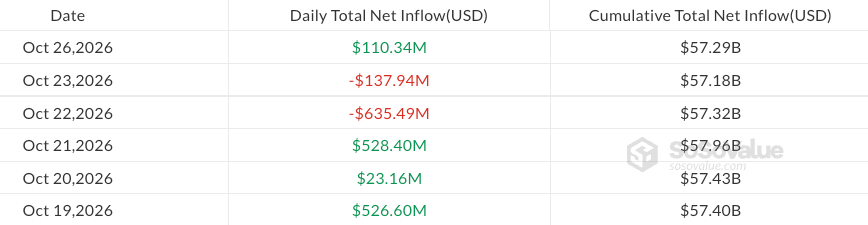
According to data compiled by SoSoValue, US spot Bitcoin ETFs attracted $110 million in net inflows on Monday. This daily influx marked a welcome and sharp reversal from the substantial selling pressure experienced just prior, having bounced back from a combined $774 million in heavy withdrawals recorded over the previous two trading sessions. While the sudden injection of capital demonstrated that institutional appetite has not entirely vanished, it was not nearly enough to erase the damage accumulated over the broader course of the month.

When factoring in Monday’s rebound, the cumulative monthly performance for US spot Bitcoin ETFs remains in the red, sitting at approximately $202 million in net outflows through Monday. This ongoing capital flight highlights a cautious, if not outright defensive, posture among traditional investors participating through regulated exchange-traded products, as broader macroeconomic uncertainties and price fluctuations weigh heavily on risk-on assets.
At the time of publication, Bitcoin was changing hands at $79,595, reflecting a 2.6% decline over the preceding seven-day period, according to tracking data from CoinGecko. The flagship cryptocurrency continues to navigate a turbulent macroeconomic and regulatory environment, with market watchers closely monitoring upcoming pivotal events such as Federal Open Market Committee (FOMC) meetings and corporate earnings reports that traditionally trigger heightened volatility across both traditional equities and digital asset markets.
Alongside the fragile price action, broader market sentiment has similarly softened. The widely followed Crypto Fear & Greed Index dipped to a reading of 48, down slightly from 50 the previous day. While this subtle shift places the index squarely in "Neutral" territory, it underscores a distinct lack of conviction among market participants, who appear hesitant to commit fresh capital while the direction of the broader trend remains up for debate.
Beneath the surface of institutional fund flows, on-chain analytics are revealing a fascinating divergence in behavior between retail traders and large-scale holders, commonly referred to as whales. Data from blockchain intelligence platform CryptoQuant indicates that smaller retail investors have been actively routing larger volumes of Bitcoin to major centralized exchanges like Binance, whereas large-scale holders have simultaneously curtailed their exchange deposits.
Detailing these market dynamics in a recent CryptoQuant QuickTake insight, analyst Darkfost pointed out that retail Bitcoin deposits flowing into Binance nearly doubled over a 30-day window, surging to a notable $10.8 billion. In stark contrast, incoming deposits from large holders experienced a significant contraction, dropping down to $3.8 billion over the same timeframe.
According to Darkfost’s analysis, this disparity suggests that smaller, retail-tier market participants may be seizing upon the recent price rebound as a strategic opportunity to take profits or cut exposure, thereby contributing to the persistent selling pressure and caution observed across the wider ecosystem.

As the market continues to grapple with these shifting dynamics between retail capitulation and institutional caution, investors and analysts alike remain focused on whether Bitcoin can successfully defend critical psychological and technical price thresholds in the weeks ahead.





Comments (0)