



Bitcoin (BTC) maintained its position above its 100-day moving average on Monday, demonstrating relative resilience as investors and traders braced for a high-stakes week defined by the US midterm elections, crucial labor market data, and major corporate earnings reports from technology giants Apple and Palantir.
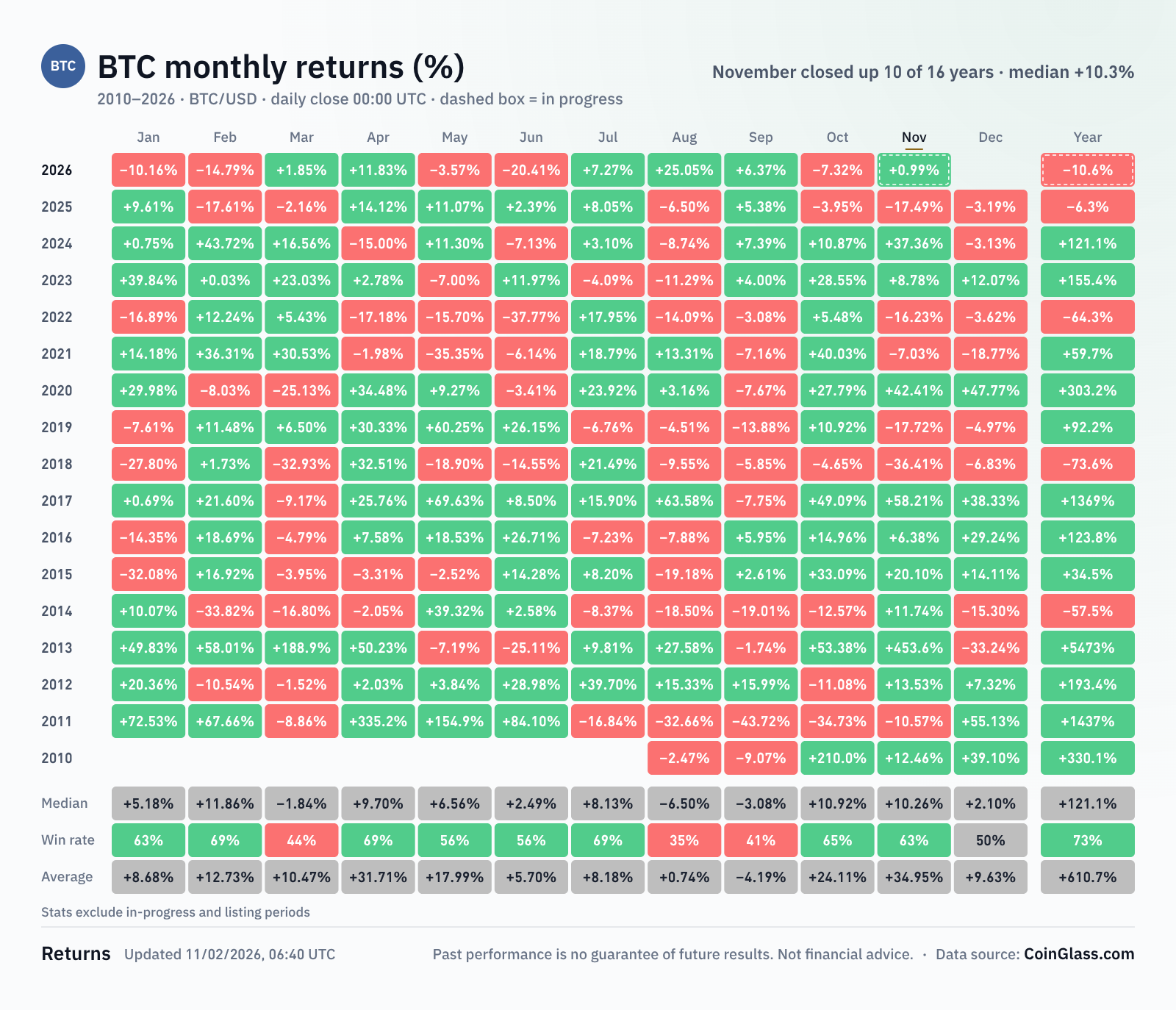
The cryptocurrency entered the week seeking stability following the conclusion of October, which data from CoinGlass revealed was Bitcoin’s weakest October performance since 2014. Down 6.4% for the fourth quarter as of Monday, BTC/USD is navigating a complex macro-financial environment where political shifts, central bank policy expectations, and equity market sentiment intersect.
Midterms Follow Bitcoin’s Weakest October Since 2014
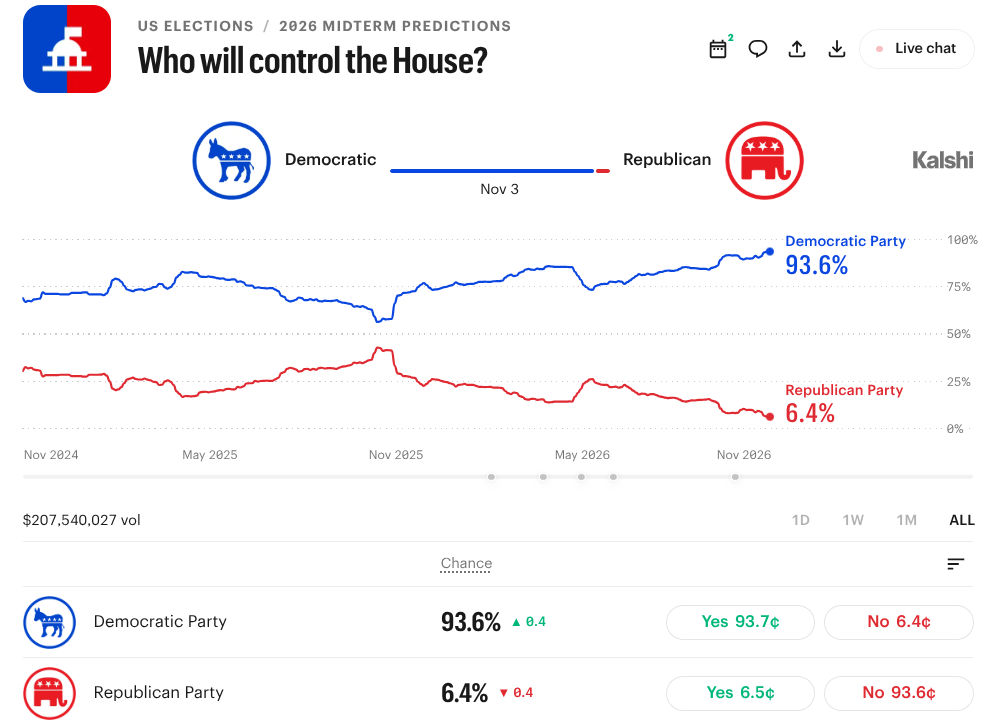
Tuesday’s US midterm elections are set to determine control of the United States Congress, with prediction market traders heavily favoring a Democratic victory in the House of Representatives. On Monday, prediction market Kalshi placed the probability of Democrats winning the House at an overwhelming 93.6%.
The political landscape could lead to institutional gridlock, a prospect underscored by President Donald Trump. Trump stated that he would readily utilize his presidential veto power should Democrats take control of Congress. "I guess I’ll become Mr Veto. They’ll be sending stuff up. You veto it," he remarked, according to the New York Post.

Historically, midterm election cycles have presented rocky paths for the world’s leading cryptocurrency. Bitcoin has ended the fourth quarter lower in each of the past three US midterm election years, registering drops of 17.3% in 2014, 43.5% in 2018, and 14.8% in 2022. Notably, all three historical periods coincided with broader Bitcoin bear markets.
Despite this historically bearish seasonal pattern, market analysts view the short-term turbulence through a lens of long-term opportunity. Benjamin Cowen, the founder and CEO of crypto analytics platform IntoTheCryptoverse, suggested that the midterm elections can function as a reliable cue to increase BTC exposure due to their historically short-term bearish impact on price action.
Writing on social media platform X on Friday, Cowen noted that the typical fourth-quarter drawdown seen during midterm years frequently serves as an accumulation window. "Usually the Q4 dump of midterm years just provide opportunities to buy for those who sold long ago," he wrote. Earlier in July, Cowen also pointed out that historical Bitcoin bear-market bottoms have frequently coincided with the second half of midterm election years.
Jobs Data and Tech Earnings Test Market Expectations
Beyond the political sphere, market participants are directing significant attention toward incoming macroeconomic indicators. September US job openings data are scheduled for release on Tuesday, which will be followed closely by October’s pivotal nonfarm payrolls report on Friday.
Economists anticipate that nonfarm payrolls will rise by 65,000. This follows a disappointing September report where the US economy added just 29,000 jobs, falling well short of consensus forecasts that had called for 84,000 additions. A softer-than-expected labor market typically increases the market-implied odds of dovish monetary policy signals from the Federal Reserve, a scenario that is broadly considered bullish for cryptocurrencies and broader risk-asset liquidity.
Federal Reserve officials are also slated to make public appearances throughout the week, with Cleveland Fed President Beth Hammack and Fed Governor Michelle Bowman among those scheduled to speak.
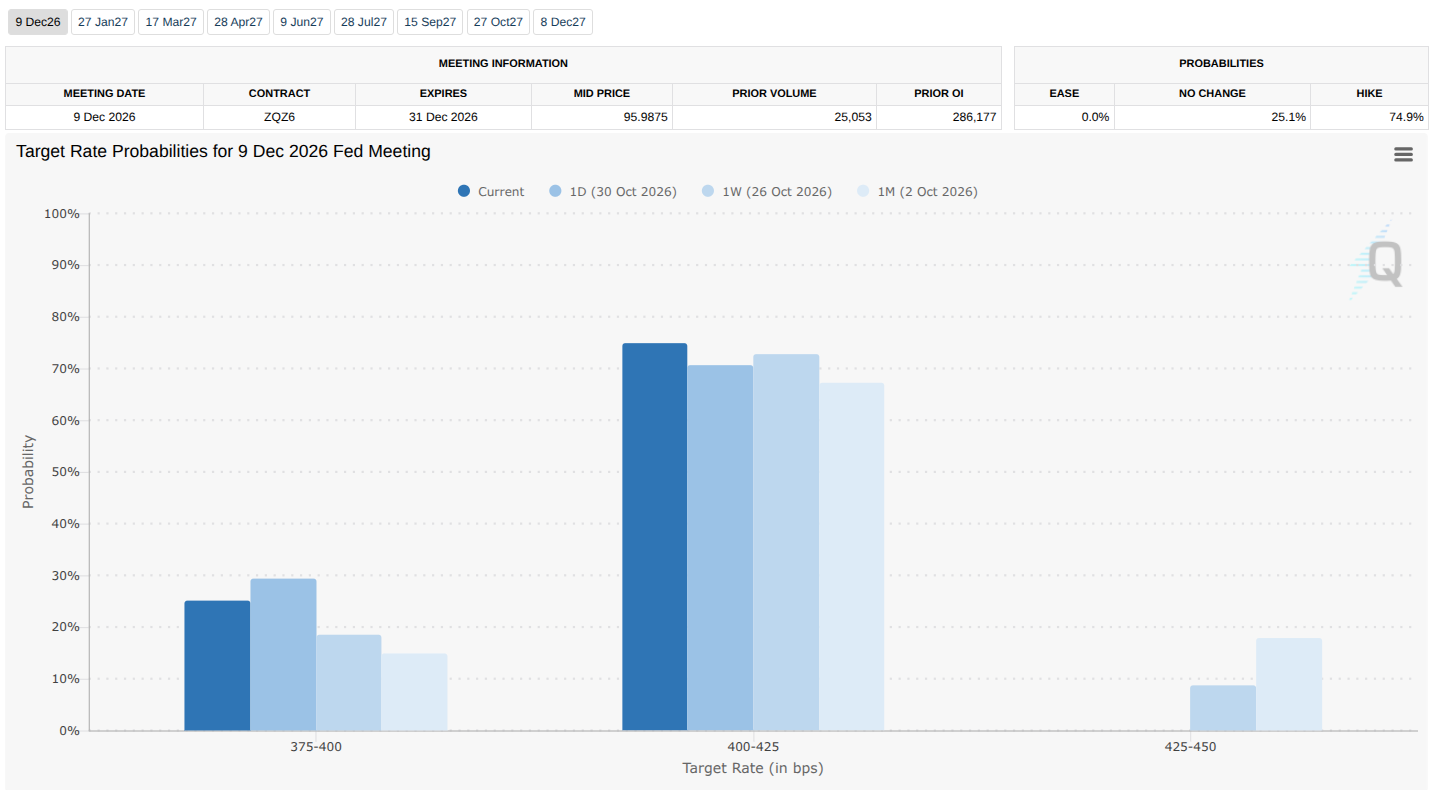
Current interest rate probabilities derived from CME Group’s FedWatch Tool indicate that markets expect the Federal Reserve to implement a 0.25 percentage point interest rate increase at the upcoming December meeting of the Federal Open Market Committee (FOMC). The implied probability of this outcome has hovered tightly between 67% and 75% over the past month. Additionally, the University of Michigan is scheduled to release its preliminary November consumer sentiment survey on Friday, which will provide updated insights into consumer inflation expectations.
Macroeconomic data prints are arriving alongside a heavy corporate earnings calendar, with approximately 20% of S&P 500 companies reporting financial results in the coming days. Chief among these are tech heavyweights Apple and Palantir, both scheduled to report their earnings after the market close on Monday.
These corporate reports follow a pronounced tech sector sell-off from the previous week, during which disappointing forward guidance and earnings reports renewed investor anxieties surrounding artificial intelligence spending levels and corporate profitability.
Noted economist Mohamed El-Erian addressed this dynamic in weekend commentary via Substack, describing traditional financial and crypto markets as now being "acutely sensitive" to tech-sector news and earnings headlines. "The market is particularly focused on justification for the massive capital expenditures being deployed across the sector, ROI’s, and revenue growth," El-Erian wrote.
Bitcoin Chart Draws Comparisons with 2023 Recovery
Amid these political and macroeconomic crosscurrents, Bitcoin’s technical posture has drawn considerable scrutiny from chart analysts. After closing October down 7.3%, Bitcoin has managed to hold firm above a key moving average that has provided reliable technical support since mid-August.
TradingView data indicates that BTC/USD successfully stayed above the previous week’s local low near $76,300, avoiding a deeper retest around the monthly close. This recent low closely aligned with the 100-day simple moving average (SMA) for BTC/USD, which has since edged upward to $76,548. Furthermore, Bitcoin successfully reclaimed its 100-week exponential moving average (EMA) just in time for the monthly candle close, with that metric standing at $77,759.
Prominent cryptocurrency trader and analyst Rekt Capital compared the current weekly price chart with Bitcoin’s notable rebound following its 2022 bear market low. During that historical recovery phase, BTC/USD formed an inverse head-and-shoulders pattern, successfully retested support at the right shoulder, experienced a brief deviation below it, and subsequently initiated a powerful macro rally.
Last week’s price dip to $76,300 brought Bitcoin back to what Rekt Capital identified as the equivalent right-shoulder support zone on the current multi-week chart. The analyst is closely monitoring whether the asset will experience a brief, similar move below that critical technical threshold in the weeks ahead.
"The question now is whether Bitcoin can produce some sort of downside deviation below here over the next few weeks," Rekt Capital noted on X, outlining the pivotal levels traders are watching as the broader macroeconomic and political events unfold.





Comments (0)