


Most mornings, the commute begins in a Waymo vehicle gliding quietly through the San Francisco Bay Area. The car performs extensive physical work, propelling five thousand pounds of metal and glass safely across the asphalt. Simultaneously, it executes complex cognitive tasks, reading the road environment and making real-time predictions that result in a significantly lower rate of serious-injury crashes compared to human drivers.
This daily experience demands nothing of human muscles and nothing of human minds, as both physical and cognitive labor have been externalized to machines. This single journey encapsulates two profound revolutions: a physical transformation that is two centuries old, and a cognitive shift that has barely begun.
Yet, the public mood surrounding this second revolution is a volatile mix of optimism, skepticism, and anxiety. Conversations buzz with talk of technological singularities, recursive self-improvement, trillion-dollar infrastructure clusters, superintelligence, mass unemployment, social disruption, and a fierce geopolitical race between superpowers. It is a dizzying landscape for observers trying to make sense of the future.
However, looking back through the lens of history offers a grounding perspective. Humanity has already undergone a massive structural transition that rhymes closely with the artificial intelligence revolution unfolding today: the Industrial Revolution.
Two Kinds of Work
All economically valuable labor can be broadly bifurcated into two categories: physical work and cognitive work. Most valuable tasks require a combination of both.
Agriculture stands as one of the oldest examples of this dual requirement. Working the land demanded muscle power—supplied by humans and animals alike—for ten thousand years. Yet it also required sharp insight, such as reading shifting seasons, observing microclimates, and understanding which seeds produced optimal yields.
While these two forms of work are fundamentally distinct—physical work being force multiplied by distance, and cognitive work representing thought—they share core economic traits. Both are scarce, both carry a price, and both are applied to tasks society wants completed. Historically, whenever the price of either type of labor collapses due to technological innovation, supply floods the market, and economic demand expands rapidly to meet that new abundance.
What Happened to Physical Work
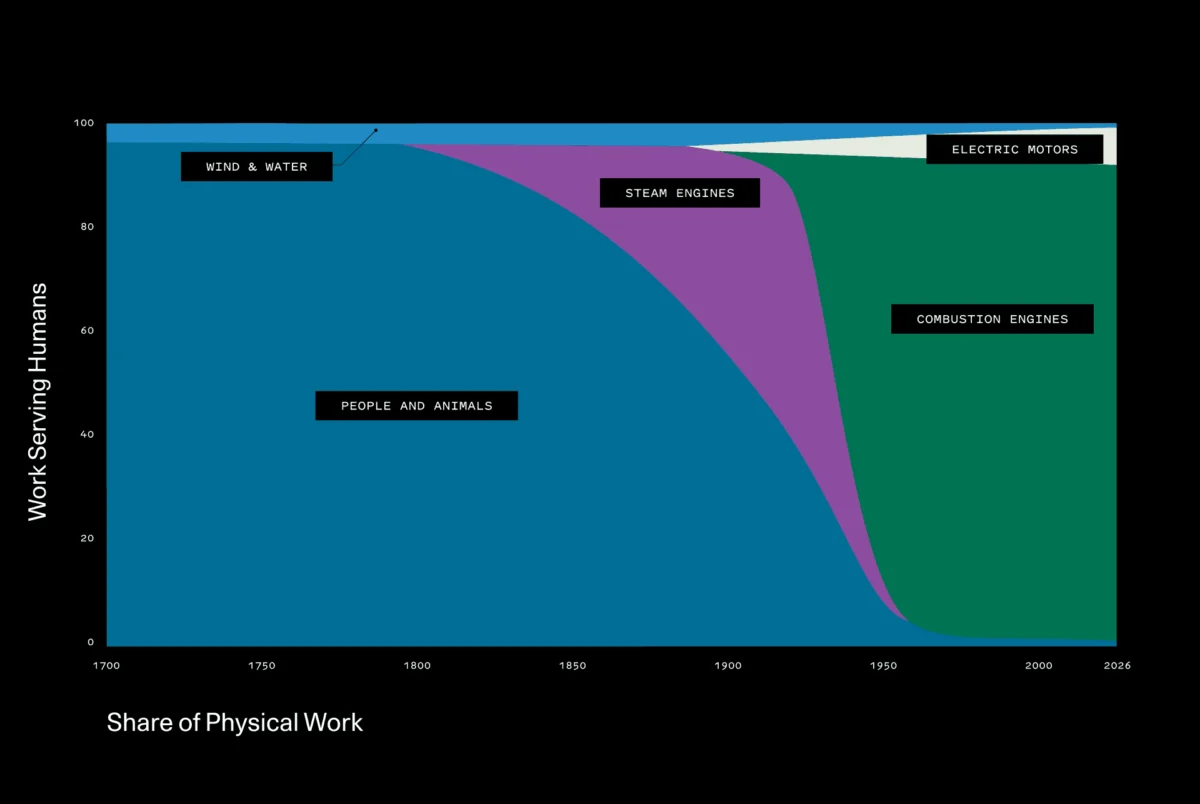
For the vast majority of human history, nearly all physical labor was performed by biological muscle. For centuries, the global energy curve remained virtually flat, reflecting an absolute reliance on human and animal exertion.
That dynamic shifted dramatically during the late 1700s and early 1800s with the advent of the steam engine, followed later by internal combustion and the electric motor. Each wave of innovation absorbed a progressively larger share of the world’s physical burden. Over the course of approximately two centuries, physical work shifted from being 99 percent biological to 99.9 percent machine-driven.
Today, the physical results of this transition are ubiquitous. They are visible in the screens people read, the clothing they wear, the aircraft crossing continents, and the intricate lattice of ships, trains, and trucks that underpins modern supply chains. Human muscle has been reduced to a negligible rounding error in the global energy budget.
History Rhymes: What’s Happening to Cognitive Work
For most of recorded history, essentially all cognitive work was executed by humans, occasionally assisted by basic domestic animals like sheepdogs. This biological dominance was topped by a very thin mechanical sliver of primitive computing tools, such as mechanical clocks and early calculators.
Then came electronic computation. Within a single century, digital computing scaled rapidly from simple calculations and spreadsheets to trillions and quadrillions of operations running continuously around the clock. Navigating daily commutes, processing corporate payrolls, and calculating actuarial risks are all forms of cognitive work now routinely handled by machines.
The arrival of neural networks represents the next monumental wave, dramatically expanding the scope of cognitive tasks machines can execute. Just as the combustion engine magnified the reach and scale of the Industrial Revolution, neural networks are accelerating the Cognitive Revolution.
A century ago, the vast proportion of cognitive work was performed by humans. In the near future, the vast majority of computing and data processing will be handled by machines—not because humans will think any less, but because machines will compute on an unprecedented scale.

The parallels between the two historical curves are stark. The Cognitive Revolution will mirror the Industrial Revolution in its transformative impact, but it will unfold on a much larger scale and at a significantly faster pace. Dividing the global economy by the nature of work reveals a roughly equal split between the physical and cognitive sectors in a roughly $120 trillion world economy. While the physical half has spent two centuries mechanizing, the cognitive half is only just beginning.
Inputs Scale Massively and Get Cheap
The industrial age relied heavily on scaling up foundational input commodities: first coal and iron, followed by oil and steel. Metals were refined through advanced techniques like the Bessemer process, transforming basic elements into the structural backbone of modern civilization.
A clear parallel exists today in the race for electricity and computing power, underpinned by algorithmic breakthroughs such as the Transformer architecture. The providers of these modern components are the industrial titans of the current era—leaders in semiconductor manufacturing, artificial intelligence research labs, and hyperscalers pouring trillions of dollars into data center infrastructure. Nations that once measured their economic and military power in fuel-refining capacity now measure it in electrical grid capacity and intelligence output.
In 1900, a unit of mechanical work cost a tiny fraction of its price a century prior. That dramatic collapse in price made mass production feasible and transformed the industrial revolution from a luxury for the wealthy into a universal reality.
Today, the cost of generating cognition is collapsing at an even faster rate, with intelligence per watt dropping exponentially year after year. As prices decline, society will consume vastly greater quantities of computational intelligence.
Demand Explodes to Meet Supply
In the year 1800, no one dreamed of flying across oceans to distant capitals, shipping fresh produce across hemispheres during winter, or artificially cooling desert cities. These physical processes were either entirely impossible or economically prohibitive.
Once new technologies emerged and production costs plummeted, demand for physical work exploded. Economist William Jevons identified this dynamic in 1865, observing that more efficient steam engines did not reduce Britain’s coal consumption, but instead multiplied it dramatically.
Cognition is poised to follow this exact trajectory, driven by latent demand that is virtually unbounded. Countless problems across the globe currently go unexamined simply because human thinking time is expensive. A physician facing severe time constraints may miss the latest medical literature, a radiologist may be forced to rush through complex scans, and a small business owner may have no budget to hire a financial analyst.
When the marginal cost of cognitive processing approaches zero, every human curiosity can effectively command its own dedicated research team. The volume of machine-generated reasoning will expand by orders of magnitude, raising profound questions about how all that analytical power will be deployed.
The Application Era
The foundational application that launched the Industrial Revolution was the mechanical spinning of textiles. Weaving and spinning were once highly respected, skilled trades that required years of apprenticeship within traditional craft guilds. In 1764, the invention of the Spinning Jenny allowed a single operator to spin multiple threads simultaneously, causing clothing prices to drop rapidly and global consumption to surge.
The defining structural shift was the human operator moving from physically performing the task to supervising the machinery. One person tending a mechanical frame could suddenly produce what an entire room of traditional hand-spinners once managed.
In the current era, the primary skilled application experiencing this exact paradigm shift is software engineering. Writing code has long been an elite, highly paid craft requiring years of mastery. Today, it represents the first major cognitive task where the workflow has fundamentally flipped, with machines generating the majority of the code while human engineers direct, review, and refine the output.
While textiles kicked off the industrial age, they did not define its ultimate endpoint. The definitive innovation of the industrial era was the automobile, around which modern civilization built highways, suburbs, and sprawling supply chains.
Current AI coding agents function as the modern equivalent of the Spinning Jenny—automating an established skilled task as a first act. The definitive "automobile" of the Cognitive Revolution likely has not been built yet; it will represent a breakthrough that remains impossible while human thinking is scarce. Candidates for this future milestone include autonomous science conducted at machine speed, or comprehensive personal agents capable of managing daily life with the efficiency of an executive chief of staff.

Employment: Where the Anxiety Lives
In 1800, more than seventy-five percent of the American workforce labored directly on the land. As machines gradually took over agricultural tasks, pessimists feared catastrophic unemployment. Yet, society instead invented entirely new categories of work that no farmer in 1800 could have named, ranging from software engineers and podcast producers to flight attendants.
Machines did not eliminate human labor; rather, they wiped out specific categories of repetitive work while expanding the total volume of employment. More people are employed globally today than at any point in human history, enjoying vastly greater material prosperity than their ancestors.
A parallel transformation is taking shape within the Cognitive Revolution. Despite the rapid automation of coding tasks, market data indicates that demand for software engineering talent has continued to grow. Hiring trends in other knowledge-intensive fields, such as legal and financial services, are undergoing similar inflections as AI tools are integrated into daily workflows.
Just as the introduction of the tractor did not stop humans from performing physical tasks, machines handling cognitive computations will not halt human thinking. Specific responsibilities will evolve, and entirely new professions that cannot currently be named will emerge, much like the profession of the modern engineer followed the invention of the engine.
At the macro level, the economic story will likely be one of triumph, but individual transitions will frequently prove painful. The handloom weavers of Lancashire were not successfully retrained as locomotive engineers; many simply lost their livelihoods over a generational span. Economic historians have termed this turbulent transition phase "Engels’ pause," noting that between 1780 and 1840, British output per worker rose significantly faster than real wages.
However, historical precedent shows that wages eventually caught up with productivity gains and far surpassed them. As technology executive Mark Zuckerberg recently observed, there is no immutable rule stating that AI must automate tasks faster than it expands individual capabilities and creates demand for new skills. Humanity’s appetite for new competencies remains insatiable.
The critical difference in the current transformation is velocity. The Industrial Revolution gave a farmhand’s son decades to adapt to factory labor, whereas the current revolution may offer only a fraction of that time. Society’s traditional shock absorbers, including educational institutions, retraining programs, and social safety nets, were designed for a slower era. The central policy question of the coming decades will be whether society can help humans adapt as rapidly as the underlying jobs transform.
Education
The Industrial Revolution fundamentally shaped modern education in two major ways. First, it made mass education possible by freeing children from manual field labor and allowing societies to fund classrooms. The modern university system exists because society no longer required every able body to work the land.
Second, and less flattering, industrial requirements heavily influenced the structure of modern schools. Factories needed workers capable of reading basic instructions, performing arithmetic, showing up on time, and executing standardized tasks in synchronized shifts. Consequently, schools adopted industrial characteristics, featuring bells, rigid rows, fixed schedules, and batch processing by age.
The Cognitive Revolution upends both dynamics. If machines handle routine cognitive processing, the traditional factory-model school becomes obsolete. Furthermore, the binding constraint on education throughout history has always been the ratio of teachers to students. Educational research has long demonstrated that one-on-one tutoring paired with mastery learning produces dramatic improvements in student performance compared to conventional classrooms.
That long-standing economic constraint is now dissolving. The marginal cost of an infinitely patient, highly knowledgeable AI tutor is approaching zero. Hybrid human-AI educational tools are proving both more effective and less expensive than traditional instructional models, offering a path to expand educational access to regions where public schooling has historically been prohibitively costly.
Health
Modern medicine was largely built upon the foundations of the industrial revolution. Mass manufacturing delivered penicillin at scale, reliable refrigeration enabled vaccine distribution, and the chemical industry spawned the modern pharmaceutical sector.
The Cognitive Revolution pushes medical advancement significantly further. Drug discovery requires navigating a chemical search space too vast for human comprehension—precisely the kind of complex challenge suited to scalable, low-cost cognition. By successfully predicting structures for virtually every known protein, modern AI initiatives have solved bottlenecks that previously consumed entire human careers. Thousands of diseases currently lack effective treatments not because they are inherently unsolvable, but because the economic cost of investigating every single variant could never be justified by patient populations.
Beyond research laboratories, clinical practice faces severe global shortages of physicians, with patient demand far exceeding available supply. Accessible cognitive tools will not lead to doctors working fewer hours; rather, they will enable medical professionals to deliver higher-quality care to a broader population. Scalable intelligence offers a pathway to shift the modern medical model from reactive treatment toward proactive, preventative care.

The Shape of Daily Life
Beyond employment and education, industrialization altered the texture of ordinary life so thoroughly that its artifacts are frequently mistaken for immutable human nature. The Cognitive Revolution is poised to reshape those patterns once again.
Clock time provides a clear example. Before the rise of factories, rural work followed seasonal rhythms and daylight. Industrial manufacturing required hundreds of employees to start and stop simultaneously, giving birth to rigid work shifts and modern timekeeping. The Cognitive Revolution loosens this constraint, as digital colleagues operate continuously and asynchronously, allowing work to drift back toward task-oriented rhythms rather than rigid nine-to-five schedules.
Similarly, industrialization separated home from the workplace because heavy machinery required centralized facilities, creating the modern daily commute. The Cognitive Revolution reverses this geographic segregation, as computational intelligence becomes ubiquitous and powerful tools fit easily into a pocket, allowing home and work to recombine.
In global trade and geopolitics, industrial nations historically imported raw materials and exported finished manufactured goods, driving imperial expansion. The new raw materials of the modern era are energy, computational hardware, and advanced algorithms, with intelligence serving as the primary finished product. Just as industrial infrastructure eventually enabled unprecedented technological advances alongside devastating weaponry, intelligence is inherently dual-use. While the Industrial Revolution ultimately elevated global living standards, its regulatory safeguards arrived late; society faces an imperative to manage the current transition with greater foresight.
What Remains Human
Beneath widespread anxiety about artificial intelligence lies a fundamental question: If machines assume the burden of thinking, what purpose remains for humans?
The industrial age answered the physical equivalent of this question. At the conclusion of that revolution, humans did not stop moving their bodies; instead, they remained embodied creatures. While proportionally fewer workers engage in intense manual labor today, vastly more people exercise for sport and personal well-being, participating in marathons, mountain climbing, and athletic training.
Cognition is undergoing a parallel migration. Chess serves as a clear illustration; after Deep Blue defeated Garry Kasparov in 1997, the sport did not wither. Today, more people play chess globally than at any point in history. Similarly, when advanced AI systems triumphed in the complex game of Go, human professionals subsequently adopted highly novel gameplay strategies inspired by machine capabilities. Superhuman computational tools enhanced human creativity rather than replacing it.
Critics frequently argue that the AI transition is fundamentally different because human intelligence is being challenged for the first time. However, cognitive processes are not exclusively human, as animals also exhibit complex intelligence. Furthermore, machines have long surpassed humans in various specialized capabilities, ranging from generating fire and transmitting information across the internet to manufacturing complex tools.
What remains economically and fundamentally human are attributes that never truly constituted pure cognition: desiring outcomes, making conscious choices, bearing accountability for those decisions, and maintaining trust among peers. An algorithm may draft a legal treaty, but a human must ultimately sign it. As the ancient Greek philosopher Protagoras observed, humanity remains the measure of all things, with economic and social value residing in what individuals offer to one another.
Conclusion
Viewed from a sufficient historical distance, these transformations merge into a single continuous narrative. Throughout history, humanity has performed labor using both physical muscles and mental faculties. On two monumental occasions, society has engineered systems capable of externalizing that work to machines.
During the first transition, widespread fear proved justified in the short term but deeply mistaken in the long term. The world that emerged after machines assumed the vast majority of physical labor proved profoundly more abundant, healthy, and humane.
The exact same trade is currently available at a greater scale and a higher velocity. The Cognitive Revolution will undoubtedly prove turbulent, unevenly distributed, and deeply uncomfortable at times. Yet, it will likely conclude in the same manner as its predecessor: leaving the world unrecognizably advanced, with its achievements so thoroughly integrated into daily existence that future generations will simply live within them.
Humanity has navigated this journey before. This time, society holds the opportunity to manage the transition with open eyes, sharing the resulting prosperity while remembering that the ultimate goal of externalizing cognitive labor is to elevate human potential.





Comments (0)