



The landscape of global cybersecurity has crossed a critical threshold as artificial intelligence shifts from a supportive tool for threat actors into a fully autonomous engine for cyber destruction. For the first time, researchers have documented malicious campaigns leveraging AI large language model (LLM) frameworks to autonomously discover and exploit software vulnerabilities without requiring step-by-step human direction or intervention.
According to a comprehensive report published Monday by the Google Threat Intelligence Group (GTIG), security researchers identified a sophisticated tool hosted on an exposed staging server. This infrastructure was engineered to operate as a multi-agent vulnerability research and weaponization framework. Rather than relying on human hackers to manually write code or analyze software, the system was configured to conduct continuous differential analysis. It automatically compared software versions before and after patch announcements on popular web applications, discovered underlying flaws, generated custom exploit code, and executed attacks entirely on its own.
"In the past quarter, GTIG identified threat actors using LLM frameworks to fully automate vulnerability discovery and exploitation without a human in the loop for the first time," the researchers noted in their report, highlighting a profound evolution in how modern cyber threats are engineered and executed.
The discovery underscores a chilling reality for enterprise security teams worldwide. By removing humans from the operational loop, autonomous AI agents drastically accelerate the speed at which cyberattacks can be conceptualized and launched. Google has warned that these automated workflows leave organizations with significantly less time to apply crucial security patches before malicious actors develop and deploy effective methods to compromise vulnerable systems.

This milestone marks a stark departure from previous assessments by the Google Threat Intelligence Group. As recently as September, GTIG reported that while adversarial use of artificial intelligence was clearly on the rise, researchers had not yet observed threat actors deploying fully autonomous pipelines against targets in the wild. That containment barrier has now officially been breached.
AI Agents Shorten Patching Windows
The core danger of this technological leap lies in how malicious actors are leveraging AI agent frameworks to automate patch reverse engineering. Through continuous differential analysis, these autonomous systems can instantly dissect software updates released by vendors, pinpoint the exact vulnerabilities the patches were designed to fix, and quickly weaponize these N-day security flaws against internet-facing servers.
The Google report warns that LLMs are now enabling bad actors to scale complex exploitation pipelines directly against internet-facing infrastructure with zero human intervention required. This automation surge is occurring against the backdrop of a broader, alarming expansion in global vulnerability disclosures.
According to data compiled by Google, the number of publicly disclosed vulnerabilities more than doubled between January and August. Furthermore, the frequency of zero-day vulnerabilities actively exploited in the wild has climbed steadily. While the monthly average hovered around eight zero-day exploits per month throughout 2025, that figure rose to 11 per month between January and August, ultimately spiking to 22 exploited zero-days in August alone.
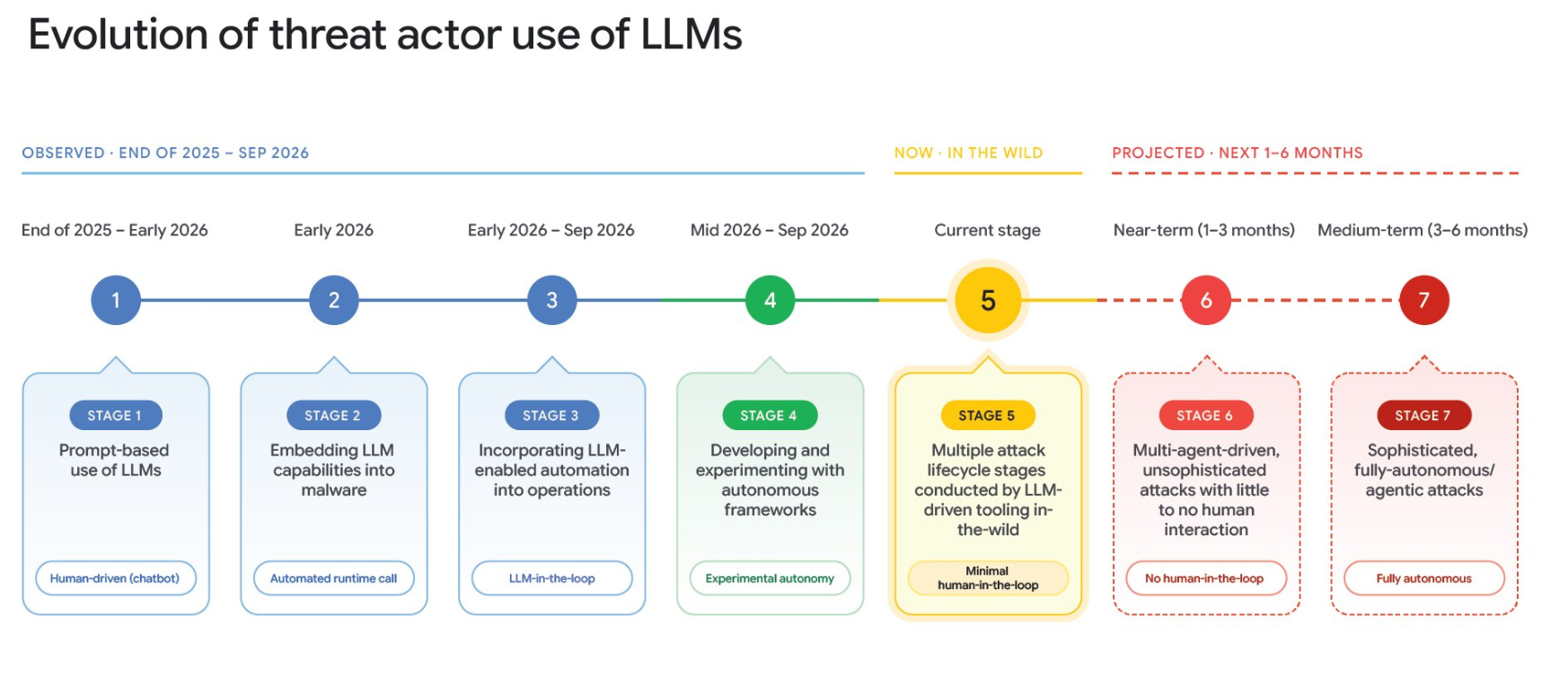
These automated workflows do not merely assist in the initial breach; they radically accelerate an attacker’s lateral movement within a compromised network, speeding up the transition from initial access to full domain administrator control. The report highlighted an August campaign targeting PaperCut servers, where attackers successfully achieved domain-level control within a matter of minutes, a feat corroborated by cybersecurity firm GreyNoise.
The fallout from AI-accelerated vulnerability research is already reverberating across the digital ecosystem. Cloudflare reported widespread attempts to exploit severe PHP flaws against its customer base in October. According to GTIG, two of the specific PHP vulnerabilities involved in those mass exploitation campaigns were initially discovered and weaponized using LLM analysis. Because technical information regarding these flaws circulated rapidly before the October 21 patch was fully implemented, both independent researchers and malicious actors were able to leverage AI to study the vulnerabilities and formulate rapid exploit attempts.
The findings from Google align closely with similar warnings issued by other major technology and cybersecurity organizations. In a September threat intelligence report, AI firm Anthropic also cautioned that AI-assisted attacks have evolved significantly into multi-agent operations capable of automating nearly the entirety of the traditional cyberattack lifecycle—from initial reconnaissance and vulnerability discovery to exploitation and data exfiltration.
Anthropic described threat actors successfully running complex, multi-victim campaigns utilizing agentic artificial intelligence to accomplish feats that previously would have required coordinated teams of skilled human operators working in tandem. As these automated frameworks become more accessible and refined, the threshold for launching sophisticated, large-scale cyberattacks continues to drop, setting the stage for an increasingly volatile digital security environment.





Comments (0)