


Software engineers working with artificial intelligence applications often rely on telemetry data to monitor performance, debug errors, and track system latency. However, capturing accurate metrics for complex language model interactions has historically presented unique challenges, particularly when moving between span attributes and structured metrics. Addressing this observability gap, Vercel has rolled out a crucial update to its AI SDK via package version @ai-sdk/otel 1.0.160, introducing a dedicated inference duration histogram designed to give developers precise visibility into model behavior.

The update follows the identification and reporting of a specific instrumentation issue within the ecosystem. An engineer debugging OpenTelemetry metrics discovered that while custom counters and individual span attributes successfully tracked runtime activity, the expected inference duration histogram remained entirely absent. Specifically, while a span attribute recorded the operation duration, it failed to automatically translate into a queryable metric distribution, leaving a blind spot for teams trying to analyze latency patterns across different workloads.
To diagnose the problem, developers investigated the dual-path nature of OpenTelemetry telemetry collection. Within the architecture, spans and metrics travel via separate mechanisms. A tracer provider routes spans to a span exporter, while metrics require an entirely distinct pipeline involving a meter provider, a reader, and a metric exporter. In earlier configurations, registering the OpenTelemetry integration before setting the global meter provider could lead to missing data streams if the underlying metrics were not properly instantiated during recording phases.

Following the submission of a detailed issue report and a subsequent reproduction, Vercel addressed the limitation through pull request #24354. The resulting release of @ai-sdk/otel 1.0.160 successfully implemented the missing metric, allowing developers to track gen_ai.client.inference.duration reliably across various operational states, including standard text generation, streaming responses, and application errors.
To verify the effectiveness of the new release, systematic local testing was conducted comparing the previous version against the updated package. Utilizing a controlled Linux environment running Node, identical workloads were executed using a mock language model configured with distinct generation delays, streaming behaviors, and injected failures. While the older version recorded zero observations in the histogram, the updated SDK successfully captured every single invocation, validating that the telemetry pipeline was functioning as intended.

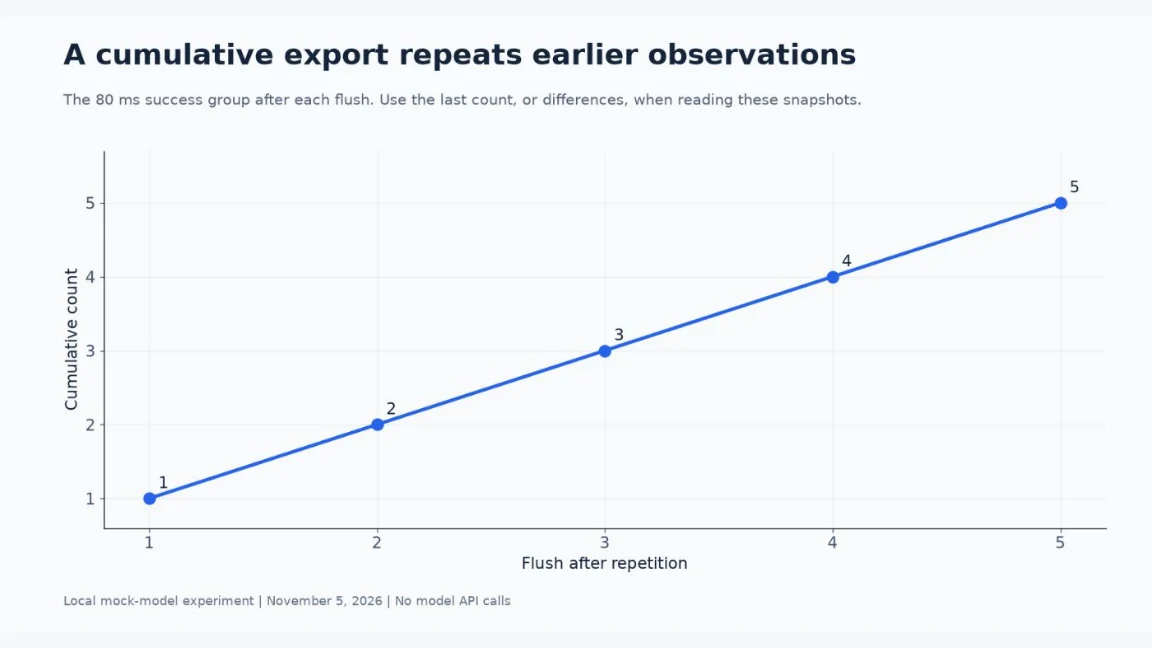
The testing framework evaluated multiple operational scenarios, ranging from rapid text generation tasks to extended streaming responses. By employing an in-memory metric exporter paired with cumulative aggregation, engineers were able to inspect discrete measurements and confirm that recorded durations closely matched the configured timer delays of the mock model. Furthermore, control measurements implemented via custom counters verified that the underlying exporter mechanism was operational throughout the entire test run, eliminating false negatives caused by misconfigured telemetry providers.
One notable insight emerging from the telemetry analysis involves the nuances of streaming and error handling within modern AI applications. When observing streaming interactions, where a model emits initial text chunks before concluding its output, a distinct temporal gap exists between the arrival of the first token at the caller and the finalization of the full inference duration. The data demonstrated that relying solely on end-of-call metrics can obscure initial responsiveness, underscoring the value of tracking time-to-first-token as a separate, complementary measurement alongside overall inference duration.

Similarly, the inclusion of failing model calls in the telemetry data provides critical context for production environments. By capturing exceptions thrown by the mock model during controlled error scenarios, the updated histogram ensures that latency monitoring accounts for unsuccessful requests rather than artificially inflating performance averages by filtering out errors. These failure points are enriched with metadata such as operation types, requested models, and normalized provider identifiers, giving engineering teams deeper diagnostic capabilities when troubleshooting flaky network requests or model provider outages.
The rollout of the inference duration histogram also highlights the importance of understanding cumulative metric aggregation and data retention policies within OpenTelemetry backends. Because metrics are exported as cumulative counts, backend query construction must account for how snapshots aggregate over time. Developers adjusting these integrations can also utilize existing configuration flags to selectively disable metrics or control input and output recording without disabling essential duration tracking.

As artificial intelligence integration becomes a standard requirement for web applications and enterprise software, robust observability tools remain essential for maintaining system reliability. Vercel’s latest update to the AI SDK bridges a critical gap between tracing and metrics, providing developers with the granular telemetry data needed to optimize performance, diagnose latency bottlenecks, and monitor AI workloads with confidence.




Comments (0)