



The digital asset market has experienced a dynamic week marked by a sharp recovery in bellwether cryptocurrencies, a reversal in institutional investment trends through exchange-traded funds, and shifting macroeconomic expectations. Bitcoin has successfully clawed its way back from local lows near $85,000 to trade around the $92,000 threshold, breathing new life into a market that had recently faced mounting selling pressure. Over the past three weeks, the leading cryptocurrency has posted a 5% gain, though this trajectory has been characterized by notable intraday volatility and distinct regional trading patterns.
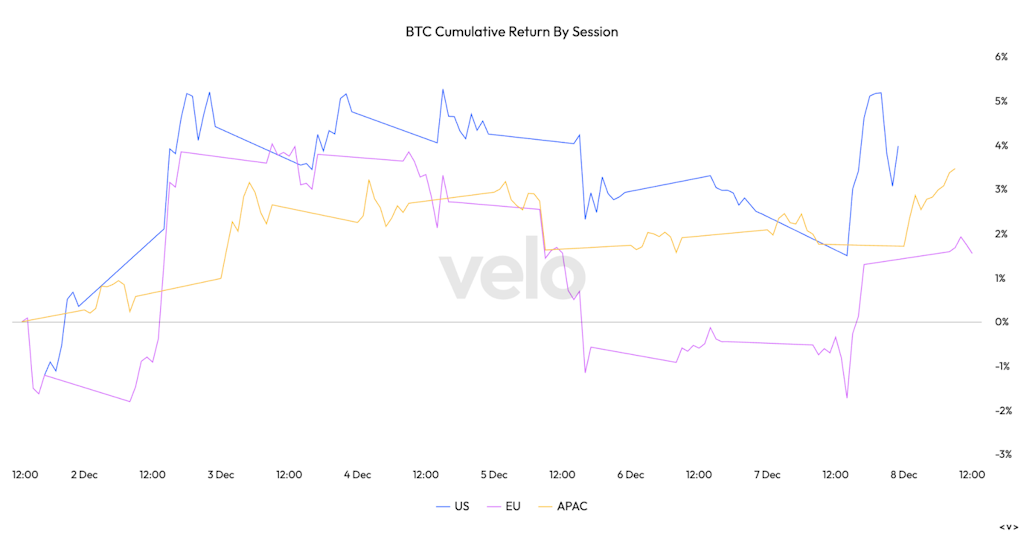
Market participants tracking these movements have noted a clear geographic divergence in sentiment. Throughout the recent sessions, Bitcoin has consistently underperformed during the European trading hours, only to recover and outperform significantly during the US and Asia-Pacific (APAC) market sessions. This regional bifurcation underscores the shifting pools of liquidity and the localized nature of macroeconomic reactions as global investors navigate a complex monetary landscape.

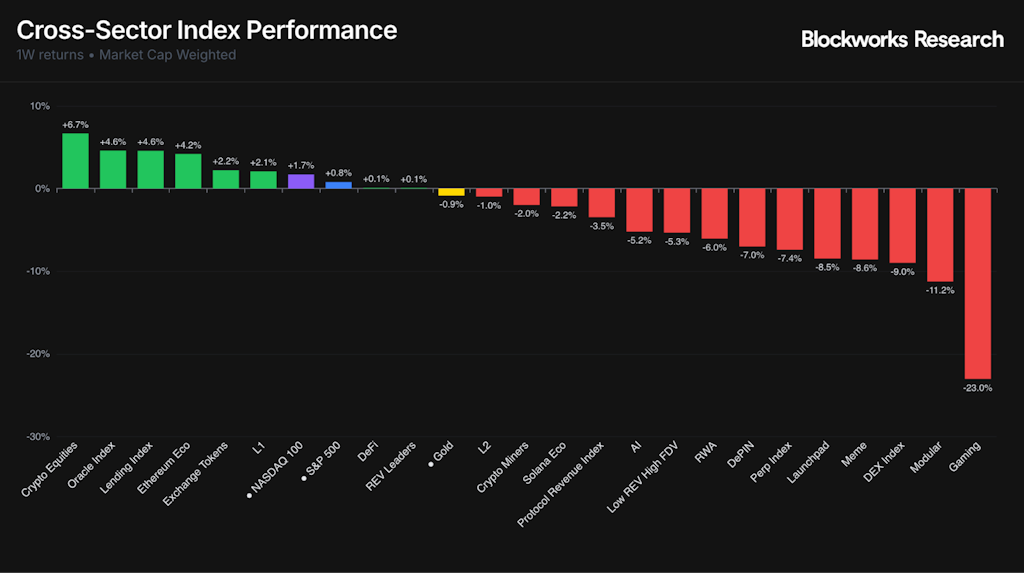
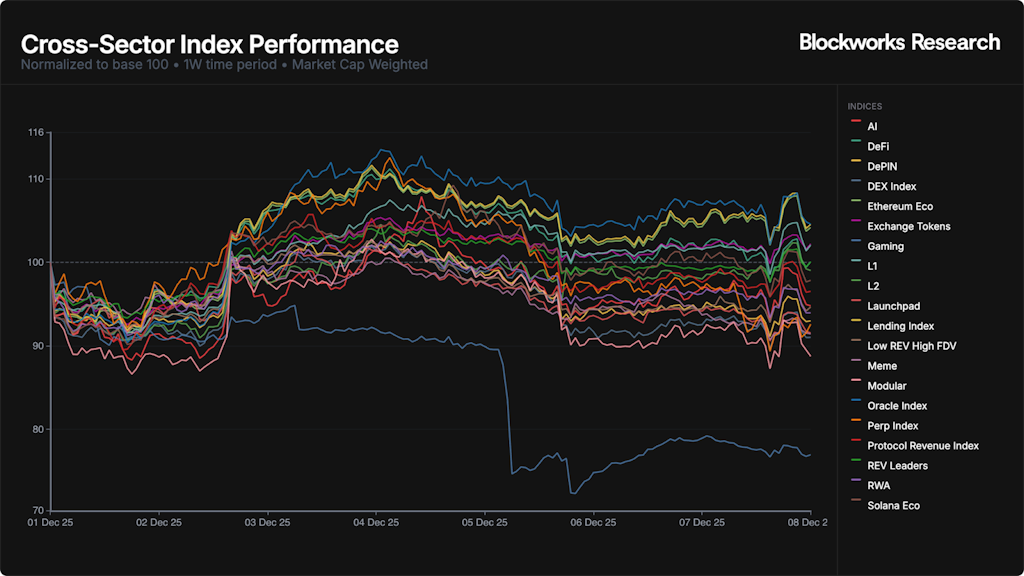
Beyond the headline token, the broader digital asset ecosystem has witnessed a fragmented performance across various sectors. Over the past week, decentralized oracles, lending protocols, and Ethereum ecosystem tokens demonstrated resilience, each recording gains of just over 4%. Meanwhile, crypto-related equities emerged as the top-performing category, surging 6.7% on average. This outperformance in the public markets was primarily driven by strong institutional and retail interest reflected in the performance of equities like Robinhood (HOOD).
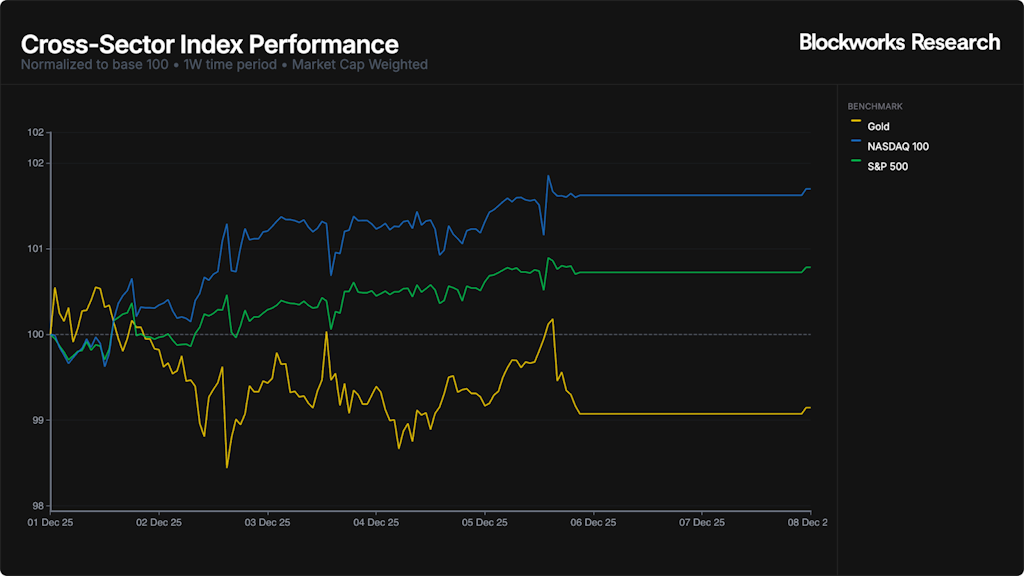
Conversely, the gaming sector faced severe headwinds, significantly underperforming the broader market with a staggering 27% decline over the trailing week. Within this segment, tokens like LGCT suffered acute corrections, plunging by 75% in a matter of days and highlighting the high-beta nature of niche crypto verticals during periods of broader portfolio rebalancing. In the wider financial markets, traditional indices such as the Nasdaq 100 and the S&P 500 continued their steady upward grind, gaining 1.70% and 0.78% respectively, while safe-haven assets like gold experienced mild underperformance, slipping 0.85%.
Macroeconomic Shifts and ETF Flow Reversals
Attention in both traditional finance and crypto circles has increasingly turned toward Washington as speculation mounts over the leadership of the US Federal Reserve. Prediction markets, including Kalshi, indicate that the probability has surged to 78% that Kevin Hassett will be nominated by President Donald Trump as the next Federal Reserve chair. With the administration confirming that an official announcement is imminent, market watchers have focused on Hassett’s policy leanings. As a close ally of the White House, Hassett is widely favored by the administration due to his alignment with demands for a more aggressive easing cycle and lower interest rates, a move intended to reduce borrowing costs for consumer loans and mortgages.
This macroeconomic backdrop coincides with a broader stabilization in digital asset investment products following a turbulent period for institutional inflows. The cryptocurrency exchange-traded fund landscape experienced a severe sentiment shock in November, reversing months of steady accumulation that had persisted from May through October. During November alone, Bitcoin exchange-traded funds recorded roughly $3.46 billion in net redemptions. This massive outflow completely erased the $3.42 billion in net new inflows captured during the previous month, marking the worst monthly outflow period for the product class since February 2025, when redemptions reached $3.56 billion.
The dramatic shift in ETF momentum underscored how rapidly institutional sentiment can sour despite months of consistent accumulation. Furthermore, the correlation between ETF flow dynamics and spot price action remained intact, with November’s heavy institutional outflows closely mirroring Bitcoin’s double-digit percentage decline over the same timeframe.
However, the tide began to turn at the onset of December. The first week of the month marked a notable milestone, delivering the first positive net inflow week for Bitcoin ETFs since the final week of October, with approximately $70.2 million in net new capital entering the products. Ethereum and Solana investment vehicles experienced even more robust demand over the same weekly interval, pulling in $312 million and $108 million in net inflows, respectively, signaling that institutional allocators are beginning to re-engage with a broader basket of digital assets.
Application Revenue and Protocol Dynamics
Fundamental metrics across decentralized applications and layer-1 networks reveal shifting patterns in value accumulation and user activity. Network revenue figures over the past week remained largely consistent with the preceding period, with specific chains dominating the fee generation landscape. Hyperliquid maintained its commanding lead, capturing roughly 35% of all network revenues. Tron followed closely behind with 20% of the market share, while Solana secured 15%. Notably, revenue generation on BNB Chain remained depressed relative to the highs achieved in October, with the vast majority of that lost market share appearing to flow directly to high-throughput competitors like Hyperliquid and Solana.
A similar trend played out in application-level revenue, which arrested a four-week streak of broad-based declines across tracked decentralized protocols. Total application revenue climbed to $38 million, representing a 10% increase compared to the previous week. Hyperliquid once again anchored the sector by capturing 35% of application revenue, followed by the Solana-based memecoin launchpad pump.fun at 25%, and Axiom at 8%. These figures indicate that while speculative fervor waxes and wanes, core trading engines and high-activity applications continue to generate substantial, recurring economic value.
Proposed Changes to Solana Tokenomics
In infrastructure developments, the Solana ecosystem is currently debating a significant governance and tokenomic proposal aimed at optimizing its long-term economic model. Helius researchers Lostin and Ichigo have formally introduced Solana Improvement Document 411 (SIMD411), which seeks to accelerate the network’s emission schedule by doubling the disinflation rate from -15% to -30%. Importantly, the proposal maintains the existing terminal inflation target of 1.5%.
By implementing this predictable parameter adjustment, the network’s current annual inflation rate of approximately 4.14% would reach the terminal 1.5% level in roughly 3.1 years—around early 2029—rather than following the original trajectory, which projected reaching that milestone in approximately 6.2 years by early 2032. Proponents argue that if adopted, SIMD411 would eliminate roughly 22.3 million SOL, valued at approximately $2.9 billion, in cumulative emissions over a six-year comparison window. By tapering new token issuance at a faster rate, the proposal aims to alleviate persistent structural sell pressure often described by market participants as a "leaky bucket," potentially strengthening the long-term supply and demand dynamics of the Solana asset.





Comments (0)