



Published October 8, 2026
Every investment starts with an idea. Maybe the cost of your morning mocha has increased, you’ve read Brazil is having a dry season, and you expect coffee prices to keep rising. What do you do next? The answer depends entirely on how much you understand about financial products, and which ones you have access to.
If you happen to be Warren Buffett, you already know every instrument type and asset class. You know precisely when to use leverage, how to construct a cost-optimized trade, and how to think about what should trigger it. You understand whether the execution should happen when the official crop estimate lands or when rainfall in Minas Gerais crosses a specific, critical threshold.
Yet, trying to set all of that up in a conventional online brokerage account remains a daunting hurdle. If you are not Warren Buffett, your real-world options are typically limited to paying someone substantial fees to manage the trade for you, or simply buying a few shares in a local coffee company and hoping for the best.
That fundamental barrier between having an intuition and executing a professional-grade strategy is precisely what Catalyst is built to solve. Now, everyday investors can use Catalyst to translate their observations into action. You simply describe your thesis in plain language. From there, Catalyst’s specialized agents gather and analyze market signals, identify the best execution paths across various platforms and venues, and help you backtest and deploy strategies complete with clear limits and safety controls. Instead of grappling with the complex plumbing of the modern financial market, users can begin directly with their core intent.

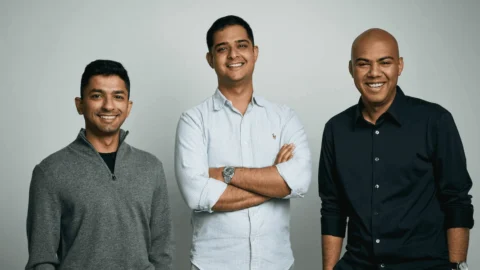
Co-founders Dylan Iskandar and Justin Zheng recognized a glaring disconnect in the evolution of financial technology. While retail investing has transitioned over the decades from the telephone to the web and finally to mobile applications, that expanded access has done remarkably little to help everyday users trade richer, more nuanced investment ideas with genuine confidence. In the broader tech landscape, artificial intelligence agents today are capable of writing full applications and proving novel mathematical theorems, while financial trading itself has become increasingly automated and algorithmic. Yet, for the vast majority of people, the actual process of finance remains largely manual, fragmented, and strictly do-it-yourself.
The persistence of this problem comes down to its sheer difficulty. Building Catalyst required Dylan and Justin to possess deep expertise in complex trading systems and heavy backend infrastructure. However, technological capability alone was not enough; they also needed the unique ability to bridge investors’ comprehension gaps. For Catalyst to truly succeed as a platform, it had to bring its users along for the journey, ensuring they clearly understood their options and the financial implications of every move. The system had to be smart enough to ask the right questions, provide accurate feedback, and build enduring trust at every step of the transaction.
Tackling such a monumental challenge demands an exceptionally rare mix of talent, and the team driving Catalyst is composed of true outliers. Dylan was a globally recognized classical pianist by the age of four, conducted cybersecurity research for the U.S. Department of Defense throughout his high school years, and arrived at Stanford University as a Jane Street scholar before ultimately leaving his studies to build Catalyst. Justin’s background is similarly extraordinary: he raised his first seed round of funding at just sixteen years old, earned a Pioneer grant for his pioneering work in biometrics and crypto synthesis, and made history as the youngest IDEO CoLab fellow—not once, but twice.
Surrounding these two founders is a powerhouse of high-achieving engineering and financial talent. The early team includes founding engineers from Palantir, the first engineering hire at Scale AI, and seasoned tech leads hailing from prominent institutions such as Citadel, Citadel Securities, Hudson River Trading, and Jump Trading. This collective group shares a deep, thoughtful dedication not only to building a superior product, but to bearing the profound responsibility of breaking entirely new ground in the realm of agent-driven finance.
Recognizing the transformative potential of this vision, early partners have stepped up to lead Catalyst’s seed round, marking what many believe is merely the opening chapter for the company. Early adopters and platform users are already describing the experience as "unparalleled" and "a perfect experience." As the broader financial world races to catch up with the pace of agentic automation, Dylan, Justin, and their team are pursuing an ambition that is nothing short of building the universal orchestration layer for turning financial ideas into reality.



Comments (0)