


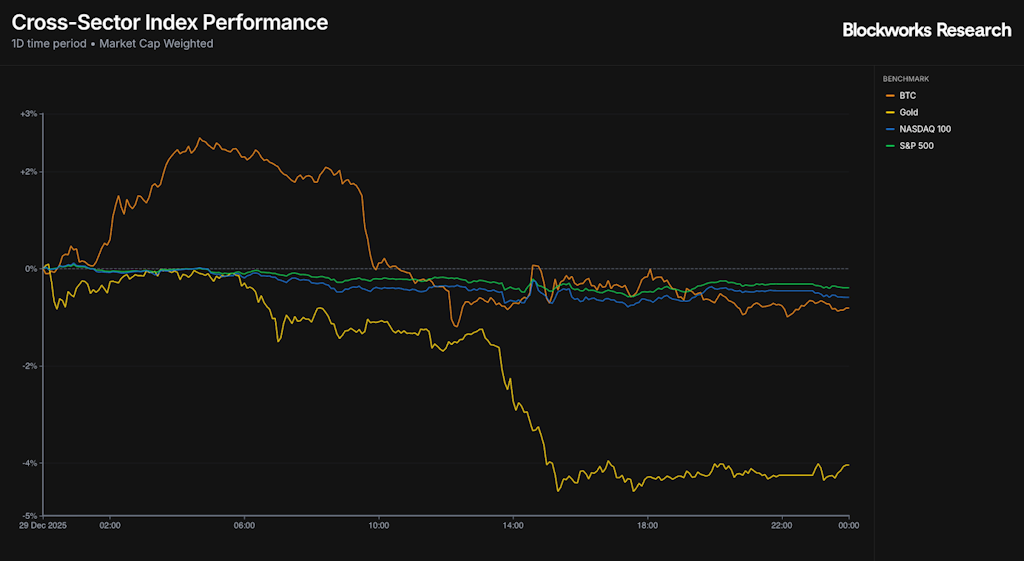
The cryptocurrency market kicked off the final week of the year with a softer tone, underperforming broader traditional financial indices as investors engaged in year-end profit-taking. Bitcoin dipped 0.81%, underperforming US equity benchmarks such as the Nasdaq, which fell 0.59%, and the S&P 500, which pulled back 0.39% following a strong run that drove tech stocks to all-time highs the previous week. Precious metals also saw a sharp correction, with gold dropping 4.04% after acting as a standout market performer over the prior few weeks.
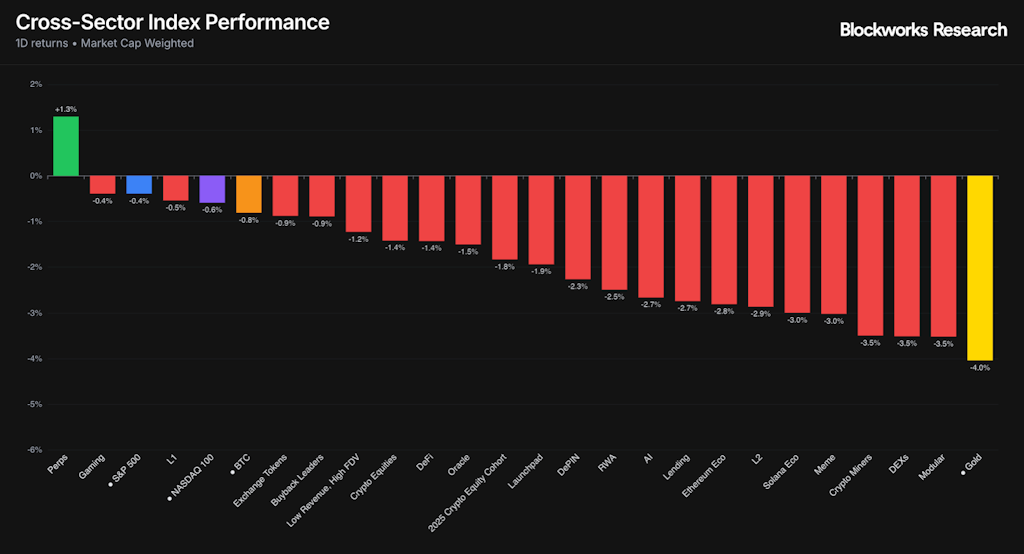
Despite the broader macro pullback, the crypto-native perpetual futures sector continued to capture market attention. The perps index managed to finish the day in positive territory, rising 1.3%, led by notable gains in HYPE ahead of a major ecosystem token generation event. The primary headline dominating crypto circles was the official launch of Lighter’s LIT token, marking a critical milestone in the fiercely contested battle for perpetual futures market share.

Over recent months, competition among decentralized perpetual exchanges has intensified dramatically. Lighter has successfully demonstrated that verifiable execution models combined with zero retail fees can capture massive market-leading volumes. Over the trailing 30-day period, Lighter led the perpetual exchange sector with just over $200 billion in trading volume. It was followed closely by Aster, which processed $172 billion, and Hyperliquid, which recorded $161 billion over the same timeframe.
Despite trailing in raw volume compared to Lighter and Aster, Hyperliquid remains the distinct revenue leader among the top tier of perpetual exchanges. Operating entirely without active user incentives, Hyperliquid generated approximately $47 million in protocol revenue over the past month.
The immediate test for Lighter will be whether it can maintain its commanding volume lead in the post-token generation event phase, particularly given that a significant portion of its recent activity has been attributed to points-farming campaigns. In a comprehensive announcement thread released on the eve of the launch, the Lighter team outlined the fundamental token structure and airdrop mechanics. The team emphasized that the value generated by all Lighter products and services will fully accrue to LIT tokenholders, while the underlying labs entity will continue to operate strictly at cost.
The initial token distribution is divided evenly, with 50% allocated to the broader ecosystem and the remaining 50% split between the core team and early investors. Notably, 25% of the total token supply was designated for an immediate airdrop distributed to eligible points holders from Seasons 1 and 2.
At the time of writing, LIT began trading with a circulating market capitalization of $695 million and a fully diluted valuation of $2.8 billion. According to data tracked by DeFiLlama, the protocol has generated $8.76 million in revenue over the past 30 days, translating to an annualized revenue run rate of approximately $105 million. These figures imply that LIT trades at a price-to-sales multiple of roughly 7x and a fully diluted valuation-to-sales multiple of around 27x.
While the broader market remains fixated on the ongoing rivalry between Hyperliquid and Lighter following the LIT token generation event, a broader structural beneficiary is quietly gaining traction elsewhere in the decentralized finance ecosystem: Pendle, through its newly introduced Boros product. From a macro perspective, Pendle is strategically positioned to capture value from the structural expansion and mainstream adoption of perpetual futures, regardless of which specific centralized or decentralized platform ultimately dominates the trading rails.
Pendle officially launched Boros in early August 2025, introducing an entirely novel onchain financial primitive to the decentralized finance landscape: interest rate swaps. Boros can conceptually be understood as a perpetual futures exchange, but with two fundamental structural differences. First, rather than speculating on the directional price movements of underlying crypto assets, participants bet on the fluctuations of interest rates and funding yields. Second, while traditional perpetual contracts feature no expiration date, Boros markets operate around specific maturity dates.
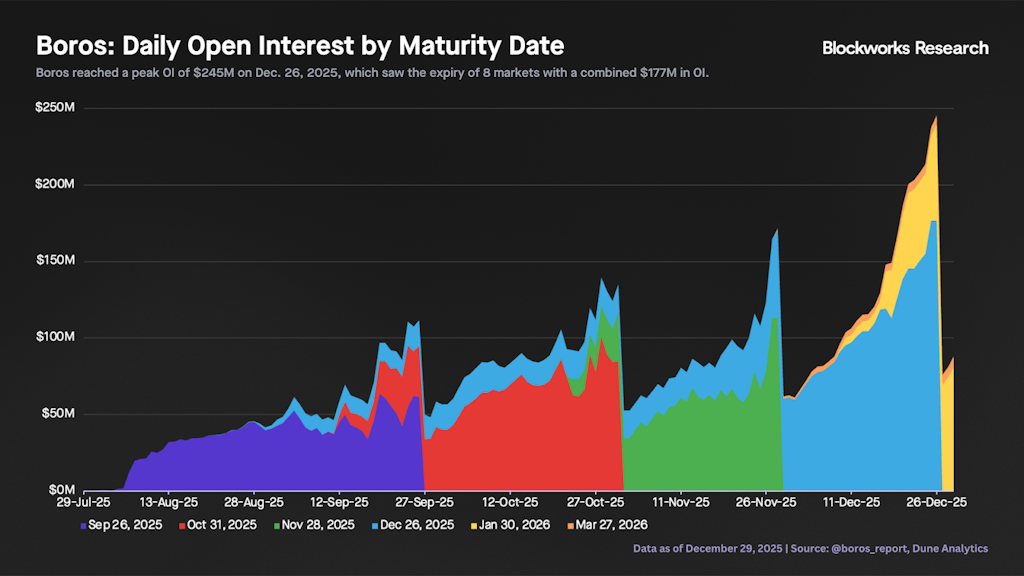
Although Boros has experienced a gradual, phased rollout, early market adoption has been remarkably robust. Daily open interest by maturity reached a peak of $245 million on December 26, 2025, a date coinciding with the expiration of eight distinct markets holding a combined open interest of $177 million. The growth trajectory of open interest on Boros exhibits a highly cyclical pattern, bearing a strong resemblance to the cyclicality observed in Pendle v2 markets, which naturally fluctuate around the maturity and redemption dates inherent to fixed-yield architecture.
In terms of underlying mechanics, Boros facilitates the trading of funding rates by establishing a financial instrument known as a Yield Unit. For market participants already familiar with Pendle v2 markets, the Yield Unit functions similarly to the traditional Yield Token, representing the cumulative future yield generated by an underlying asset up until its designated maturity date. Traders have the flexibility to take either long or short positions on these Yield Units depending on their market outlook.
Rates on Boros are settled periodically, aligning precisely with the settlement schedules of the underlying exchange’s funding rate mechanisms. For instance, funding rates on Binance settle every eight hours, meaning that Boros markets tied to Binance pools adhere to the exact same eight-hour settlement cycle. Similarly, Hyperliquid funding rates settle on an hourly basis, and Boros pools tracking Hyperliquid mirror this hourly cadence. At the point of maturity, or when a position is prematurely closed, profitability is determined by comparing the average underlying annual percentage rate against the average implied annual percentage rate recorded at the time of position entry. If the underlying rate exceeds the implied rate, long positions secure a profit, and vice versa.
Beyond open interest, which currently hovers around $88 million, another critical performance indicator for Boros is cumulative notional trading volume. Since its inception, Boros has processed approximately $6.8 billion in cumulative trading volume, maintaining a steady median monthly volume of roughly $1.5 billion over the preceding four-month period.
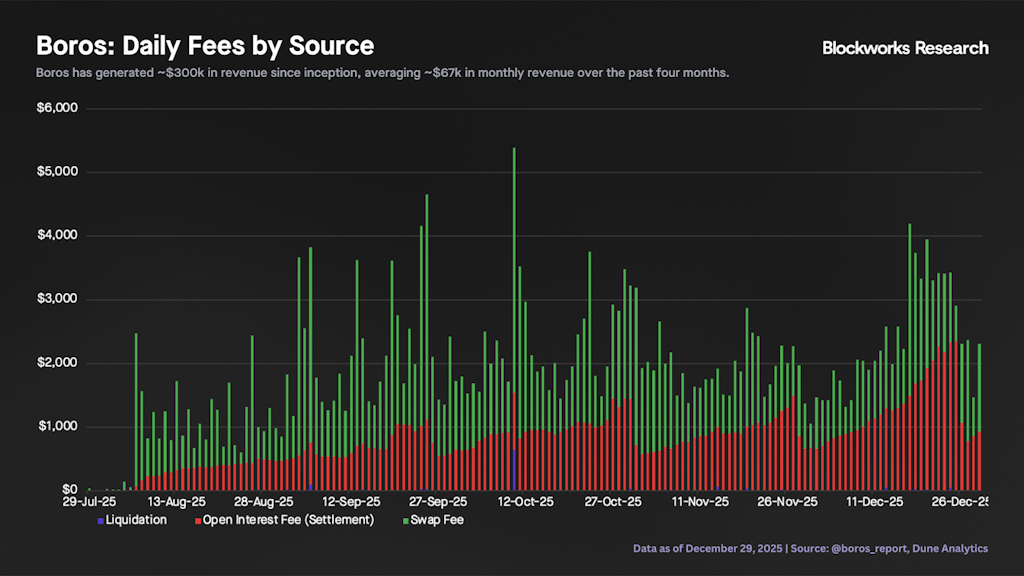
Boros derives its revenue primarily from two distinct sources. The first is a flat fee layered on top of the implied annual percentage rate for every swap transaction, which varies depending on the specific market conditions. The second is a flat fee set at 0.2% applied to the fixed annual percentage rate side of every Yield Unit during the periodic settlement process. Historical data indicates that Boros has generated roughly $300,000 in cumulative revenue since its launch, averaging approximately $67,000 in monthly revenue over the last four months. Meanwhile, liquidation fees have remained negligible, amounting to just $1,300 since inception.
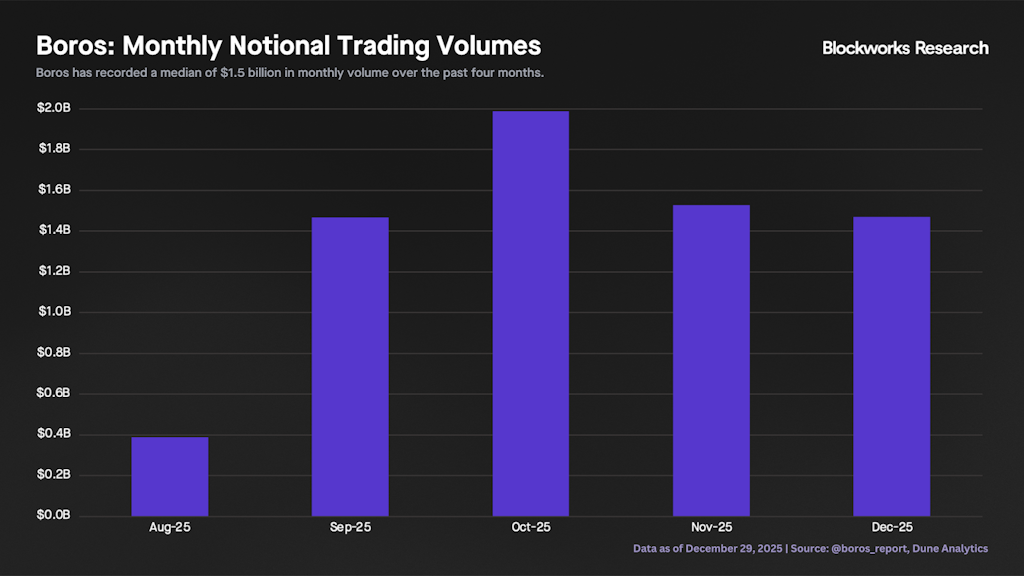
Swap fees naturally correlate directly with overall notional trading volume. In a market featuring a swap fee tier of 0.05%, traders will secure a net profit if the implied annual percentage rate moves in their favor by more than 0.1%, assuming no intermediate yield settlement occurs. Because traders must both open and close positions, they incur the swap fee twice. Conversely, open interest fees follow the cyclical expansion and contraction patterns of the platform’s aggregate open interest.
The foundational bull case for Boros is its potential to establish itself as the definitive interest rate derivatives venue across decentralized finance, eventually expanding far beyond funding rates to capture stablecoin yields, money market rates, and liquid staking token yields. However, its most immediate and substantial growth opportunity over the next six to twelve months lies squarely within the perpetual futures vertical. When Boros initially launched in August, its offerings were restricted to Bitcoin and Ethereum perpetual markets tied to Binance. Since then, the protocol has successfully expanded its footprint to additional venues, including Hyperliquid and OKX, alongside new underlying assets such as HYPE.
Open interest distribution reflects this multi-venue expansion. While Binance dominated early liquidity, open interest had become nearly evenly distributed across multiple venues by the end of December, with Binance holding 37%, Hyperliquid accounting for 35%, and OKX representing 29%. Regarding asset dominance, the Ethereum-USD market remains the largest pool on Boros by open interest, followed closely by the Bitcoin-USD and HYPE-USD markets.
A core competitive advantage of the Boros architecture is its ability to capture value from the maturation of the perpetual futures market without being tied to the success or failure of any single trading venue. Because it can seamlessly support multiple exchanges and diverse assets, Boros is well-positioned to serve advanced market participants. As more sophisticated traders enter the perpetual futures space, they increasingly demand specialized strategies that Boros uniquely facilitates, including hedging funding payments on long positions, hedging funding receivables on short positions, and executing complex cash-and-carry trades. Looking further ahead, as perpetual futures achieve broader regulatory clarity and traditional financial institutions begin trading real-world asset perpetuals tied to equities and commodities, these institutional players are expected to demand the ability to trade Yield Units for traditional financial instruments directly on-chain.
At present, Boros accounts for less than 5% of total Pendle v2 revenue. Nevertheless, the protocol is strategically positioned to serve as the most significant growth vector for Pendle moving forward, with the potential to eventually rival or even surpass the core v2 revenue streams over time.


Comments (0)