



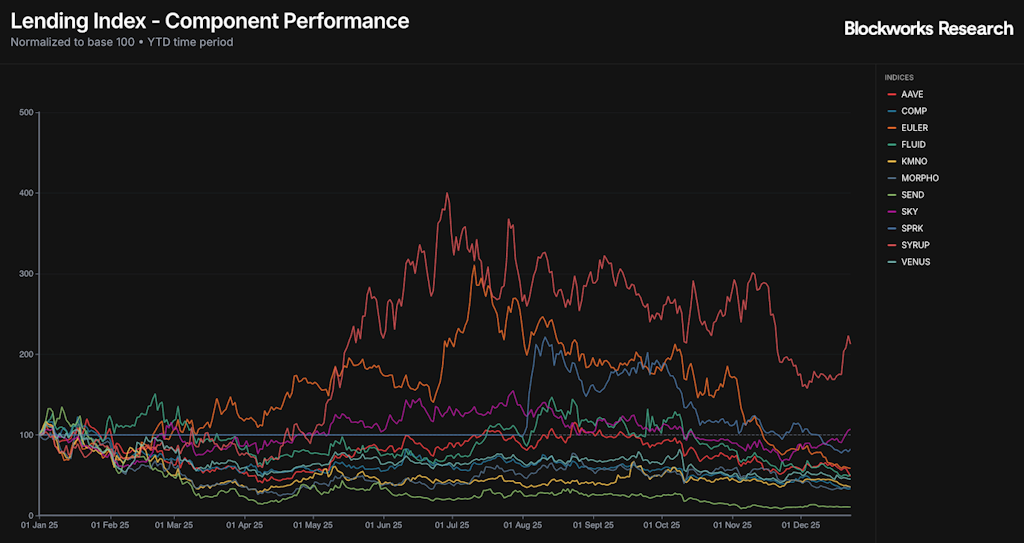
In the fast-paced and often volatile world of decentralized finance, few protocols have managed to stage a recovery as decisive and comprehensive as Maple. Over the past week, Maple’s native token, SYRUP, surged by an impressive 26%, comfortably outperforming virtually all other money markets tracked in industry lending indexes. When viewed through a broader lens, Maple stands alongside Sky as one of the very few assets in the index boasting a positive year-to-date performance, though Maple does so by a staggering margin. While Sky has registered a modest 7% gain over the period, Maple has skyrocketed by a remarkable 112%. This widening performance gap begs a critical question for market participants: What fundamental drivers are fueling Maple’s current strength, and how has the protocol managed to maintain such resilient momentum amid challenging macroeconomic and sector-specific conditions?
To understand Maple’s current dominance, one must look back at its evolution as one of the longest-standing lending protocols in the decentralized finance ecosystem. Like many digital asset platforms, Maple faced severe headwinds during the tumultuous credit crisis of 2022. However, rather than succumbing to the structural failures that plagued many of its contemporaries, the protocol executed a strategic pivot. Moving away from the riskier undercollateralized lending models that characterized its early days, Maple embraced a fully secured, overcollateralized operational framework tailored specifically for institutional participants.
Under this modern institutional approach, Maple operates distinct liquidity pools designed to accommodate various regulatory and risk profiles. Its permissionless Syrup pools accept deposits of stablecoins such as USDC and USDT, issuing corresponding yield-bearing tokens known as syrupUSDC and syrupUSDT in return. Meanwhile, the platform also maintains a permissioned pool that accepts exclusively USDC. Capital gathered from these diverse pools is then deployed over-the-counter to institutional borrowers, carefully secured by high-grade collateral, predominantly consisting of Bitcoin and other highly liquid cryptoassets.

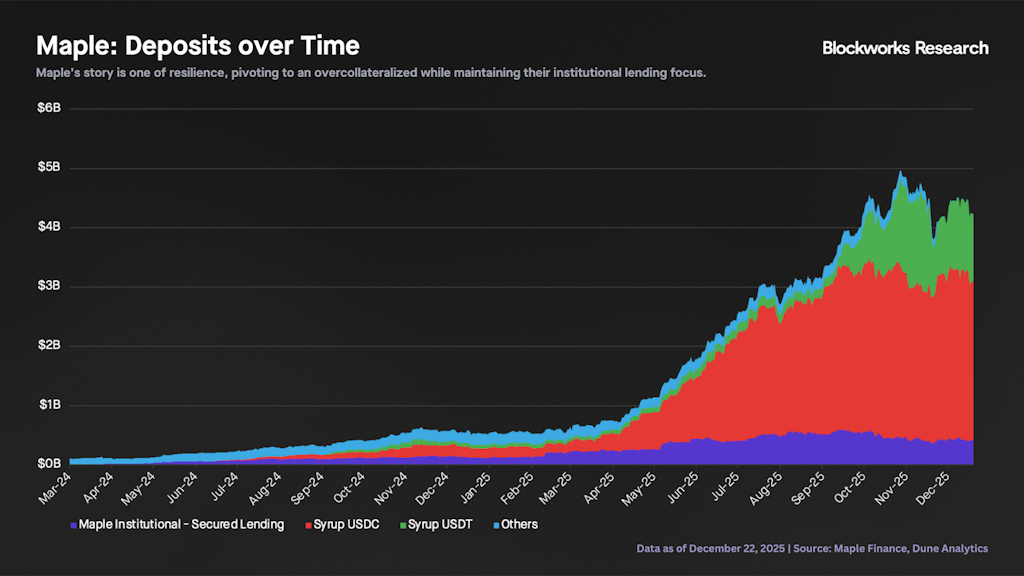
This strategic pivot has yielded monumental results, with Maple recently surpassing the significant milestone of $4 billion in total deposits. A breakdown of this liquidity reveals that the vast majority of capital resides in the permissionless retail and institutional channels, with approximately 63% of total deposits originating from the syrupUSDC pool. Another 27% of the capital pool is anchored by the syrupUSDT offering, while the remaining 10% is held within Maple Institutional, the platform’s permissioned secured lending pool.
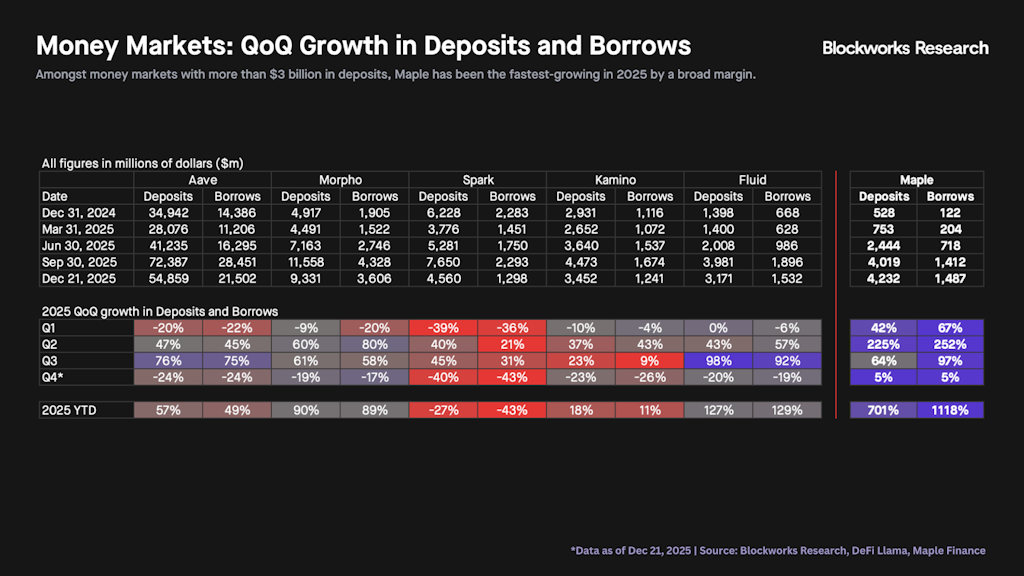
When stacking Maple up against competing money markets across the decentralized finance landscape, its growth trajectory becomes even more pronounced. Among protocols managing more than $3 billion in deposits, Maple has earned the distinction of being the fastest-growing platform in nearly every quarter of the year. The sole exception occurred during the third quarter, when Maple secured a very respectable second-place ranking behind Fluid. The protocol’s zenith arrived in the second quarter, a period marked by an explosive 225% surge in deposits and a concurrent rise of more than 250% in active borrowing volume.
Looking at the broader year-to-date figures, Maple’s expansion defies standard market cycles, with deposits climbing an extraordinary 701% and outstanding loans expanding by a massive 1,118%. Crucially, the rate of loan origination has consistently outpaced the growth in incoming deposits, a dynamic that underscores exceptionally high asset utilization and robust, organic demand for the protocol’s liquidity.
The primary engine behind this relentless expansion has undoubtedly been syrupUSDC, which commands the lion’s share of the protocol’s total deposits at roughly $2.66 billion as of late December. A major selling point for syrupUSDC has been its ability to generate sustained, attractive yields tied directly to the steady, unyielding demand from Maple’s institutional client base. Throughout the year, syrupUSDC has consistently outperformed benchmark yields across comparable cohorts, delivering an average annual percentage yield of approximately 8%.
Nevertheless, the competitive landscape of decentralized finance remains fiercely contested. In recent months, syrupUSDC has experienced some downward pressure on its yields, with rival platforms like Morpho maintaining competitive stablecoin yields since August and even outperforming Maple sharply during November. To measure these trends accurately, market researchers typically employ a standardized methodology that analyzes market-weighted USDC supply rates across competing protocols. By focusing strictly on the base interest paid by borrowers—while deliberately excluding external token incentives—analysts compute trailing 30-day annualized rates to draw direct performance comparisons against the syrupUSDC benchmark.
Beyond its core lending mechanics, a major catalyst driving the recent adoption and growth of both syrupUSDC and syrupUSDT has been deep integrations throughout the broader decentralized finance ecosystem. Maple’s yield-bearing stablecoins have successfully integrated into Pendle’s principal token markets, allowing sophisticated traders to speculate on future yields. Furthermore, these assets have been onboarded as accepted collateral across a wide array of prominent money markets, including Aave, Fluid, Jup Lend, Spark, and Kamino.
These integrations empower users to execute sophisticated looping strategies utilizing non-yield-bearing stablecoins, creating a powerful network effect. This high degree of distribution is expected to accelerate Maple’s growth further, particularly during market phases when syrupUSDC manages to outpace competing benchmark yields, such as Ethena’s sUSDe.
Synthesizing all of these metrics reveals that Maple has decisively outpaced rival money markets across every major category year-to-date, including deposit growth, borrow growth, and USDC supply yields. The natural question for investors is how this stellar operational performance translates into tangible protocol revenue and corporate valuation. When evaluating quarterly revenue generation and price-to-sales multiples against its closest peers, Maple occupies a uniquely advantageous position.
Based on revenue figures calculated for the final quarter of the year, Maple and its native token SYRUP are trading at highly attractive valuations when evaluated on both a growth trajectory and a fully diluted valuation to sales basis. This financial health is underscored by a dramatic scaling of top-line metrics: Maple’s annualized revenue run rate has surged by 533% year-over-year, climbing from a modest $1.0 million in the final quarter of the previous year to a forecasted $6.6 million.
Tokenomics and distribution mechanics have also played a vital role in fostering market confidence. All initial allocations designated for team members, strategic advisors, seed investors, and public sale participants reached full vesting status by the end of 2023. This complete release schedule effectively eliminates the looming threat of supply overhangs that often plague early-stage crypto assets.
Additionally, Maple demonstrates a strong commitment to operational clarity. The SYRUP token recently achieved a score of 37 on the Token Transparency Framework, a standard that evaluates projects on the thoroughness of their disclosures. This score highlights the fact that Maple has fully and transparently revealed its core revenue streams, the legal and operational rights associated with holding the token, the identities of its advisory service providers, and the personnel comprising its executive leadership team.
Taken as a whole, the combination of robust fundamental growth, high asset utilization, strategic ecosystem integrations, and a clean token structure with minimal supply overhang explains why market participants are heavily favoring the protocol. Backed by clear disclosures and demonstrated value accrual mechanisms, SYRUP’s position as the top-performing lending token year-to-date reflects a broader market appreciation for sustainable, institutionally anchored decentralized finance models.





Comments (0)