


Microsoft has officially launched a new suite of specialized artificial intelligence models during its Ignite conference, setting the stage for a direct commercial and technical confrontation with industry rivals Anthropic and OpenAI. Rather than pursuing the industry-standard approach of building a single, all-encompassing frontier chatbot designed to dominate every category of request, Microsoft is shifting its strategic focus toward leaner, highly specialized models engineered to
excel at specific enterprise tasks at a fraction of the cost.
The cornerstone of this new lineup is MAI Code 2, a coding model that Microsoft asserts delivers 96% of the performance offered by Claude Opus 5.5 on standard enterprise software development tasks, while operating at a staggering 5% of the cost. Furthermore, the company claims that MAI Code 2 achieves 98% of the capability demonstrated by GPT-6.1 Sol while consuming only 40% of the price. Because OpenAI concurrently released GPT-6.2, comparisons against the Sol iteration reflect an older generation of technology, yet the economic implications for enterprise deployment remain profound.
These performance and cost metrics represent averaged results drawn from four distinct evaluations centered on practical software engineering workflows, including code remediation and multi-file code modifications. Microsoft conducted three of these benchmarks on its proprietary evaluation infrastructure, relied on external validation results for the final assessment, and factored a 50% promotional discount into its calculation of MAI Code 2’s operational costs.
Complementing the primary coding engine is a lighter variant designated Code 2 Flash. Tailored specifically for routine code adjustments and rapid edits, Code 2 Flash matches the performance profile of Claude Haiku 5.5 while cutting expenses down to 20% of its rival’s price point. Both coding models have already been integrated directly into GitHub Copilot, marking a significant milestone where Microsoft embeds its proprietary in-house technology into a widely adopted developer product that has historically depended on external AI suppliers.
Security has emerged as the second major battleground for Microsoft’s specialized architecture. The company unveiled MAI Cyber 2 Flash, reporting that the model successfully navigated 92.3% of the vulnerability-discovery tasks presented in the CyberGym-E2E benchmark. This performance slightly edges out GPT-6 Astra, which scored 91.5%, while costing less than 2% per task. The CyberGym-E2E evaluation framework scores models based on the proportion of software-security investigations completed successfully, though Microsoft noted that it excluded 92 out of 905 tasks after identifying overlapping material between the benchmark’s source data and its own training corpora.
While Microsoft has not yet published a direct performance comparison against OpenAI’s restricted GPT-6 Cyber model, the new security system is slated to begin replacing an older MAI infrastructure for eligible MDASH customers starting in mid-December. This rollout expands upon the automated vulnerability-scanning workflows that have increasingly become a focal point of enterprise defense strategies.

In AI, David Can Also Beat Goliath
The strategic pivot toward task-specific models highlights a broader architectural debate within the artificial intelligence sector: whether smaller, focused systems can effectively outperform massive general-purpose models. Industry analysts note that while a general-purpose model must divide its capacity across an immense breadth of knowledge—ranging from composing poetry and explaining quantum physics to debugging software and answering historical queries—a model tuned expressly for coding or cybersecurity can dedicate the entirety of its computational budget and training parameters to the structural patterns that matter for those specific professions.
This specialization does not inherently render smaller models universally superior, but it grants them distinct advantages in speed and operational economy when deployed against well-defined tasks, particularly within business environments where identical computational workflows are executed thousands of times daily. For instance, an automated security scanner evaluating routine code modifications does not require an expensive frontier model to interpret literary history. By channeling full computational power into the generation of Python code or vulnerability detection, enterprises can optimize their API expenditures without sacrificing output quality.
This functional specialization also enhances the auxiliary systems surrounding the AI model, including the tools it invokes, the verification protocols that check its logic, and the localized datasets used for fine-tuning. OpenAI has pursued a related strategy through its Mini and Nano models, delegating routine tasks to cheaper auxiliary systems while reserving larger frontier networks for complex exceptions.
Nevertheless, these efficiencies involve clear trade-offs. Microsoft’s technical documentation indicates that Code 2 is not yet fully optimized for foundational scientific research or long-running, autonomous research assignments. Moreover, because Anthropic actively competes in the cost-sensitive sector of the market with models like Haiku rather than relying solely on premium offerings like Opus, Microsoft is stepping directly into a fiercely contested pricing war that its competitors already understand well.
MAI Image Is the More Convincing Demonstration
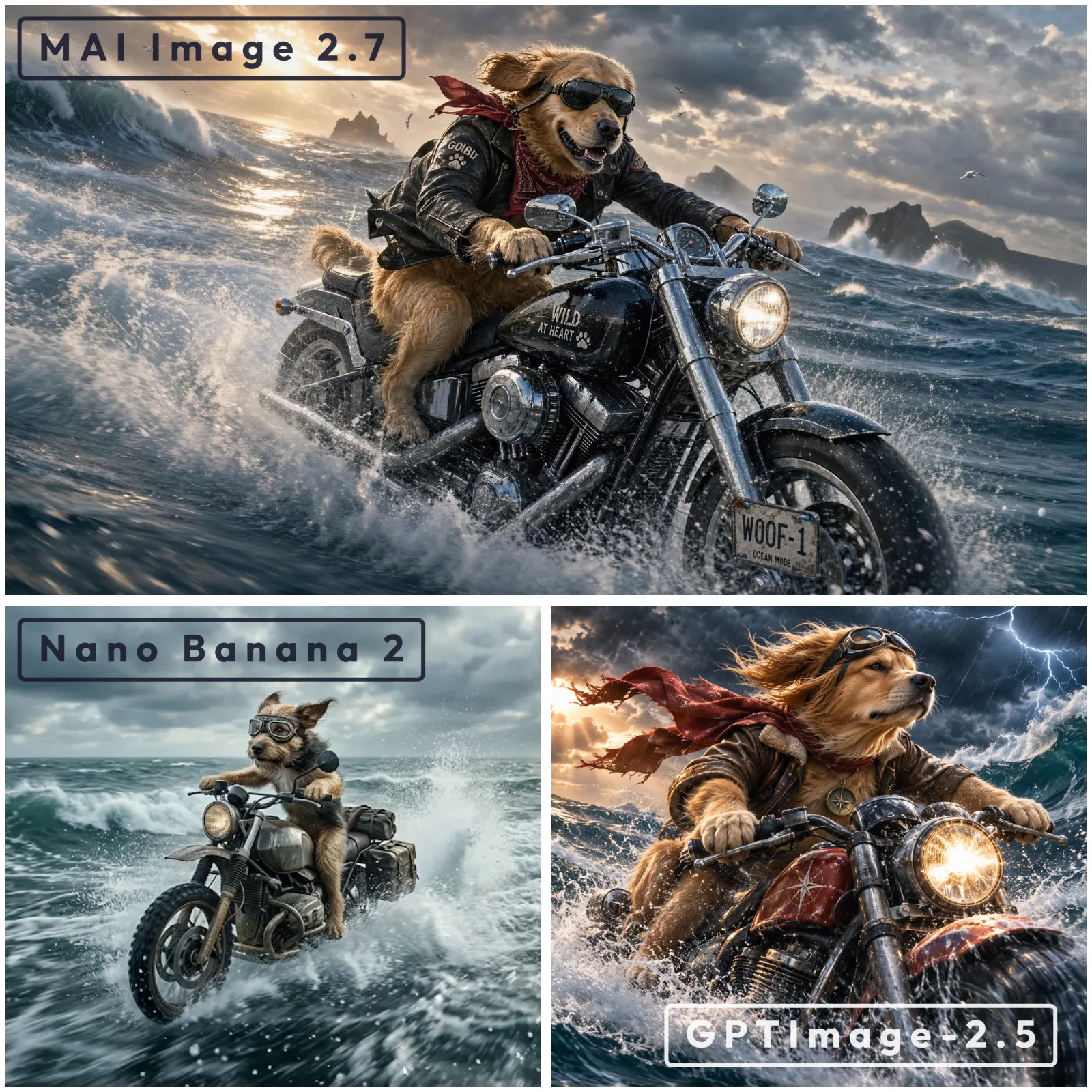
Microsoft’s deployment of MAI Image 2.7 provides some of the most compelling evidence that its specialized model strategy is gaining traction. In initial side-by-side evaluations, the model’s generated imagery outperformed both GPT Image and Google’s Nano Banana in terms of visual realism, creative composition, and overall fidelity.
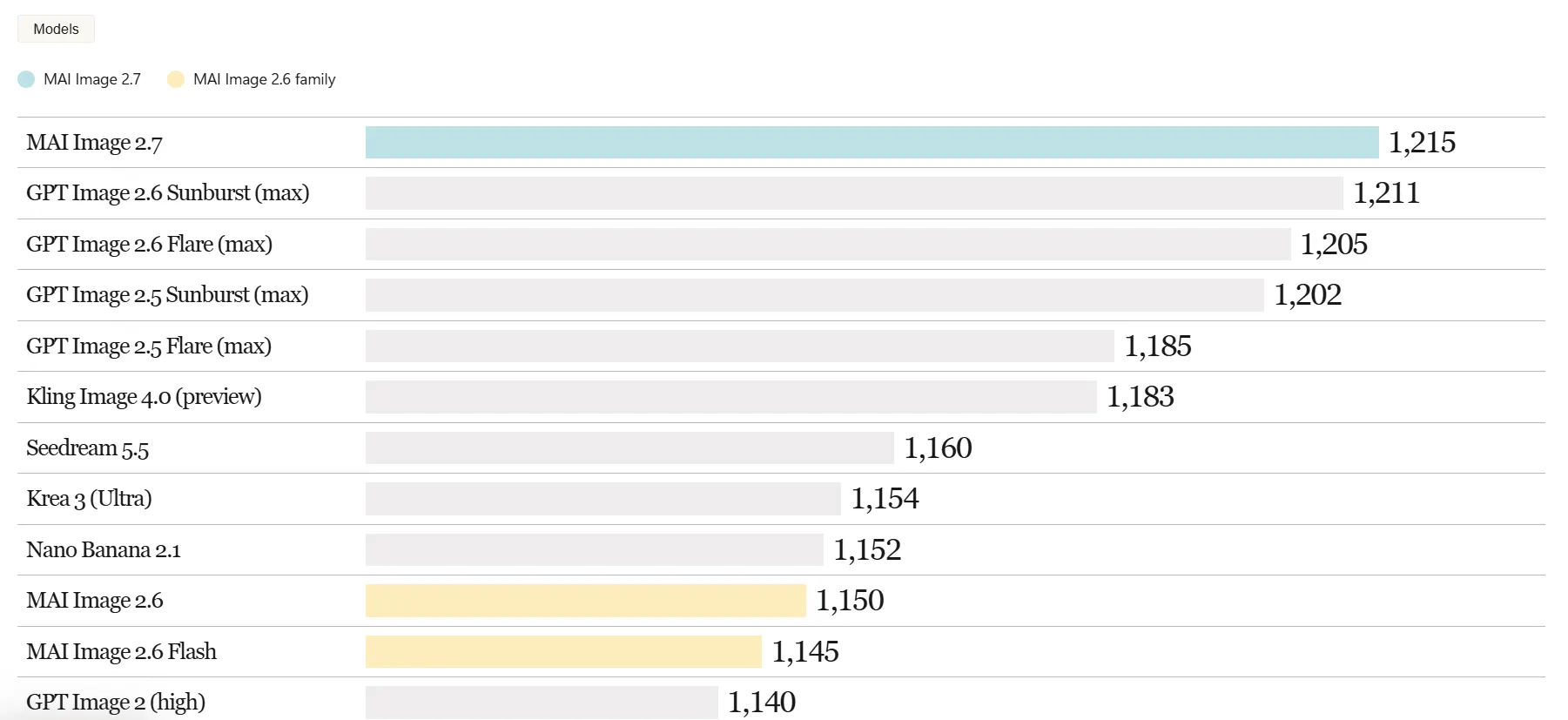
These early qualitative impressions align closely with results seen on independent benchmarking platforms. On Artificial Analysis’s image-editing leaderboard—which compiles user preferences between anonymously generated image edits into a standard Elo rating system—MAI Image 2.7 currently occupies a leading position with 1,215 points, narrowly ahead of GPT Image 2.6 Sunburst at 1,211 points. Because the four-point margin falls within statistical uncertainty ranges, and text-to-image generation rankings place Microsoft fourth, the competitive landscape for visual media remains dynamic.
The economic differentiator, however, lies in pricing. Microsoft lists MAI Image 2.7 at approximately $35 per 1,000 generated images, with its Flash variant priced at $10 per 1,000 images. By comparison, GPT Image 2.6 Sunburst commands roughly $211 per 1,000 images at maximum quality settings on Artificial Analysis, while Google’s Nano Banana 2.1 hovers around $34 per 1,000 images and its Pro tier reaches approximately $134, though actual operational costs vary depending on the chosen provider, resolution, and configuration parameters.
Earlier iterations of Microsoft’s image technology demonstrated high realism but faced functional constraints regarding editing flexibility and output format compatibility. The newer release addresses some of these limitations by introducing interactive editing capabilities through Microsoft’s Canvas workspace, transparent background support, and expanded accessibility via Foundry. However, bridging the gap between raw image capability and a seamless production product remains an ongoing challenge, alongside strict content moderation filters built into the model.
To further solidify its enterprise appeal, Microsoft is offering select business customers the capability to customize and execute these licensed model weights directly within Azure environments. This approach minimizes external vendor reliance while keeping the proprietary technology closed source. Following the immediate availability of Code 2 within GitHub Copilot, the phased rollout of Cyber 2 Flash is scheduled to commence in mid-December, marking the next major milestone for Microsoft’s specialized AI strategy.




Comments (0)