


This is a segment from The Breakdown newsletter. To read full editions, subscribe.
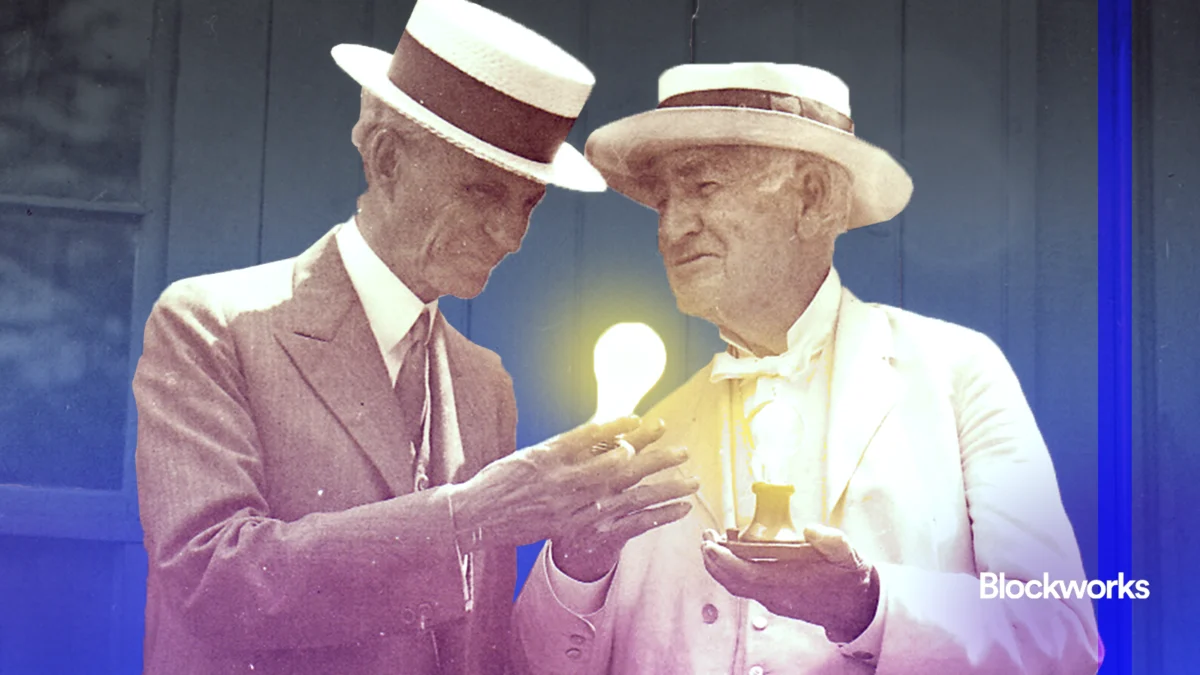
"There was no lightbulb moment in the story of the lightbulb." — Steven Johnson, How We Got to Now
In popular culture, the lightbulb has become the ultimate symbol of serendipitous inspiration—that cinematic moment when a fully formed, brilliant idea suddenly pops into an inventor’s head, prompting an immediate, triumphant shout of "Eureka!"
Yet, historical reality paints a vastly different picture. The lightbulb was not born from a solitary flash of genius. Instead, it was the product of a century of relentless trial, error, and collaboration by dozens of inventors scattered across the globe.
Electric light was first demonstrated decades before Thomas Edison claimed household recognition, with Humphry Davy showcasing the principle as early as 1802. Later, the foundational enclosed bulb mechanism was developed by Warren de la Rue in 1840—seven years before Thomas Edison was even born. Many more contributors worked on the technology both before and after 1847. In his definitive research on the subject, historian Arthur Bright lists approximately two dozen individuals as co-inventors of the lightbulb. Viewed through this historical lens, Edison’s famous work represented the culmination of a long, collective journey, not its origin.
As author Steven Johnson observes in his acclaimed book How We Got to Now, the Edison lightbulb was not a single, isolated invention, but rather a "bricolage of small improvements." Edison’s primary and most crucial contribution to that collaborative mosaic was the invention of the carbonized bamboo filament in the late 1870s. This specific breakthrough was what ultimately made incandescent lightbulbs longer-lasting, safe for indoor residential use, and commercially viable on a mass scale.
Even after achieving this breakthrough, Edison was forced by patent courts to share official credit with Sir Joseph Wilson Swan. Swan’s parallel version of the lightbulb was historically notable for being the first to successfully illuminate both a private home—his own—and a major public venue, the Savoy Theatre. This shared heritage led directly to the portmanteau naming of the "Ediswan incandescent lamp," which was offered to consumers starting around 1880.
This joint custody of the incandescent lamp does nothing to diminish Edison’s monumental achievements as an inventor and entrepreneur. In fact, it highlights an accomplishment even greater than bringing artificial lighting to the masses: Edison industrialized the act of inventing itself.
As Johnson explains, Edison did not just invent a new piece of technology; he invented an entirely new system for inventing—a structural framework that would come to dominate 20th-century industry and corporate research.
That pioneering system inspired the explosive proliferation of corporate research and development laboratories. It fostered environments where teams of diverse specialists could collaborate on complex problems, share in the financial upside, absorb outside ideas, and freely build upon one another’s work. This early form of "networked innovation" proved to be infinitely more powerful than the romanticized, yet misleading, image of the solitary genius working in isolation.
According to Johnson, this collaborative reality holds the true lesson we must learn from the history of the lightbulb. If society persists in believing that innovation comes from a lone genius inventing a new technology entirely from scratch, that mental model naturally steers policymakers toward certain types of decisions, such as aggressively stronger patent protections and rigid intellectual property walls. However, if we recognize that true innovation actually emerges from collaborative networks, our priorities shift entirely. We begin to support different policies and organizational structures: less-rigid patent laws, open standards, employee participation in stock ownership plans, and robust cross-disciplinary connections.
And this realization inevitably leads to a modern parallel: cryptocurrency.
At its core, crypto is fundamentally a mechanism designed to incentivize the kind of open, composable innovation that builds immensely powerful networks. While Edison proved definitively that collaboration beats isolation, his corporate model still ultimately relied on traditional patents and proprietary control to secure commercial advantage.
By contrast, the most transformative and enduring networks in human history—such as Roman roads, standardized shipping containers, the internet, and GPS—operated on an entirely different philosophy. They were built as open, permissionless infrastructure that anyone could access, modify, and build upon without asking for centralized permission.
Highlighting this historical lineage, Christian Catalini makes a compelling case for the role of crypto by recounting the evolution of open-source networks. "Money," Catalini notes, "is the last closed network."
Crypto, in this view, is the technological key to opening up financial infrastructure to everyone’s mutual benefit. Permissionless innovation will invariably create exponentially more value than any closed, proprietary system ever could.
At the close of what has been a challenging and disappointing year for open-source crypto adoption, it is worth pausing to remember just how profoundly powerful these networks can ultimately become.
Just as there was no singular lightbulb moment in the true history of the lightbulb, there may not be one single cinematic moment when crypto "arrives" into mainstream dominance, either. Both phenomena are classic products of networked innovation that only realize their true, world-changing potential when they evolve into widespread infrastructure networks themselves. After all, the early lightbulb was merely a fragile glass ornament until it was plugged into a vast, functioning electrical grid.
Today, crypto is actively building that exact kind of grid for the modern digital economy—open, permissionless infrastructure patiently waiting for the next great idea to plug in and light up the world.
Let us hope that illumination happens in 2026.





Comments (0)