



Cryptocurrency markets tilted sharply toward a risk-off posture, with bitcoin sliding below the $86,000 threshold as digital assets underperformed broader traditional equities and gold ahead of a pivotal week for economic data. Despite the overarching market downturn, isolated pockets of relative outperformance emerged, led notably by Aave and broader strength within decentralized lending and Ethereum ecosystem indices.

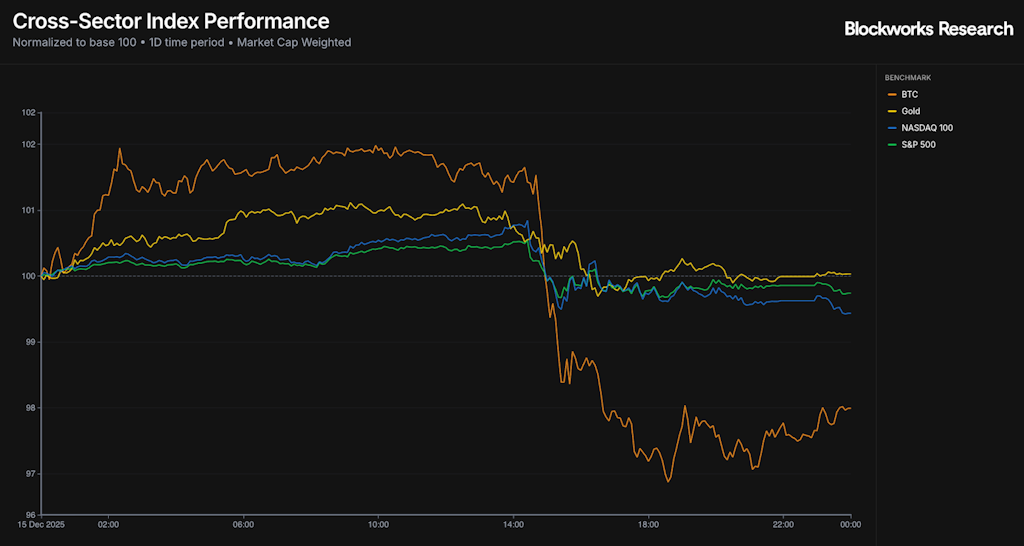
The broader macroeconomic backdrop has left investors positioning defensively during what marks the final full trading week of the year for traditional stock markets. Gold managed to close the day flat, while bitcoin dropped roughly 2.01%, dragging it down alongside major stock indices. The S&P 500 declined 0.26% and the Nasdaq 100 fell 0.57% as participants rotated into safer assets.
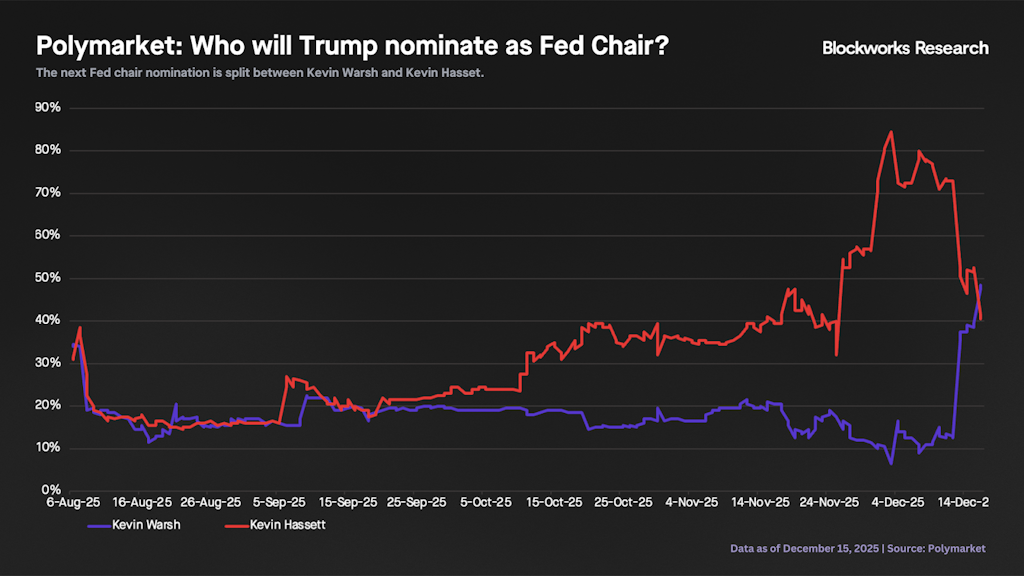
Attention on the macroeconomic front is heavily concentrated on upcoming labor market data, specifically the delayed October and November nonfarm payroll reports. The October figures had been pushed back earlier in the quarter due to a temporary United States government shutdown. At the same time, speculation surrounding the leadership trajectory of the Federal Reserve has intensified following news that Chairman Jerome Powell’s term is slated to conclude in May 2026. While Kevin Hassett surfaced as a prominent frontrunner for the Fed chair position earlier in the month, Kevin Warsh has since captured a narrow lead, highlighting a fluid and closely watched race. Regardless of the final appointment, market participants generally anticipate a more dovish central bank under incoming leadership, setting expectations for additional interest rate cuts in the year ahead.
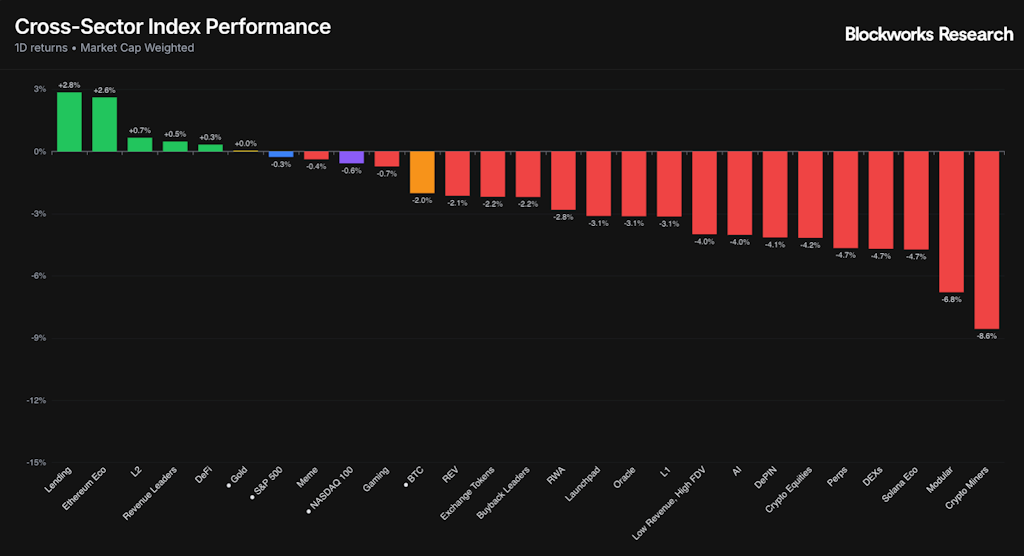
Amidst the broader red ink, cross-sector indices offered a contrasting narrative. The Lending index rose 2.8% and the Ethereum Ecosystem index advanced 2.6%, displaying remarkable resilience. Aave emerged as the standout performer across both categories, registering a 3.0% gain. The positive momentum followed a decisive move by Aave founder Stani Kulechov, who swapped nearly $10 million of wrapped ether into AAVE tokens. The maneuver served as a public signal of direct financial alignment with the token following internal governance tensions between the DAO and Aave Labs.
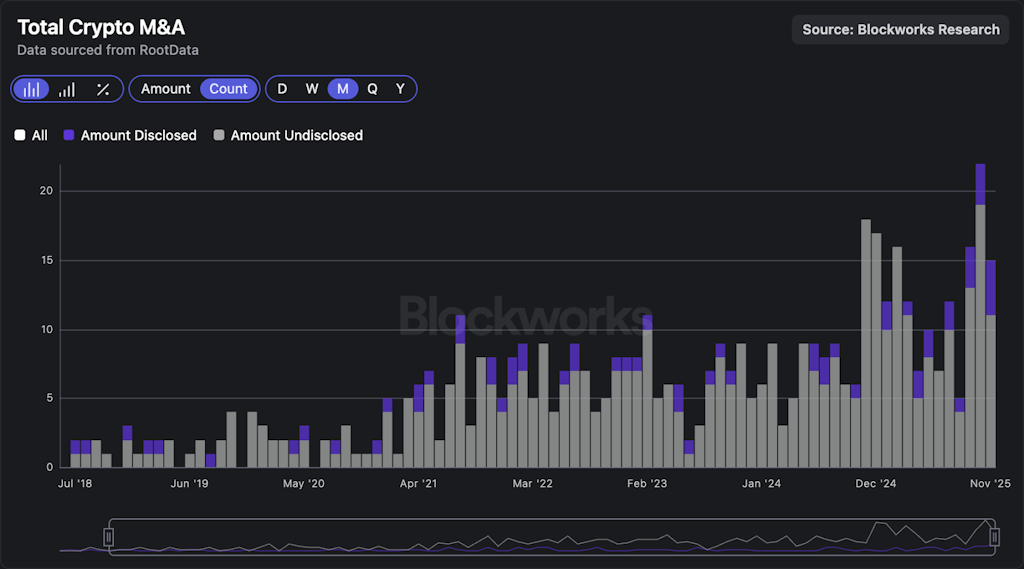
The ongoing evolution of the digital asset landscape highlights a broader structural theme expected to define the market throughout 2026: consolidation. Across the sector, activity is increasingly coalescing around a select group of dominant platforms and foundational players. Crypto merger and acquisition activity has accelerated noticeably over the past year, reflecting the early stages of this maturation process. According to data from RootData, the industry has witnessed 143 M&A deals over the course of the year, though financial terms have been publicly disclosed in only 21 of those transactions. The most monumental deal of the period remains Dunamu’s $10.3 billion acquisition by Naver, pointing to the immense scale of corporate integration taking place.
While corporate consolidation underscores an industry maturing into traditional financial frameworks, a series of high-profile M&A transactions over the preceding two months has simultaneously dragged a fundamental structural flaw back into the spotlight: native tokens remain largely broken and uninvestable for the average market participant.
Recent industry combinations—including Pump’s acquisition of Padre, Coinbase’s acquisition of Vector, and Circle’s acquisition of the Axelar core team alongside its related intellectual property—share a common thread of completely neglecting token holders. In the case of Pump, acknowledgement of PADRE token holders only materialized following substantial and vocal community backlash.
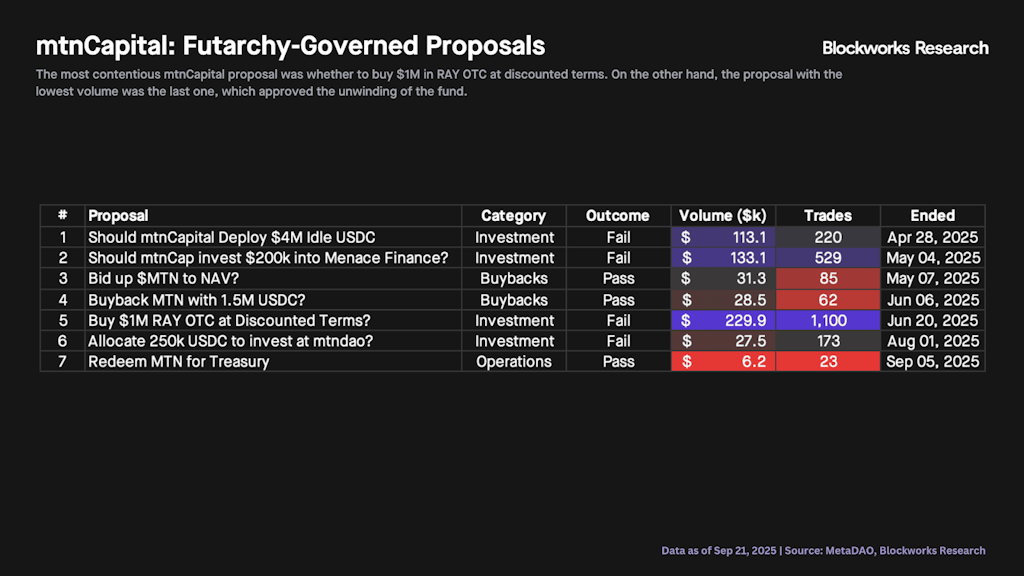
This structural deficiency sits at the heart of the problem that innovative models like MetaDAO are attempting to solve, explaining why specialized ownership coins have managed to outperform the broader crypto market over recent months. Although significant legal uncertainties persist around alternative token governance frameworks, MetaDAO successfully embeds mechanistic protections directly into tokens. This architecture empowers holders to submit treasury clawback proposals as an ultimate safety net. The orderly unwinding of mtnCapital demonstrated this mechanism in functional practice, allowing token holders to redeem their MTN directly for USDC held in the treasury once it became evident that the underlying experiment had failed.
Alternative projects are tackling the same underlying dilemma from completely different angles by seeking to bridge equities and primary capital formation directly onchain. Platforms such as Superstate and its Opening Bell initiative allow partner issuers, including Galaxy, to move shares seamlessly between traditional legacy markets and tokenized digital representations operating natively on Ethereum and Solana.
Superstate further advanced this mission with the introduction of Direct Issuance Programs designed to modernize traditional capital formation. This proprietary infrastructure enables SEC-registered issuers to receive stablecoins directly into corporate wallets from verified KYC investors, instantly issuing tokenized shares to the investor’s digital wallet while simultaneously updating the corporate shareholder registry in real time.
Ultimately, market participants are unlikely to differentiate heavily between buying a conventional token or a tokenized stock, provided the financial instrument conveys a direct legal claim on underlying cash flows, hard assets, and reliable legal recourse. Both methodological approaches are expected to coexist and play foundational roles in the maturation of onchain markets through 2026 and beyond.
A parallel critical question facing digital asset markets is the true durability of onchain demand, particularly regarding the pervasive reliance on financial incentives, airdrops, and points-farming campaigns. For retail and institutional users alike, these incentive structures have remained a lucrative element of the user experience, offering an attractive risk premium for participating in novel financial applications. For protocols and emerging projects, token-based incentives function as a non-cash customer acquisition expense, enabling them to bootstrap a critical mass of liquidity and successfully overcome the classical cold start problem.
Eventually, however, the designated community rewards budget tied to initial token allocations inevitably exhausts itself, leaving the open market to independently judge the organic viability and standalone utility of the financial product absent artificial stimulus.
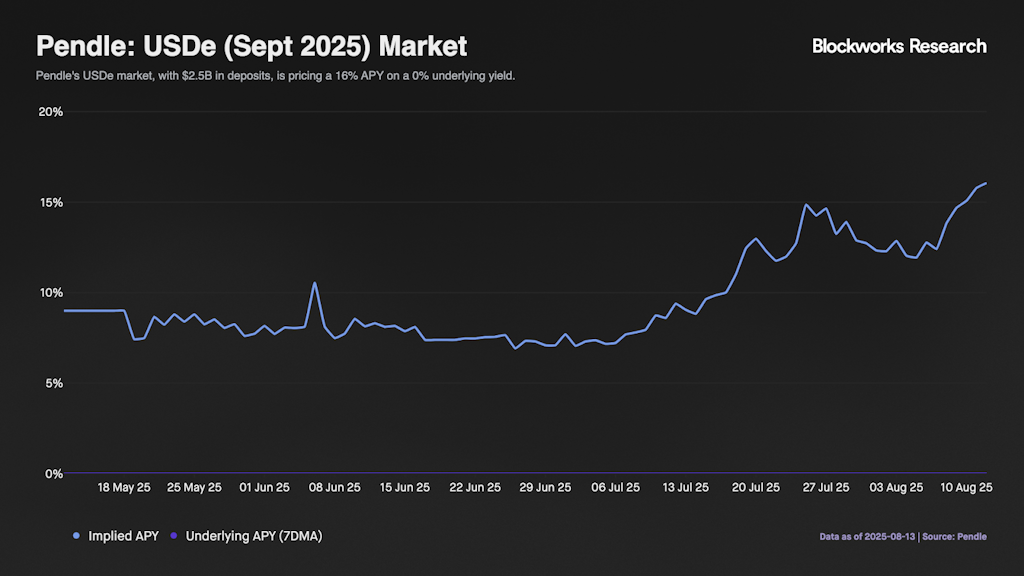
A clear historical case study involves the market for Ethena’s USDe synthetic dollar on Pendle leading into its late-September maturity date. That specific market successfully captured a 70x points boost. Despite paying zero underlying organic yield on the instrument itself, the implied yield on the Pendle market climbed past 16%, fueling an accumulation of more than $3 billion in total deposits.
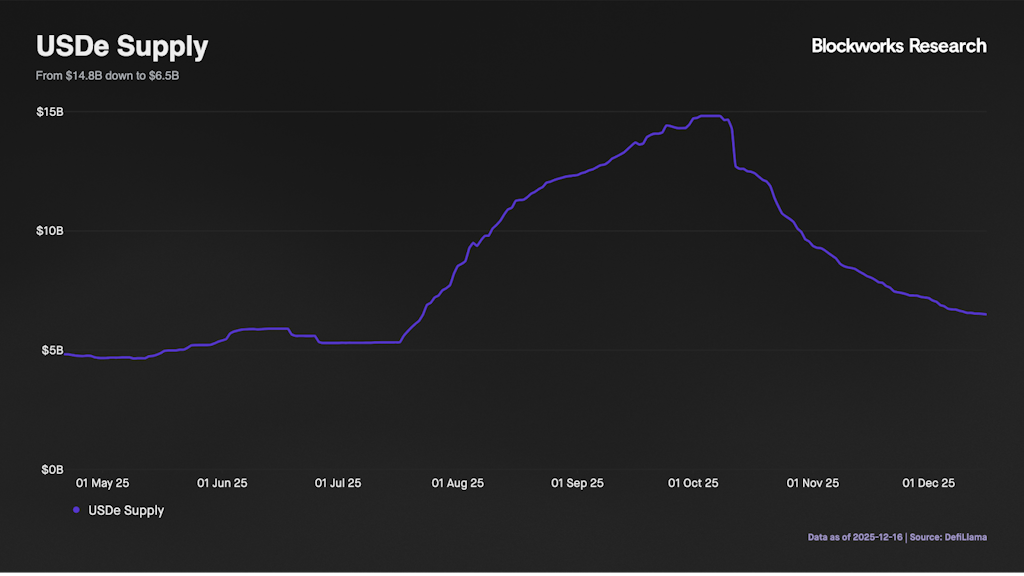
The structure presented a compelling arbitrage opportunity for sophisticated participants. Users could secure a fixed 10% to 15% yield on USDe-related principal tokens while looping their positions on lending protocols like Aave at a borrowing cost of 5% to 7%, all while backed by billions in deep liquidity. Simultaneously, ENA token incentives papered over the spread. Between the USDe and sUSDe markets operating on Pendle, the architecture propelled the overall supply of USDe from $5 billion toward $15 billion. Following the September maturity of over $5 billion in instruments and the concurrent conclusion of Ethena’s Season 4 points campaign—compounded by broader market liquidations and a natural decline in market funding rates—the total circulating supply of USDe sharply contracted back down to $6.8 billion.
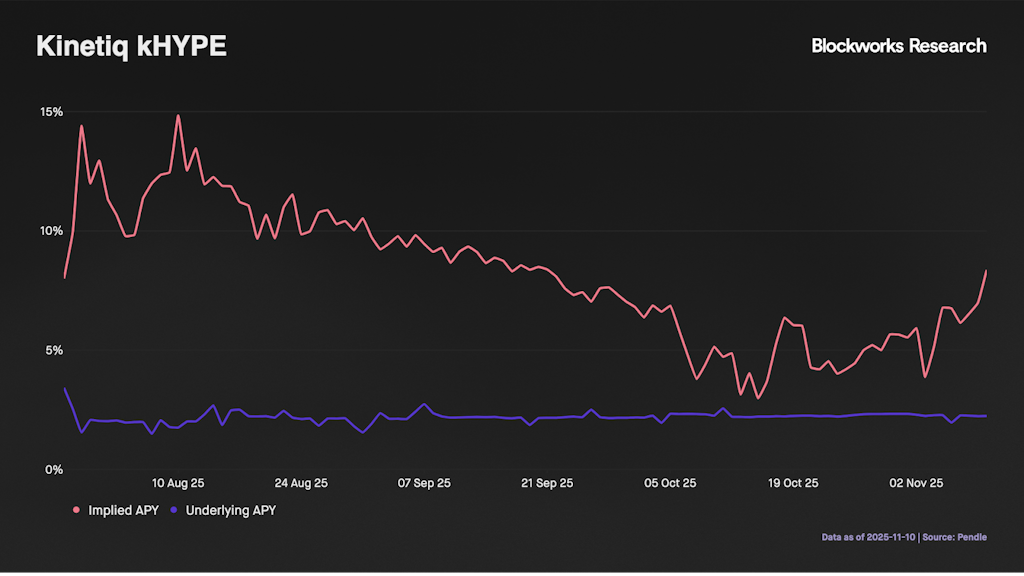
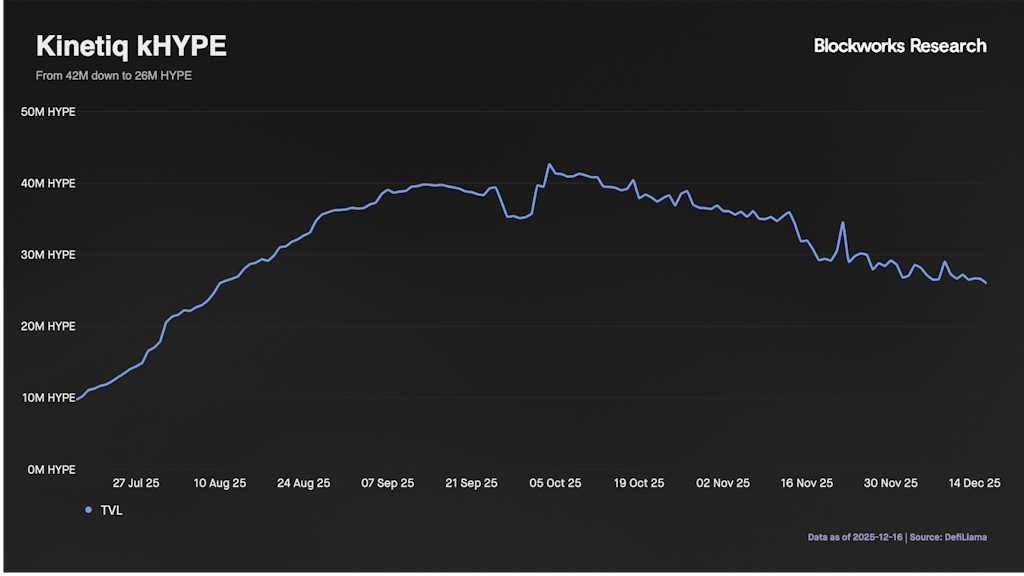
While the Ethena ecosystem serves as a prominent example, the dynamic repeats frequently across the sector. More recently, Kinetiq’s kHYPE asset garnered substantial deposits ahead of an anticipated token airdrop. Pendle markets priced the yield on kHYPE as high as 15%, despite an underlying base staking yield of only 2% to 3%. That specific market managed to amass over 40% of the entire circulating kHYPE supply, expanding to become Pendle’s second-largest listing.
Similar to the USDe dynamics, bullish market participants purchased kHYPE principal tokens at an approximate 10% fixed yield and looped the asset against borrowing costs of 2% to 3% on platforms like HyperLend or Felix, all while maintaining their underlying delta exposure. Following the token generation event and the expiration of that high-yield maturity cycle, the supply of kHYPE contracted by 40%.
A similar trajectory is currently unfolding with emerging yield-bearing assets. USD.AI, a protocol that aggregates onchain stablecoin suppliers to deploy capital into physical hardware for GPU financing, rapidly accumulated over $600 million in deposits. Operating under a strict points campaign with hard caps on deposits, the overwhelming demand for airdrop exposure drove frustrated participants locked out of direct deposits to bid up the underlying stablecoin four cents above its intended peg.
USD.AI markets on Pendle have consistently offered some of the highest stablecoin yields available in an otherwise subdued yield-farming environment. The implied yield on the March maturity launched around 30% before drifting down toward 10%, despite the underlying GPU financing operations generating no native yield from traditional sources. More than 80% of the total USD.AI supply has been actively utilized within Pendle markets.
Whether these elevated yields can prove sustainable remains a central question for participants. Once initial incentives conclude and token generation events pass, yield-bearing variants like sUSD.AI will rely entirely on cash flows generated from an underlying loan book that currently stands at under $1 million. Absent a dramatic expansion in actual loan volume—potentially scaling by a multiple of 200—the underlying annual percentage yield may struggle to maintain the intense capital appeal currently supported by its massive deposit base.
While incentive programs remain extraordinarily lucrative for end-users and highly effective for protocols attempting to solve cold-bot activation hurdles, they remain transient features rather than durable pillars of financial products. Points farming will undoubtedly endure as a persistent characteristic of the onchain economy, but capital will perpetually rotate toward the most compelling risk-adjusted returns available across the ecosystem.


Comments (0)