



As the year winds down, traditional risk assets and the cryptocurrency market alike are showing persistent signs of fatigue, offering little in the way of holiday cheer for investors. Across the broader financial landscape, market participants are actively hunting for a definitive price floor, looking toward fundamental metrics such as institutional exchange-traded fund (ETF) inflows and protocol-level buybacks to stabilize valuations. Unfortunately, these structural supports have yet to provide the necessary cushion to halt the ongoing slide.

This week closes out with widespread weakness across the board, hitting crypto-related risk assets particularly hard. Traditional equity markets have mirrored this pessimistic sentiment, with both the S&P 500 and the Nasdaq 100 moving more than one percent lower over the course of the week. Amid the sea of red, precious metals proved to be a notable exception, with gold standing out as one of the few instruments maintaining genuine structural strength.
In the digital asset ecosystem, every crypto index tracked by analysts traded lower throughout the week, reflecting a broad-based retreat from risk. However, internal market dynamics revealed interesting divergences beneath the surface. Notably, exchange-related tokens, buyback leaders, and the cohort of crypto equities slated for 2025 outperformed bitcoin on an intra-week basis. Meanwhile, nearly every other sector underperformed, dragging overall market sentiment lower.
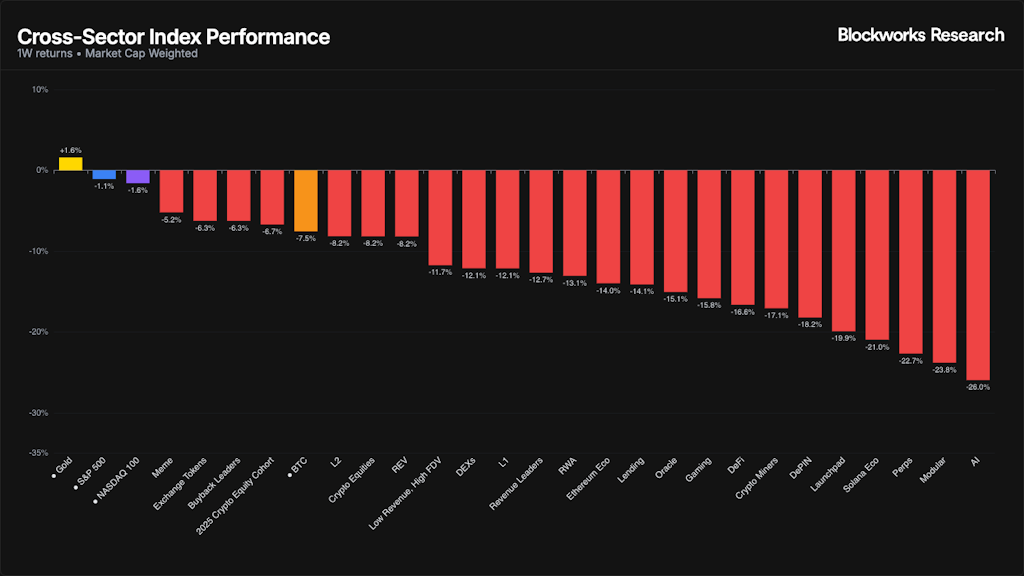
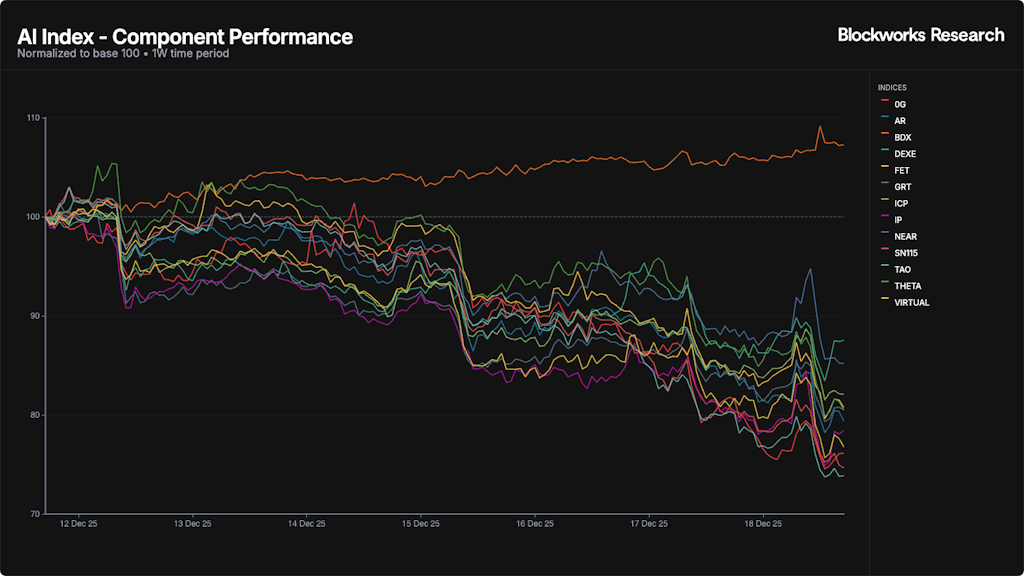
The artificial intelligence sector suffered the most severe downturn of the week, absorbing a staggering 26% loss across its major tokens. This downward momentum was spearheaded by TAO, which plunged to new multi-month lows. The sharp correction marks a dramatic reversal for the token, which had enjoyed a stellar run as one of the top-performing assets just a couple of months prior in October.
Broadly speaking, the broader cryptocurrency market remains locked in a clear downtrend. Major tier-one assets such as bitcoin, ethereum, and solana continue to exhibit noticeable weakness, while longer-tail alternative coins are experiencing significantly more aggressive moves to the downside. Market observers note that risk assets are urgently searching for a fundamental floor. This bottoming process may take time to materialize, potentially remaining elusive until spot prices and token buyback yields become so compelling that incoming protocol cash flows can definitively establish a cyclical low.
Similarly, major digital assets may require a substantial uptick in spot ETF inflows to construct a reliable price floor. Regrettably, the support provided by these institutional investment vehicles has been conspicuously anemic over the preceding weeks, leaving major tokens vulnerable to continued downward pressure.
As market participants navigate these challenging macro conditions, the broader industry continues to debate the underlying structural forces shaping the future of finance, decentralized technology, and macroeconomic precarity. A series of notable commentaries and research publications released over the weekend have sought to contextualize these shifts.
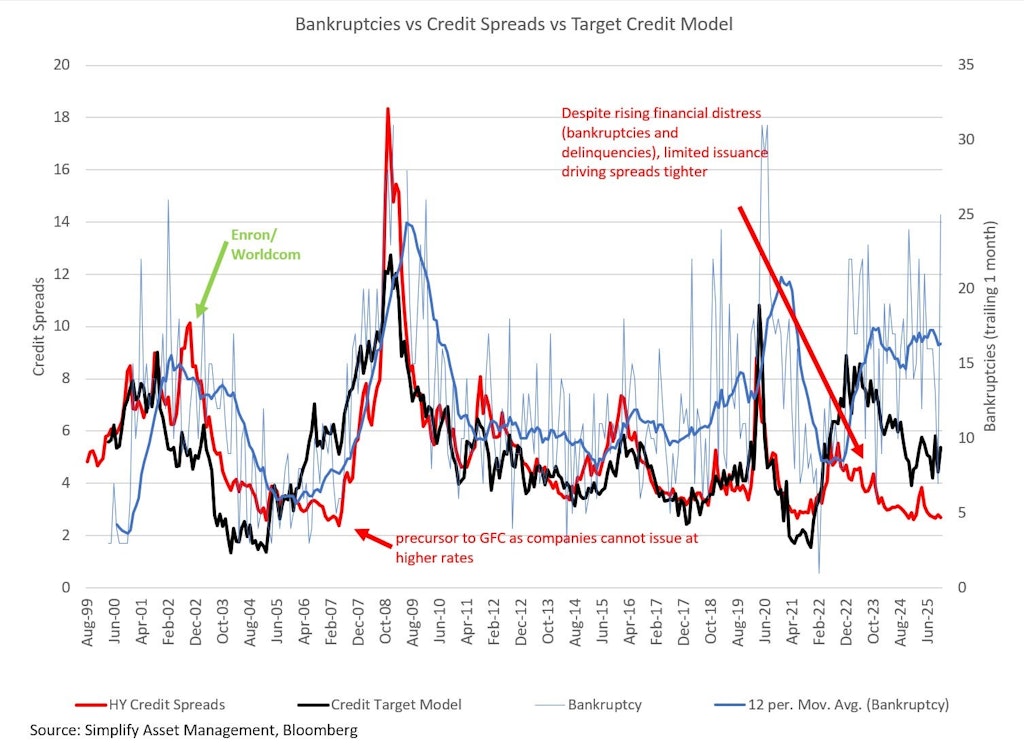
Among them, Michael W. Green published a prominent blog post examining United States economic precarity through a distinctly structural and mathematical lens. Drawing upon physicist Ole Peters’ theoretical framework known as the "Equation of Life," Green argues that wealth has a natural tendency to concentrate in the absence of explicit redistribution mechanisms, ultimately driving systemic societal inequality. He offers sharp critiques of distorted Consumer Price Index measures, technocratic complacency within regulatory bodies, and persistent housing scarcity, framing each as a mechanism of modern economic extraction. With credit spreads remaining artificially tight despite a creeping rise in underlying defaults, Green warns of hidden financial fragility lurking beneath the surface of traditional markets. He ultimately issues a call for heightened civic engagement and institutional accountability, setting the stage for subsequent political interviews and essays focused on comprehensive systemic reform.
Meanwhile, within the decentralized finance ecosystem, the Sky Frontier Foundation released its comprehensive annual research report detailing the protocol’s major operational achievements and financial growth throughout the year. The report highlights an 86% expansion in the supply of the USDS stablecoin, bringing its total circulation to $9.86 billion and allowing it to comfortably outpace the broader stablecoin market’s growth rate. Furthermore, the Sky Protocol demonstrated robust financial performance, generating $435 million in total revenue and $168 million in net profits. This revenue generation supported substantial SKY token buybacks and attractive staking rewards for participants. Bolstered by emerging regulatory clarity stemming from the passage of the GENIUS Act and the rollout of multiple autonomous Sky Agents, the research report projects strong institutional adoption and further protocol expansion looking ahead, positioning Sky as a formidable leader in the sector of decentralized, yield-bearing stablecoins.
However, as traditional financial institutions increasingly eye the blockchain landscape, industry veterans are urging caution. Omid Malekan published a critical analysis examining the lofty promises made by traditional financial giants—including institutions and networks such as the DTCC, Visa, SWIFT, Stripe, and PayPal—as they selectively embrace tokenization. Malekan argues that these legacy firms are eager to adopt the efficiency benefits of blockchain technology while actively ignoring the existential threats it poses to their traditional business models. He contends that such institutions champion tokenization precisely because they can avoid true decentralization, thereby risking the co-optation of crypto’s core values. He warns that the proliferation of permissioned, private chains and heavy-handed regulatory lobbying could dilute the foundational principles that made public blockchains revolutionary. While acknowledging the importance of engaging with traditional finance, Malekan urges the cryptocurrency community to staunchly defend public, permissionless networks and resist compromising decentralization merely for the sake of mainstream corporate adoption.
Adding to the discourse on stablecoins and global liquidity, independent analyst DeFi Cheetah published an insightful commentary on the structural barriers facing the expansion of digital currencies. The piece challenges the common narrative that there is no genuine global demand for non-USD stablecoins, arguing instead that the real bottleneck lies in structural limitations inherent to the traditional global banking system. The analysis dissects how strict international frameworks such as Basel III regulations, persistent liquidity constraints, and G-SIB regulatory penalties actively discourage commercial banks from holding non-USD inventories or servicing emerging market financial corridors. The consequence of these regulatory burdens is a severe liquidity vacuum in non-USD foreign exchange markets. The author advocates for the development of native decentralized finance solutions to bootstrap non-USD stable liquidity independently, warning that any strategy reliant on legacy foreign exchange infrastructure is bound to fail by design.




Comments (0)