


RouteMesh has reached a significant operational milestone, bringing thousands of active nodes into its system and unlocking unprecedented visibility into the software client landscape of modern public blockchains. For years, the broader cryptocurrency ecosystem has operated with remarkably scarce data regarding precisely which client software runs across different chains, leaving a major blind spot in understanding how infrastructure operates under the hood. By systematically benchmarking and extracting data from every new node added to its network, RouteMesh is now offering a comprehensive look at client distribution, version control, and infrastructure provider habits across the multi-chain universe.

To understand the significance of this development, it helps to examine the mechanics of decentralized networks. Operating a blockchain node requires specific software implementations known as clients. The most widely recognized client in the Ethereum ecosystem is "geth," short for go-ethereum. Over the years, however, the industry has evolved to support a rich variety of alternative clients. When a blockchain’s consensus mechanisms, operational parameters, or core architectures differ from Ethereum’s baseline, developers either adapt the original geth codebase or engineer entirely new client software from scratch. Furthermore, for major networks, independent development teams frequently write competing software clients. This practice fosters what is known as "client diversity," a critical property that enhances a blockchain’s resilience by preventing a single software bug from taking down an entire network.

Because RouteMesh integrates thousands of nodes spanning more than 30 Remote Procedure Call (RPC) providers, the platform is uniquely positioned to quantify client diversity at a scale that has previously been unachievable in the ecosystem. The system continuously polls and re-discovers the state of its nodes every few days, tracking vital operational metrics such as client version updates and infrastructure configuration changes made by node providers. While RouteMesh acknowledges that its coverage remains incomplete—as it is impossible to capture every single node in existence across every network—the data gathered from its extensive network of integrated RPC providers serves as a robust and reliable proxy for the broader industry. Observers and researchers can examine this aggregated data directly through the RouteMesh client portal.

When analyzing the aggregate data across all integrated RPC providers, a striking revelation emerges: the vast majority of nodes run on geth. While analysts might have anticipated a more evenly distributed market share among competing clients, the sheer dominance of geth underscores its foundational role as the heavy lifter of the crypto infrastructure stack. Following geth in overall absolute node count is reth, the high-performance execution client developed by Paradigm. Although this data measures absolute node counts rather than the exact volume of requests served by each client, node counts and request distribution remain closely correlated in practice.

A deeper dive into the multi-chain data reveals that geth functions as the true cross-chain dominant client, maintaining a presence across hundreds of individual chains throughout the cryptoverse. Following geth, a secondary tier of clients maintains notable multi-chain deployments, while specialized networks rely on a long tail of alternatives including cdk-erigon, nethermind, skaled, zkSync, erigon, go-opera, OpenEthereum, and bor.

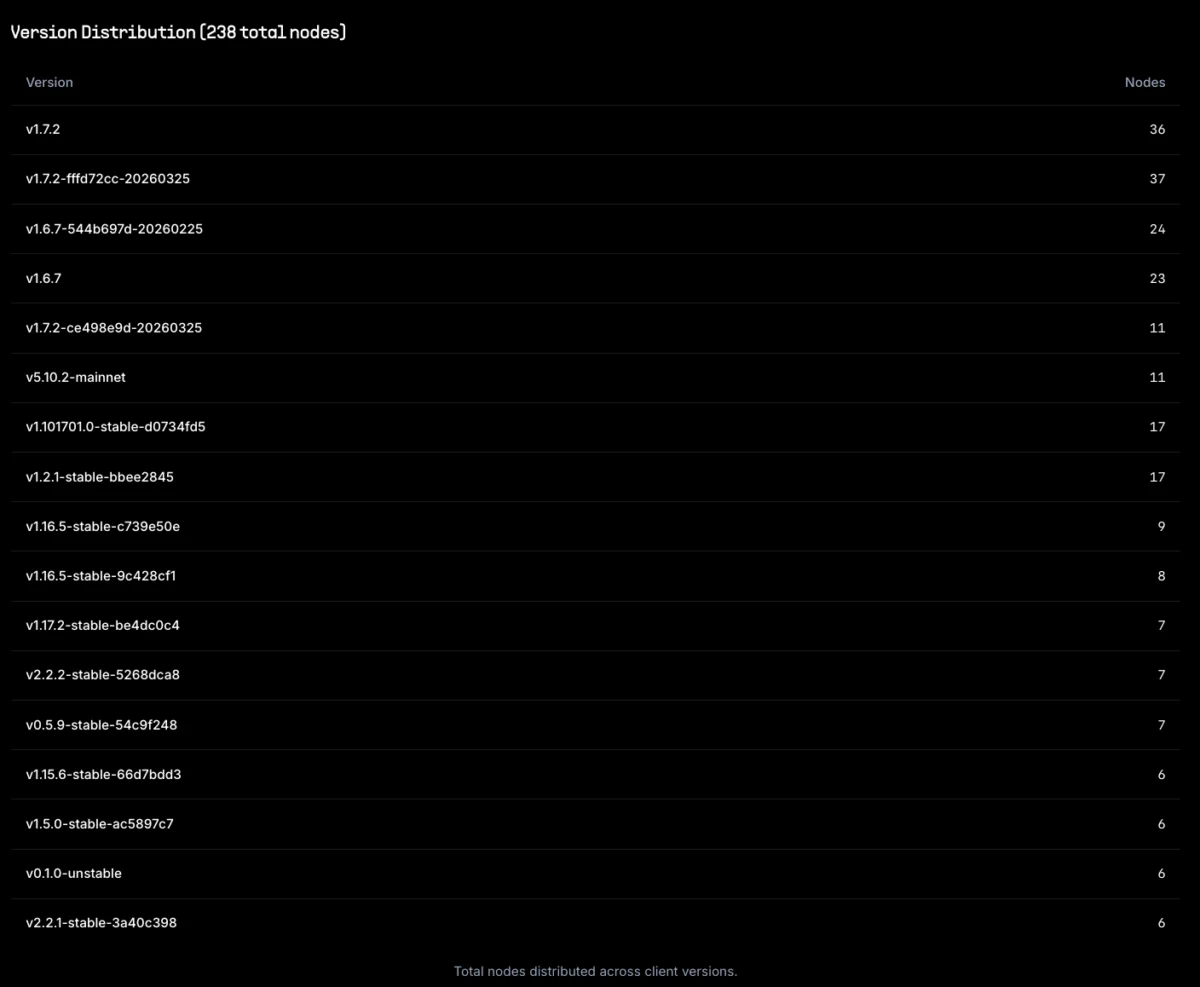
Examining specific client implementations provides further clarity on how infrastructure is maintained. Geth acts as the underlying backbone for the crypto RPC industry, serving as the client software for nearly 427 distinct chains. However, an analysis of version distribution across geth nodes reveals a wide spread of active software releases. While major upgrades introduce significant performance enhancements—such as those rolled out in recent iterations designed to optimize extensive RPC queries—a surprisingly large portion of nodes continue to operate on older releases. For instance, legacy versions released years ago still maintain a presence in the wild. If an individual provider relied on a single node running an outdated release, that infrastructure would be vulnerable to sudden disruptions. Within RouteMesh’s aggregated model, however, this risk is mitigated by robust architectural fallbacks and multi-provider redundancies.

The operational habits of node providers come into sharper focus when examining individual fleets. While major enterprise infrastructure providers like Alchemy and Quicknode manage extensive networks—though complete visibility is sometimes constrained by provider pricing models for supplementary node tracking—the available data sheds light on how different ecosystems manage software lifecycles. For example, contrasting geth with Paradigm’s reth client reveals distinctly different patterns of adoption. Reth demonstrates a much tighter clustering of version numbers, indicating that infrastructure providers maintain better alignment and keep their reth deployments significantly more up to date than their geth fleets.

The primary supported chain for reth is Base, followed closely by Ethereum, Optimism, Base Sepolia, Ethereum Sepolia, and Binance Smart Chain. This close relationship between specific chains and their preferred client software highlights the symbiotic development cycles within modern Layer 2 and Layer 1 ecosystems. While major new major versions of reth have been introduced recently, adoption data shows that infrastructure operators typically allow a grace period of a few months to thoroughly test and deploy updates across their production environments.

A similar pattern emerges when analyzing Nitro, the execution environment heavily dominant within the Arbitrum ecosystem. Nitro runners demonstrate a high degree of coordination, with providers maintaining relatively recent version numbers across their fleets. Codebase reviews indicate that infrastructure operators within the Arbitrum network closely track official releases, ensuring a high level of synchronization between developers pushing updates and providers adopting them across the numerous mainstream and niche chains powered by Nitro technology.

This continuous pipeline—stretching from core developers writing client software to infrastructure providers implementing updates—governs the reliability of decentralized networks. RPC providers form the literal backbone of the digital asset economy, and gaining deep visibility into their operational decisions allows the entire ecosystem to better understand how data requests are handled and served. By shining a light on these lower-level technical realities, RouteMesh’s ongoing research delivers unprecedented transparency into how live blockchains operate day-to-day. The complete dataset remains publicly accessible for ongoing analysis through the RouteMesh platform.





Comments (0)