



Bitcoin’s evolutionary journey from an experimental digital currency to a widely accepted macroeconomic asset may be entering a transformative new chapter. According to a comprehensive new report released by Bitcoin infrastructure developer RootstockLabs, the next wave of institutional demand for the world’s largest cryptocurrency is poised to stem from lending, yield generation, and balance-sheet financing. This anticipated shift suggests that Bitcoin’s utility could soon expand significantly beyond its traditional categorization as a passive digital store of value.
The analysis highlights a striking disparity between Bitcoin’s total market presence and its current utilization within decentralized financial frameworks. RootstockLabs estimates that a mere 1.5% of the total circulating supply of Bitcoin is actively participating in lending and Bitcoin-native finance. Meanwhile, identifiable institutional investors currently hold roughly 3.9 million BTC. The report contends that finding secure, efficient ways to put a larger portion of these institutional holdings to work could generate substantial organic demand for the asset without altering its strictly enforced, fixed supply cap of 21 million coins.
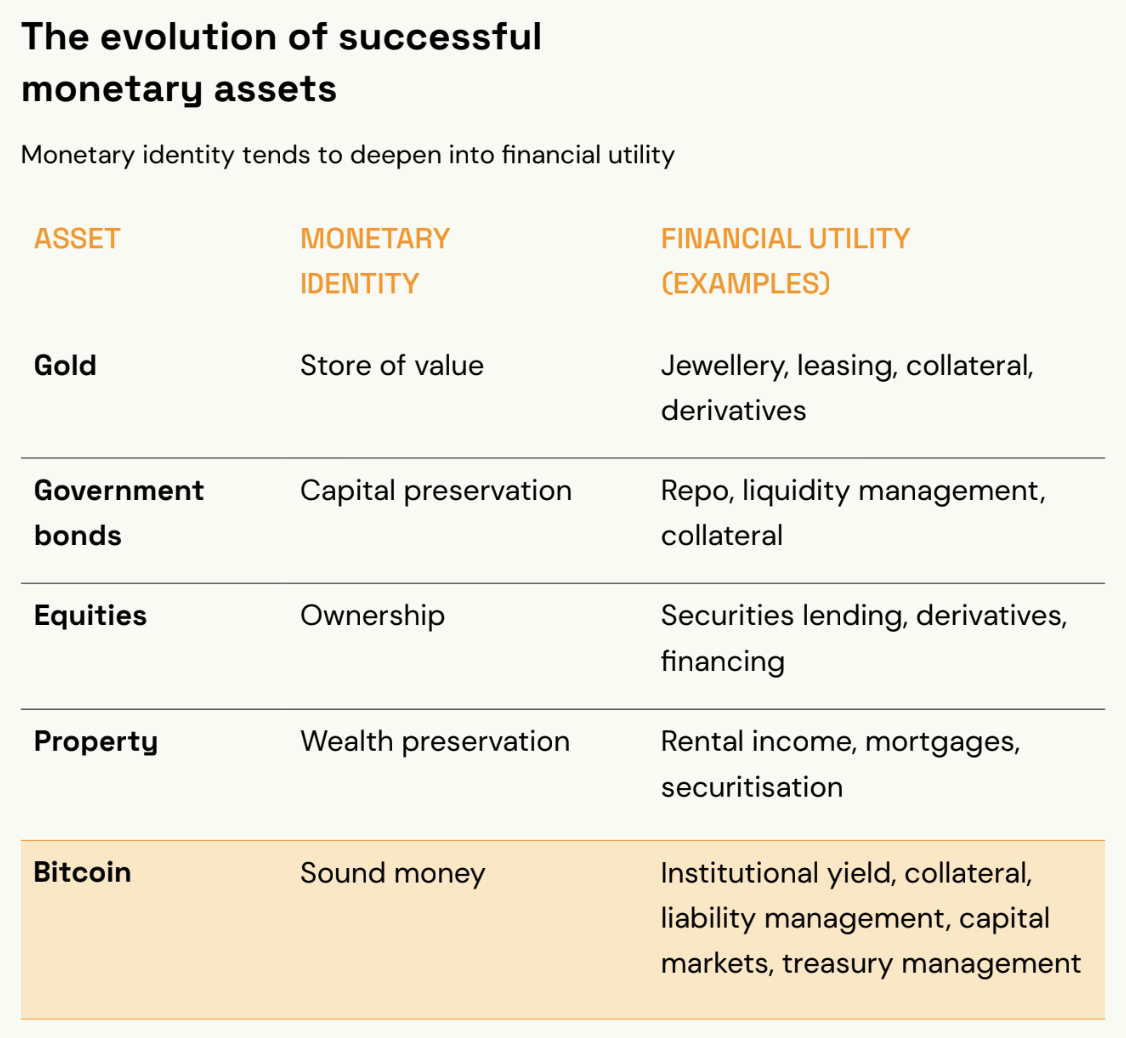
To understand how this financialization might unfold, the RootstockLabs analysis identifies two primary emerging sources of financial utility. The first involves generating consistent returns from existing Bitcoin holdings through sophisticated lending markets and structured credit products. The second centers on corporate balance-sheet efficiency, where companies integrate Bitcoin alongside traditional fiat-denominated liabilities. RootstockLabs argues that both use cases could incentivize institutional players to not only acquire larger allocations of BTC but also to retain them over the long term as productive economic assets rather than idle reserves.

To illustrate the scale of this potential activity, the report outlines a hypothetical scenario in which institutional Bitcoin holdings double over time to reach 7.8 million BTC. Under this projection, if just 5% of those accumulated holdings were deployed to earn a conservative 5% annual yield, institutions would collectively generate approximately 19,500 BTC per year. The researchers emphasize that this figure represents a model of potential returns on existing capital rather than a direct forecast of new market demand, providing a framework for how institutional treasury managers might view the asset class in the future.
Drawing a historical parallel to gold, the report asserts that successful monetary assets throughout history invariably develop secondary and tertiary sources of demand far beyond their original, primary role as stores of value. While physical gold eventually found extensive industrial and aesthetic applications in jewelry, dentistry, and high-end electronics, RootstockLabs anticipates that Bitcoin’s next great evolution will unfold entirely within the architecture of modern financial markets, driven by programmatic trust and cryptographic verification.
Could Bitcoin’s Financialization Introduce New Risks?
As the conversation surrounding Bitcoin shifts toward deeper financial integration, industry observers naturally raise questions regarding the systemic risks such an evolution might introduce. Financialization in traditional markets has historically paved the way for excessive leverage, opaque lending chains, and systemic vulnerabilities. When asked about the potential hazards associated with this growing trend, Tony DiCarlo, director of institutional propositions at RootstockLabs and author of the report, acknowledged the validity of these concerns while emphasizing that Bitcoin’s underlying technological design offers distinct structural safeguards.
Speaking about the inherent dangers, DiCarlo noted that financialization always carries real risks, pointing out that fractional reserves, rehypothecation, and excess leverage have a tendency to grow around any scarce economic asset. However, he maintained that Bitcoin’s unique properties significantly mitigate some of those traditional risks. Specifically, he highlighted that collateral is entirely verifiable on-chain, liquidation rules are fully transparent and programmable, and, crucially, the underlying supply of the collateral can never be artificially diluted by monetary authorities.
Despite these architectural advantages, DiCarlo conceded that certain risks remain prominent for institutional market participants. Borrower defaults, custody failures, and legal enforceability across various global jurisdictions continue to present operational challenges. Furthermore, Bitcoin’s well-documented price volatility inherently compounds the risks associated with leverage, requiring sophisticated risk management frameworks from any institution attempting to build financial products around the asset.
To demonstrate how these financial mechanisms can be applied constructively in the real world, DiCarlo pointed to recent corporate activity, such as MARA securing $750 million in Bitcoin-backed loans. This financing structure was utilized to help fund a planned power plant acquisition in Ohio, allowing the enterprise to retain its underlying Bitcoin holdings while leveraging them as robust collateral to finance tangible, real-world infrastructure. Such arrangements signal a growing willingness among corporate treasuries to treat Bitcoin not merely as a static digital asset, but as a dynamic financial instrument capable of bridging the digital and physical economies.
At the same time, the report does not shy away from the centralization risks posed by institutional adoption. DiCarlo acknowledged that the rapid growth of institutional participation could potentially concentrate large portions of Bitcoin supply among a relatively small number of institutional custodians. He noted that while spot Bitcoin exchange-traded funds have successfully driven massive institutional capital inflows, ETF shareholders ultimately own shares of a fund rather than the underlying coins themselves, warning that a handful of dominant custodians could eventually control the vast majority of circulating BTC.
Nevertheless, DiCarlo maintained that Bitcoin’s foundational, decentralized architecture remains its most vital competitive advantage. This decentralized design allows individual holders to retain direct control of their private keys and enables innovative financial services to operate with significantly fewer intermediaries. By removing middlemen from the equation, financial products built natively on Bitcoin can theoretically carry substantially less counterparty risk and lower administrative fees. These structural benefits, according to RootstockLabs, are precisely what will continue to attract forward-thinking users and reward the developers who build financial applications tailored to Bitcoin’s unique properties.





Comments (0)