


Decentralized finance has long wrestled with one of its most persistent and destructive structural flaws: impermanent loss. For years, automated market makers have required liquidity providers to accept the inherent risk of asset price divergence, often wiping out fee earnings or discouraging capital deployment entirely. Countless mechanisms have been proposed, tested, and ultimately abandoned in the pursuit of a sustainable solution. Now, a novel protocol called Yield Basis appears to have finally cracked the code, introducing a sophisticated leveraged mechanism designed to eliminate impermanent loss from automated market makers altogether.

The protocol carries significant pedigree within the decentralized finance ecosystem. Yield Basis was founded by the same visionary mind behind Curve DAO, establishing immediate architectural synergies and industry credibility from its inception. The formal mechanics governing how this innovative leveraged liquidity model operates are detailed in the protocol’s foundational whitepaper, outlining a system that leverages positions to neutralize the downside risks traditionally associated with providing liquidity on decentralized exchanges. After years of witnessing failed attempts across the sector, Yield Basis stands out as the first viable solution with genuine market traction, boasting metrics that speak for themselves.
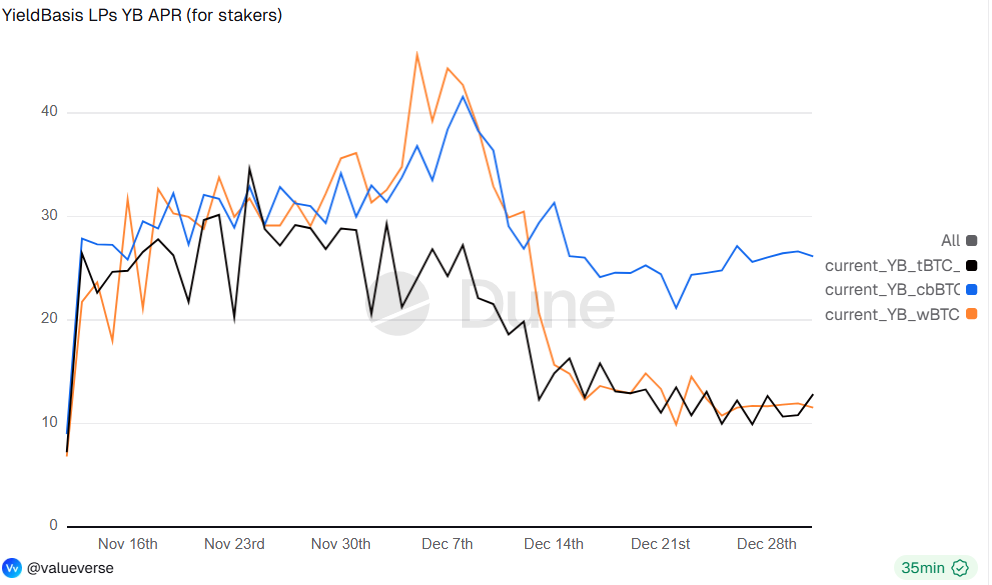
The market has responded swiftly to the protocol’s arrival. Yield Basis already accounts for the three-largest bitcoin decentralized exchange pools across the entire decentralized finance landscape, commanding over $400 million in total value locked. This massive concentration of capital highlights a fundamental shift for holders of wrapped native bitcoin tokens, who can now securely earn organic yield while supplying liquidity to the market. Historically, the seven-day moving average for this liquidity supply yield has fluctuated between an impressive 4% and 40%, depending on market conditions and pool activity. Because many crypto investors typically avoid liquidity provisioning in automated market makers unless heavily incentivized by liquidity mining campaigns, market participants might overlook a crucial structural feature: yields within these pools are paid out in the underlying pool tokens. For bitcoin holders, this translates directly into genuine, native bitcoin yields.

Beyond its role as an efficient liquidity venue, Yield Basis has structured its native token with tangible utility rather than relying solely on speculative governance dynamics. The protocol’s much-anticipated fee switch was officially activated earlier this month, establishing a direct value-accrual mechanism for participants. Liquidity providers on Yield Basis currently have two distinct avenues for generating returns from their supplied capital. They can choose to hold the ybbitcoin liquidity provider tokens directly, receiving their share of trading fees denominated in native bitcoin. Alternatively, they can stake their tokens, forgoing the bitcoin-denominated trading fees in order to participate in native token emissions.
This dual-pathway approach aligns closely with sound corporate finance principles, echoing the classic sentiment that investors often prefer direct earnings distribution over arbitrary token buybacks, allowing individuals the autonomy to decide when and how to acquire the underlying asset. Dividends provide essential financial optionality, particularly when participants retain the flexibility to choose the precise type of yield they wish to receive. To put the scale of this fee distribution into perspective, the protocol distributed approximately $450,000 in rewards during the week ending December 25 alone, and this substantial figure was achieved despite existing caps on the underlying liquidity pools.

For industry observers who view this development as a long-awaited breakthrough allowing investors to earn native yield on bitcoin without suffering impermanent loss and without enduring the complex risks, persistent effort, and direct costs associated with external hedging strategies, the assessment is largely accurate. However, the ambitions of Yield Basis extend far beyond functioning merely as an impermanent loss-free automated market maker. The protocol is strategically positioned as comprehensive yield and liquidity infrastructure designed to transform historically non-productive assets into yield-bearing instruments while simultaneously establishing robust secondary markets.
By systematically targeting wrapped native assets and tokenized real-world assets, Yield Basis possesses the theoretical capacity to render virtually any sufficiently liquid and volatile asset productive. This capability allows asset issuers to generate sustainable revenue directly from liquidity rather than perpetually subsidizing market-making operations. Simultaneously, it enables asset holders to access organic yield and downstream decentralized finance use cases, including advanced collateralization strategies.
This sophisticated economic model is not restricted to crypto native heavyweights like bitcoin and ether. It extends outward to encompass tokenized commodities and traditional equities such as gold, silver, and major corporate stocks like Nvidia, whose broader on-chain adoption has historically been severely constrained by the persistent threat of impermanent loss, shallow secondary liquidity, and a total absence of native yield generation or efficient liquidation pathways. By offering a unique, structurally superior yield option defined by an attractive risk-reward profile, deep liquidity pools, and powerful network effects, Yield Basis could successfully unlock these dormant traditional markets for decentralized finance participants.
Despite its innovative architecture and rapid early adoption, Yield Basis is not entirely without risk. Navigating complex financial engineering requires diligence, and industry participants are encouraged to examine the protocol’s whitepaper or utilize analytical tools to thoroughly comprehend both the potential operational downsides and the broader structural unlocks that Yield Basis offers to the decentralized finance ecosystem.





Comments (0)