


Every single trading day, it seems that memory stocks are on an inexorable march upward. Industry titans like Micron, one of the world’s largest memory manufacturers, have watched their valuations nearly triple over the past year alone. For many market participants, watching these familiar tickers climb day after day has sparked a cycle of anxious waiting for a meaningful pullback. Yet, despite the soaring share prices and intense market enthusiasm, a vast majority of investors fail to truly grasp the nature of the physical product driving this unprecedented financial surge.
To bridge this gap in understanding, analysts are taking a closer look at what memory actually is, how it operates within modern computing architecture, and why it represents one of the most lucrative opportunities in the contemporary technology landscape.
Demystifying Memory: What It Is and Why It Matters
At its core, memory is the vital component that enables a computer or electronic device to temporarily store information while ephemeral computation is being executed. This process is carried out predominantly through high-frequency read and write operations. Every distinct layer of memory within a hardware ecosystem features a unique profile balancing read and write speeds, financial cost, and physical storage capacity.
In the era of artificial intelligence, memory has transcended its traditional role to become an even more critical determinant of performance. Modern AI models require systems to process massive, unprecedented amounts of data all at once. Whether users interact with sophisticated chatbots, advanced image generators, or complex recommendation algorithms, memory is constantly shuttling colossal datasets in and out at breakneck bandwidths.
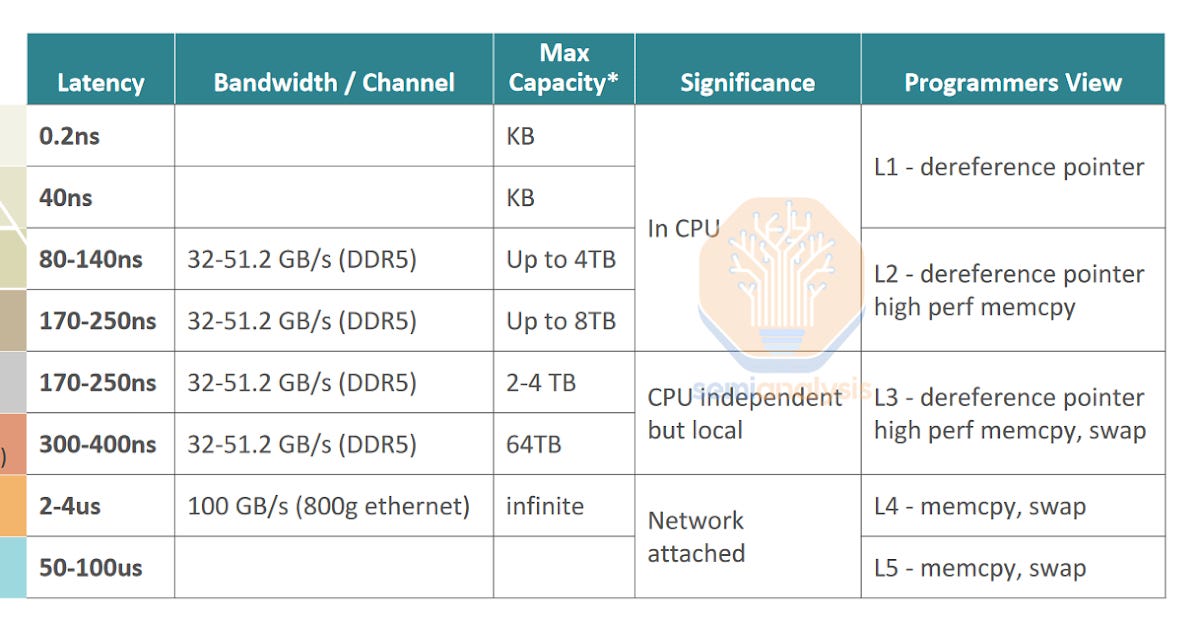
As artificial intelligence models grow increasingly intelligent, sophisticated, and capable, their underlying appetite for memory scales proportionally. Without powerful, high-throughput memory systems, research and development in Large Language Models and machine learning use cases inevitably stall, hitting a hard architectural ceiling regardless of how many processing units are deployed.
The Hierarchy of Memory: From Working Storage to Long-Term Retention
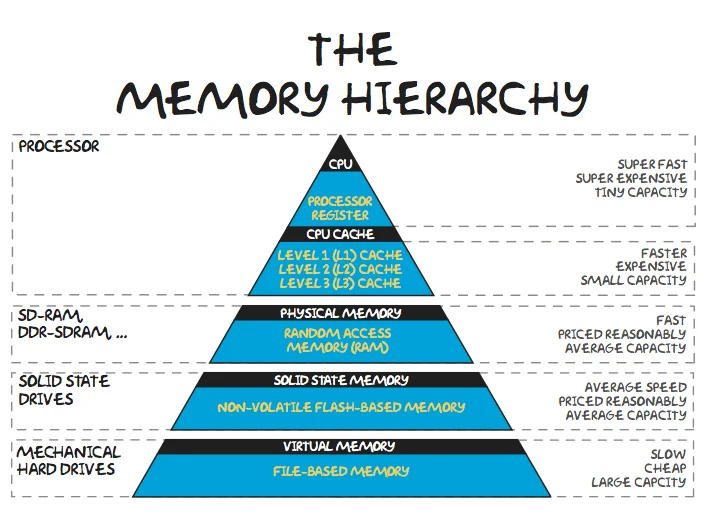
To truly comprehend the dynamics currently reshaping the semiconductor market, one must first break down the distinct layers of the computer memory hierarchy. Computers traditionally divide memory into working memory—utilized while the system is actively performing real-time computations—and storage memory, which is designed to save data long-term at the expense of slower read and write speeds.
This functional separation exists because high-bandwidth memory, characterized by exceptionally low read and write latencies, is inherently expensive to manufacture. Conversely, long-term storage memory is cheap to produce, but suffers from lower bandwidth and significantly higher read and write times. Much of the engineering complexity surrounding memory design ultimately boils down to the physical distance between the storage chip and the central processing unit. The greater the physical distance, the slower the data throughput.
SRAM, or static memory built directly on logic silicon, sits at the absolute pinnacle of this hierarchy. It is frequently the highest-throughput memory in the entire system because it resides directly inside or immediately adjacent to the XPU, a blanket term encompassing both central processing units and graphics processing units. It holds tiny, critical fragments of data that the processor requires at that exact microsecond. However, it is extraordinarily expensive per bit, offers a microscopic storage capacity, and is manufactured on the exact same silicon die as the primary processor by key industry players such as Intel, AMD, and Apple.

Moving down the hierarchy brings us to Designated Random Access Memory, universally known as RAM. This serves as the computer’s primary working memory—effectively the physical desk where active programs live and execute. High throughput is an absolute requirement here, as any delay creates a bottleneck that forces a queue of stalled computations to accumulate. DRAM cells are constructed using a combination of one transistor and one capacitor per bit. While somewhat expensive and offering medium capacity measured in gigabytes, the vast majority of DRAM is fabricated in specialized facilities located across South Korea, Taiwan, and the United States by dominant manufacturers including SK Hynix, Samsung Electronics, and Micron.
A specialized evolution of this technology is High Bandwidth Memory, commonly referred to as HBM. This ultra-fast DRAM is stacked vertically and placed in close physical proximity to advanced AI accelerators. Because of its vertically stacked architecture, HBM achieves drastically higher throughput, though this comes at the cost of immense manufacturing complexity. Fabricated using DRAM dies stacked together via through-silicon vias, HBM is very expensive and offers smaller raw capacity relative to standard DRAM, yet it delivers unmatched speed. Given the intensive physical vertical integration required, HBM production is heavily concentrated in Taiwan and South Korea among leading makers like SK Hynix, Samsung, and Micron.
Beyond working memory lies non-volatile flash memory, most notably NAND, which stores data persistently even when the power is completely shut off. NAND is deployed in high-density storage devices such as solid-state drives, USB drives, and memory cards, serving as long-term storage for files, applications, and operating systems. Constructed using flash cells that retain an electrical charge, NAND is cheap per gigabyte, offers massive capacities ranging from hundreds of gigabytes to multiple terabytes, and features lower throughput than HBM and DRAM—though it remains entirely sufficient for less latency-critical computational workloads. NAND is manufactured primarily in Asia, including Korea, China, and Japan, by companies such as Samsung, SK Hynix, SanDisk, Micron, and Kioxia.
At the very base of the memory hierarchy are traditional hard disk drives, which rely on spinning magnetic platters and mechanical parts for cheap bulk storage. While physically large and exceptionally slow in terms of throughput, they remain ultra-cheap and are produced in Asia by legacy manufacturers like Seagate, Western Digital, and Toshiba.
The AI Push and the Reality of the Memory Wall
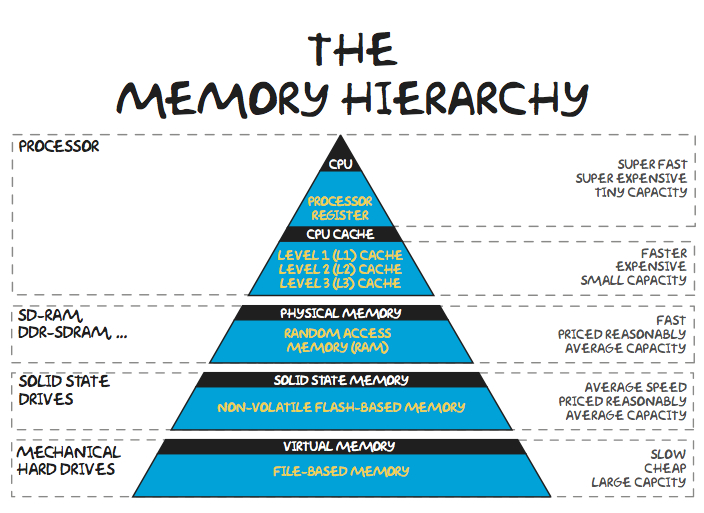
As the memory hierarchy demonstrates, the closer a storage medium is positioned relative to the processor, the faster, smaller, and vastly more expensive it becomes. The massive global push toward artificial intelligence is driving unprecedented demand straight toward the very top of this architectural pyramid. This surge is directly driven by the intensely parallel nature of modern GPUs, which are tasked with executing trillions of computations per second.
Within this ecosystem, HBM has emerged as the most critical memory layer because it sits directly alongside AI accelerators. Meanwhile, NAND acts as the massive digital warehouse holding expansive training datasets, model checkpoints, and operational logs. Inside modern AI data centers, NAND-based solid-state drives continuously feed data into DRAM and HBM layers, which in turn feed the GPU at speeds sufficient to keep the relentless compute engines fully occupied.
Large language models utilize this meticulously tiered architecture to ensure the most efficient possible utilization of every storage layer. Nevertheless, the engineering preference is always to position as much computation and data as physically close to the GPU as humanly possible. Over the past few years of the aggressive AI infrastructure buildout, both HBM and high-capacity NAND have witnessed unprecedented, structural demand. HBM demand is exploding because bandwidth has become the ultimate system limiter, while SSD demand continues its relentless climb as data inputs and outputs—including training inputs, retrieval-augmented generation repositories, and inference logs—expand exponentially.
An often underappreciated factor driving these memory requirements is the recursive nature of modern agentic workflows. These advanced AI systems aggressively consume compute resources as individual software agents call upon other agents, which in turn invoke even more agents in complex, cascading loops. Consequently, autonomous agentic activity can easily trigger situations where demand scales far beyond traditional human-induced workloads.
From Commodities to Bottlenecks: The New Power Dynamics of Silicon
Historically, standard DRAM and NAND have been treated as cyclical commodities by investors and the broader financial markets. Because of this perception, supply has historically been monitored with extreme care and tightly matched to immediate demand requirements. Overbuilding capacity carries dire financial consequences, as semiconductor fabrication plants require multi-billion-dollar investments to spin up and incur massive ongoing operational costs.
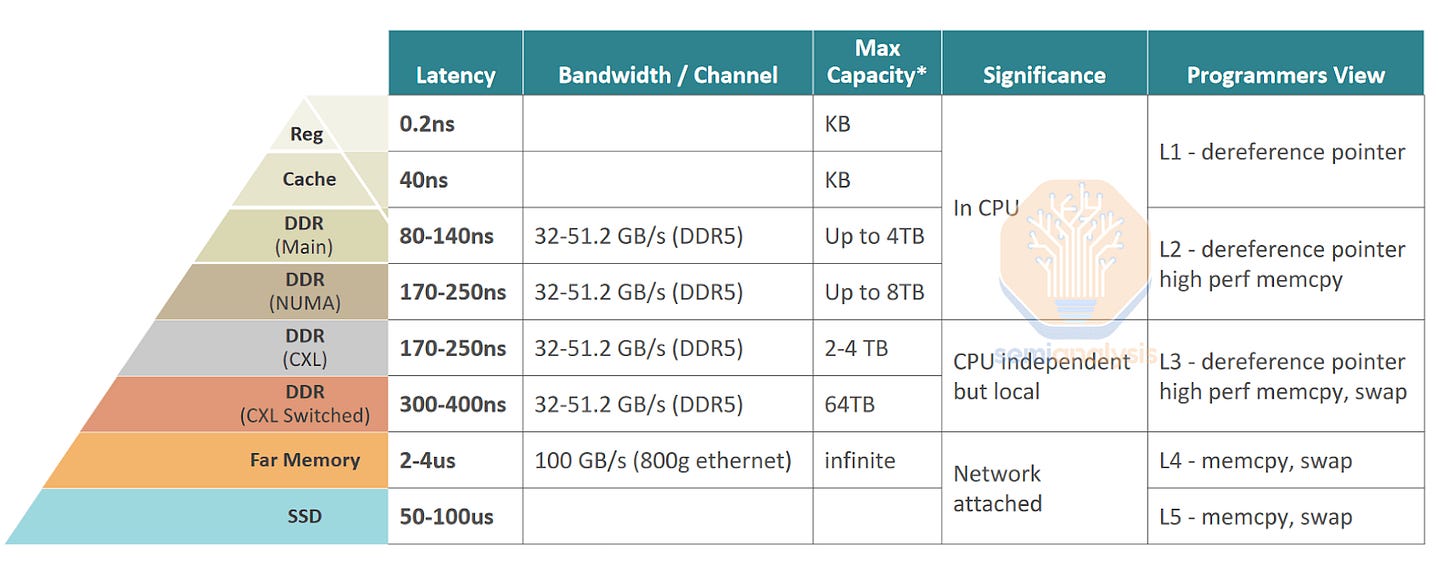
To prevent damaging oversupply cycles, supply has traditionally been increased at a very gradual pace. However, as AI-driven demand exploded virtually overnight, all forms of memory rapidly transformed into critical operational bottlenecks. This sudden shift has granted memory manufacturers significant pricing leverage over their downstream customers.
This newly unlocked pricing leverage has enabled memory players to record skyrocketing profits, establishing them as the absolute gatekeepers of the AI supply chain. The underlying operational reality is stark: advanced graphics processing units without high-performance memory are rendered entirely useless. No computation can occur without memory to feed it.
The underlying technological moat protecting these manufacturers is formidable. The memory business is fundamentally a game of producing billions of microscopic cells reliably, at a massive industrial scale, and often operating on razor-thin cyclical margins. For HBM specifically, success requires advanced DRAM fabrication coupled with complex three-dimensional packaging techniques—including through-silicon vias, advanced thermal management solutions, and silicon interposers—that only a handful of global enterprises can execute at acceptable production yields. Furthermore, customers must undergo lengthy, rigorous validation cycles before integrating these parts into production systems.
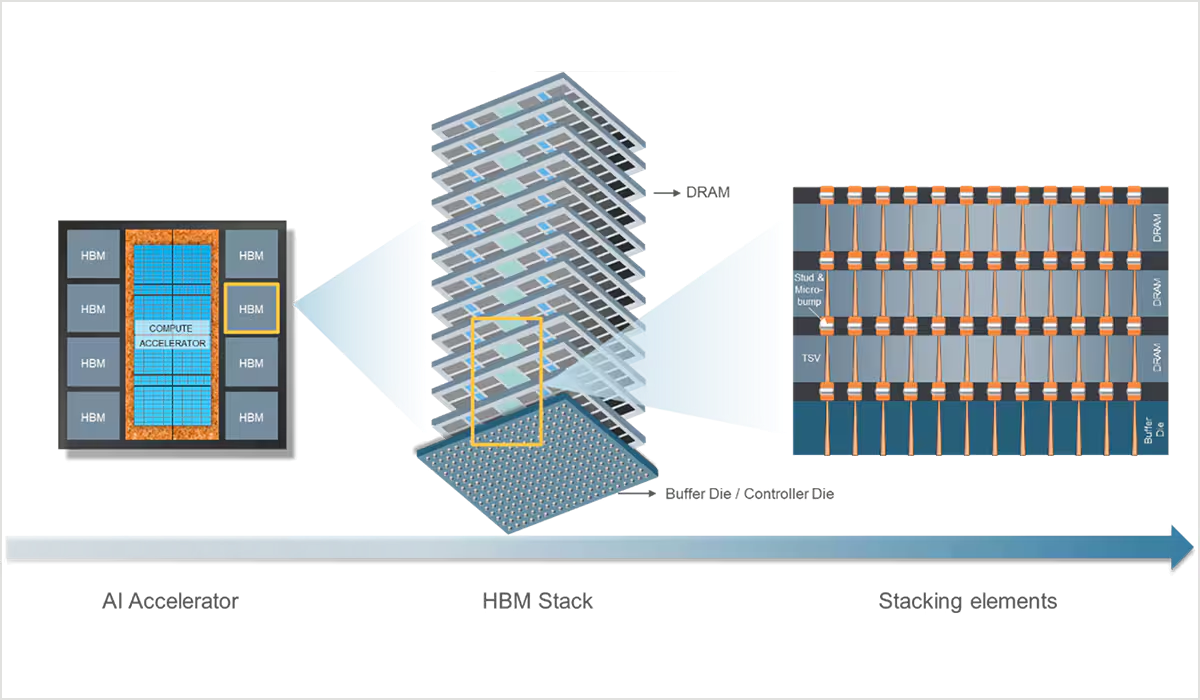
It is precisely for this reason that only three primary global companies currently qualify to compete at the bleeding edge of HBM production. Leadership shifts in this space carry profound market implications; whichever vendor successfully ships next-generation memory stacks earlier gains a decisive competitive advantage in perfecting the manufacturing processes for subsequent iterations. Moreover, HBM is structurally premium-priced compared to legacy DRAM because it is physically co-packaged alongside the processor rather than functioning as a homogenous commodity.
Constructing a new memory enterprise capable of competing at the scale of current market leaders would demand over two decades of accumulated engineering expertise and north of $50 billion in capital expenditure. While regional players like China’s YMTC have made strides in catching up with legacy DRAM manufacturing processes, they have consistently struggled to achieve high production yields without heavy government subsidization. Furthermore, these entities remain strictly locked out of advanced semiconductor manufacturing capabilities due to sweeping material and technology export restrictions imposed by the United States.
Beyond physical hardware constraints, the memory ecosystem relies on deep chains of software, including specialized chip firmware that demands sophisticated systems integration. State-backed competitors attempting to break into the market must overcome these deeply entrenched software lock-ins alongside an array of daunting physical engineering hurdles. As a result, incumbent memory corporations are far more defensible today than at any previous point in their corporate lifecycles.
The Memory Wall and the Future of the AI Supercycle
Raw computational power has scaled at a pace significantly faster than memory’s fundamental ability to move data around—a persistent engineering hurdle widely known throughout the industry as the "memory wall." Modern processors are fully capable of executing mathematical operations at astonishing speeds, but they inevitably stall if data cannot physically reach the execution units quickly enough.
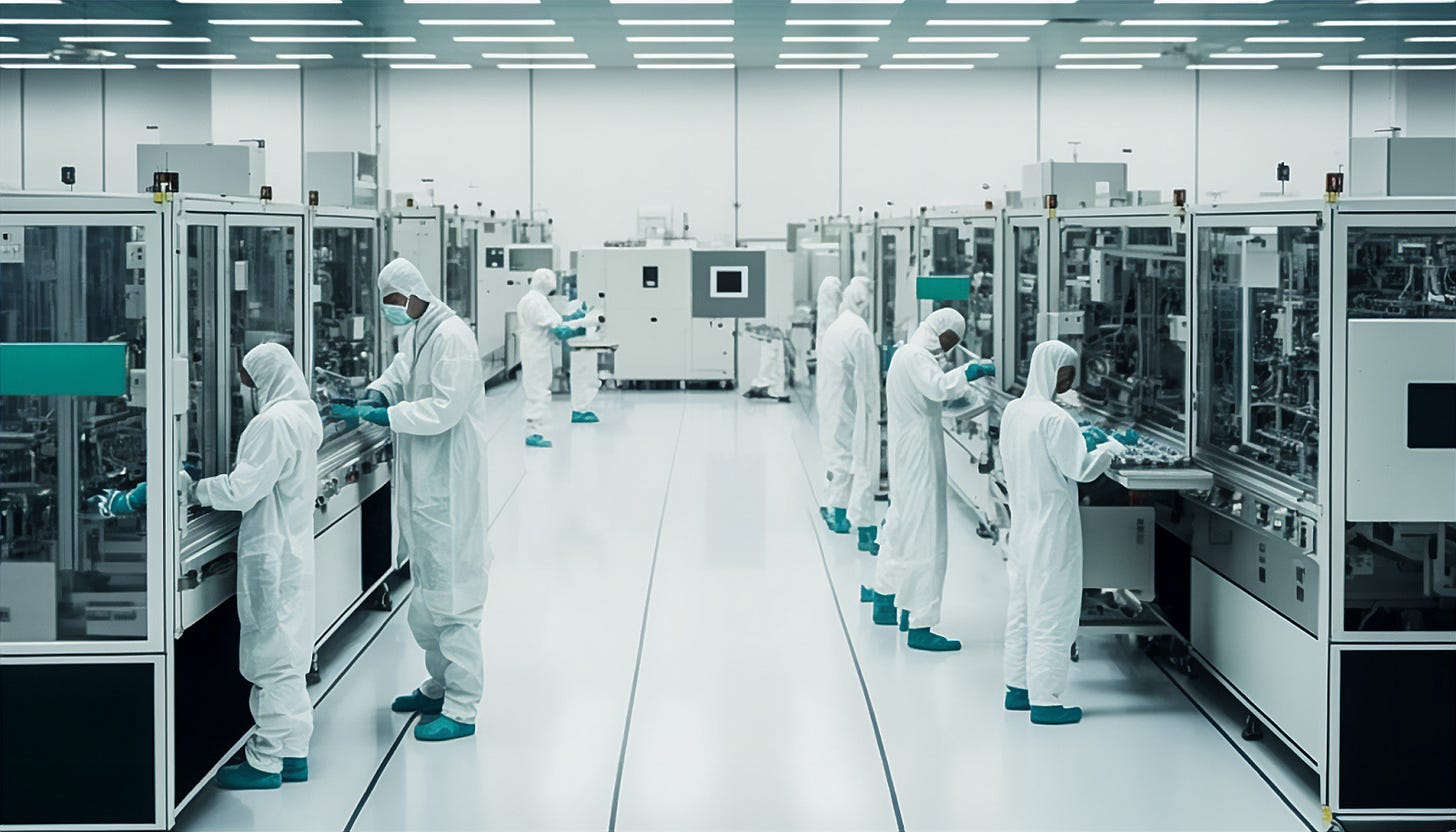
A substantial portion of total operating time and energy expenditure is dedicated entirely to shuttling model weights and activation states back and forth between memory and compute resources, rather than performing the actual mathematical calculations. Consequently, memory bandwidth has established itself as the definitive governor of system performance.
High Bandwidth Memory represents the current industry-standard workaround because it places wide, ultra-fast memory directly beside the AI processor. Yet, because HBM remains intensely capacity-constrained and supply-constrained, memory ultimately dictates the precise pace at which global artificial intelligence systems can scale.
What the technology sector is experiencing is a historic bottleneck controlled by a mere handful of companies holding the exclusive manufacturing specialization required to build the memory chips powering the future of AI. Beyond corporate productivity and commercial applications, this dynamic is slowly bleeding into the realm of national security, as these advanced silicon components increasingly enable next-generation defense and computational capabilities.
For market participants operating on the premise that artificial intelligence is a permanent structural shift, and that the computational demands of AI will only escalate over time, the long-term outlook highlights these decades-old semiconductor institutions. Once dismissed as producers of volatile commodities, they now control the core chokepoint of the global AI buildout. Their immense, newly acquired pricing power has already begun to squeeze profit margins across downstream customer supply chains—a deflationary pressure on buyers that analysts expect to persist. As the global economy undergoes a profound structural transformation, the memory sector stands as one of the earliest and most unmistakable indicators of a shifting industrial order.



Comments (0)