


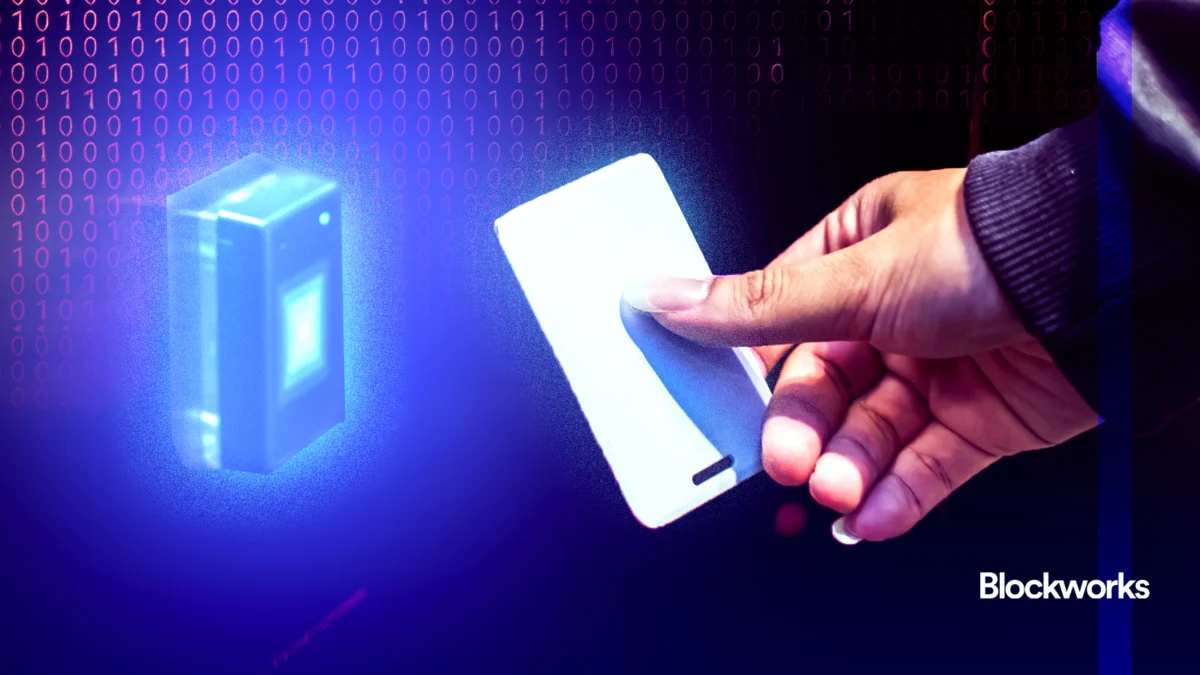
In the opening scene of Philip K. Dick’s 1969 science fiction classic Ubik, the protagonist, Joe Chip, faces a distinctly modern-feeling nuisance. Behind on his rent and short of cash, he attempts to open his apartment door for an incoming guest, only to be stopped cold by a synthesized voice demanding payment: “Five cents, please.” When Chip explains that his credit score is currently ruined and tries to reason with the mechanical barrier, pointing out that what he pays is more in the nature of a gratuity rather than a fixed obligation, the door remains entirely unimpressed. It smugly instructs him to check the fine print of his lease. When Chip resorts to unscrewing the bolt mechanism with a knife, the door calmly threatens legal action—prompting Chip to quip that he has never been sued by a door, though he imagines he can survive it. Before any real damage can be done, his guest steps in, pays the fee from the outside, and finally allows him to pass.
Later in the narrative, the apartment’s refrigerator, coffee maker, and shower all demand micro-payments before rendering their respective services, transforming a simple living space into an automated pay-as-you-go vending machine. For decades, this scenario stood as a quintessential example of dystopian corporate overreach in speculative fiction. Yet, as the financial technology landscape evolves, a remarkably similar architecture is emerging as a potential utopian framework for decentralized finance (DeFi). The core ambition of decentralized finance has always been to transform every conceivable asset into a programmable financial instrument capable of automatically executing and enforcing the precise terms of its own contract without human intermediaries.
The persistent bottleneck for this burgeoning industry, however, has been its strict confinement to native crypto assets. Traditional smart contracts executed on blockchains like Ethereum operate entirely within a digital vacuum; they lack the physical capability to reach out into the tangible world to repossess an automobile, evict a defaulting tenant, or physically bar entry to a home. But what if a smart contract could dynamically lock and unlock the physical door to a house, a car, or a commercial refrigerator? In that scenario, lenders could confidently accept real-world assets—virtually anything equipped with a remotely controllable lock—as ironclad collateral against onchain loans, opening up vast new horizons for capital formation and liquidity.
This concept is far from entirely novel. Way back in 1997, cryptographer and legal scholar Nick Szabo articulated the immense utility of evolving smart contracts into physical smart locks. Writing foundational papers on the architecture of digital contracts long before the invention of Bitcoin or Ethereum, Szabo described how various contractual clauses, including collateralization, bond postings, and the explicit delineation of property rights, could be embedded directly into the hardware and software systems governing everyday objects. By doing so, breaching a contract becomes economically and physically burdensome, if not entirely prohibitive, for the offending party. These protocols would dynamically allocate control of the cryptographic keys required to operate a physical piece of property strictly to its rightful owner, governed entirely by the programmatic terms of the underlying financial agreement.
Up to this point, the property governed by such cryptographic rules has remained almost exclusively limited to digital tokens, largely because tokens are the only assets whose complete ownership structure can be seamlessly native to smart contracts. However, the integration of smart locks controlled by verifiable, immutable, and autonomous rules could effectively turn large swathes of the physical world into an interconnected network of automated vending machines. Szabo famously referred to the humble vending machine as the primitive ancestor of the modern smart contract—a mechanical apparatus that safely holds a physical asset, such as a can of soda, and unhesitatingly releases it to any individual who satisfies the deterministic conditions of the contract by inserting the required coin, eliminating the need for a human or corporate shopkeeper.
In Szabo’s vision, the rules-based machine effectively becomes the shopkeeper, much like the demanding smart door in Philip K. Dick’s novel assumed the role of an uncompromising landlord. Sixteen years before the activation of the Ethereum network, Szabo envisioned these smart locks granting automated digital control over real-world property, pointing to automobiles as the most straightforward and immediate application of the concept. He proposed the creation of a smart lien protocol: if an owner fails to meet their scheduled financing payments, the smart contract automatically invokes the lien protocol, instantly returning the control of the car keys and ignition permissions back to the issuing financial institution.
While a frictionless, fully decentralized version of that exact protocol has taken years to materialize, Szabo’s core thesis was directionally correct on two major fronts. First, advanced smart contract platforms exist and process billions of dollars daily. Second, traditional auto-loan lenders have independently adopted remote locking technology to secure their underlying physical collateral. Over the past couple of decades, starter interrupt devices (SIDs) have surged in popularity among sub-prime auto lenders. These hardware units allow lenders to remotely disable a vehicle’s ignition system the moment a borrower falls behind on their loan installments, mitigating default risks in high-risk lending environments.

This modern reality, however, introduces significant friction and ethical dilemmas. If a borrower’s vehicle is suddenly disabled, they may find themselves unable to commute to work, crippling their ability to earn the very income required to catch up on their overdue loan. The situation becomes even more precarious if a driver is traveling at highway speeds when a lender decides to execute a remote shutdown. Unlike Joe Chip’s fictional door, a driver stranded by a SID-disabled car cannot simply drop coins into the dashboard to restore functionality, nor can they easily reach a human customer service representative at a massive lending institution to plead their case or process an immediate override.
An onchain financial infrastructure could theoretically solve this rigid operational bottleneck. With a smartphone-based digital wallet connected to a blockchain, a borrower could instantly execute a payment via a smart contract to re-enable their vehicle the moment funds become available, bypassing bureaucratic delays entirely. This intersection of physical locks and blockchain protocols has been attempted before. Back in 2015, a high-profile venture named Slock.it promised precisely the kind of decentralized digital locks that Joe Chip negotiated with in fiction, asserting that a tenant renting a property would pay directly to the lock itself, which would independently execute a smart contract with the occupant.
Although Slock.it ultimately failed to achieve widespread commercial production—distracted in part by a side project known as The DAO, which nearly destabilized the nascent Ethereum ecosystem—the broader thesis may have simply arrived ahead of its time. If those early pioneers were merely early adopters, the current market environment suggests that the timing for blockchain-backed smart locks might finally be aligning. Today, the foundational infrastructure is robust: underlying blockchains are fast, transaction fees are low, and user-facing frontends have matured significantly in terms of design and accessibility.
Simultaneously, traditional finance institutions have doubled down on the mandate to tokenize everything. Even as native crypto asset markets experience periods of consolidation or volatility, institutional enthusiasm for bringing real-world assets onchain has accelerated exponentially. Investors across the global economy are perpetually searching for alternative yield-bearing assets, driven by an insatiable demand for productive returns outside the increasingly crowded and expensive universe of public equities. Smart contract-enabled physical locks could serve as the crucial technological bridge to unlock these productive assets at scale.
Consider emerging markets facing severe inflationary pressures, such as Turkey, where retail borrowers routinely encounter auto loan interest rates reaching 5% per month. This translates to an annualized borrowing cost exceeding 100%, vastly outstripping local inflation figures. If those high-yield auto loans were successfully tokenized and governed by immutable smart contracts capable of automatically managing collateral rights and vehicle access upon default, they could attract a global pool of liquidity-seeking investors searching for compelling risk-adjusted yields. BlackRock executives, including CEO Larry Fink, have repeatedly emphasized that tokenization holds the profound potential to dramatically expand the universe of investable assets far beyond the traditional listed stocks and bonds that currently dominate global financial markets.
Philip K. Dick predicted the behavioral and societal implications of automated property rights in science fiction, while Nick Szabo meticulously wrote the technical manual for their implementation in computer science. As global finance continues its march toward digitization, the industry now faces the task of building the infrastructure required to open the door to this ambitious onchain future.



Comments (0)