


Every few weeks, the technology world witnesses the launch of yet another state-of-the-art large language model, greeted by digital media feeds calling it an unprecedented revolution. When viewed in isolation, these rapid-fire releases often resemble confusing noise rather than a coherent path forward. Yet beneath the complex technical jargon, continuous benchmark updates, and corporate rivalries lies a remarkably simple narrative. Every major milestone in the evolution of modern artificial intelligence over the past eight years can be traced back to a fundamental shift in a single strategic decision: determining what the model is explicitly trained to do.
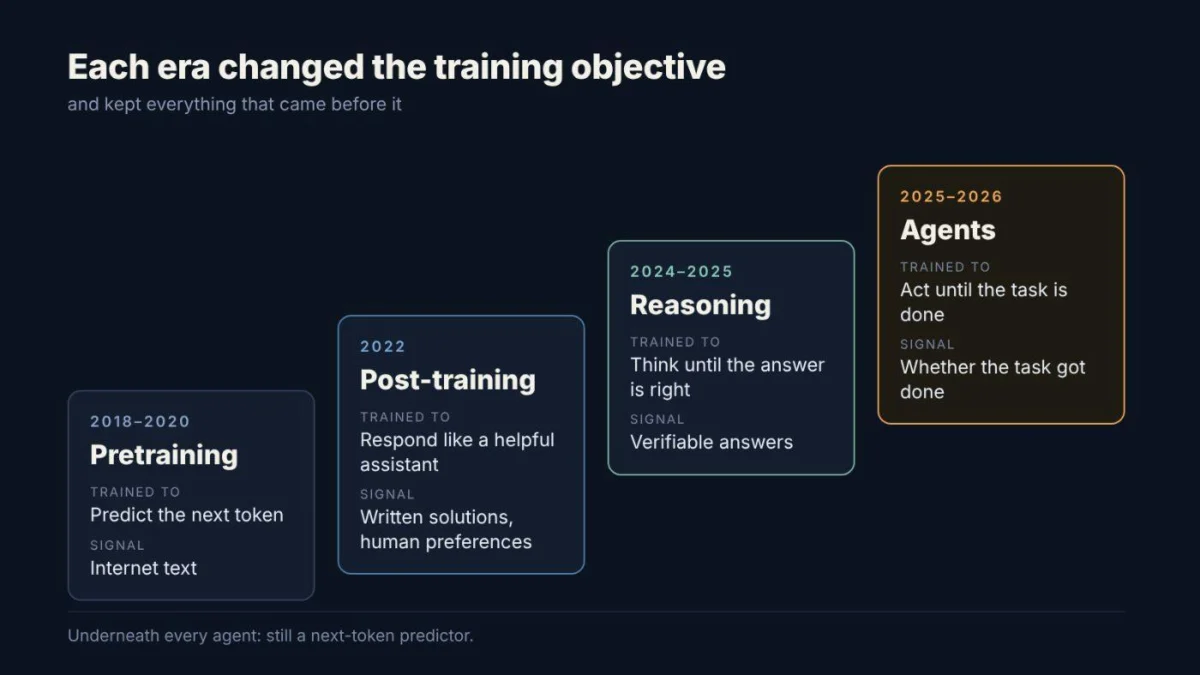
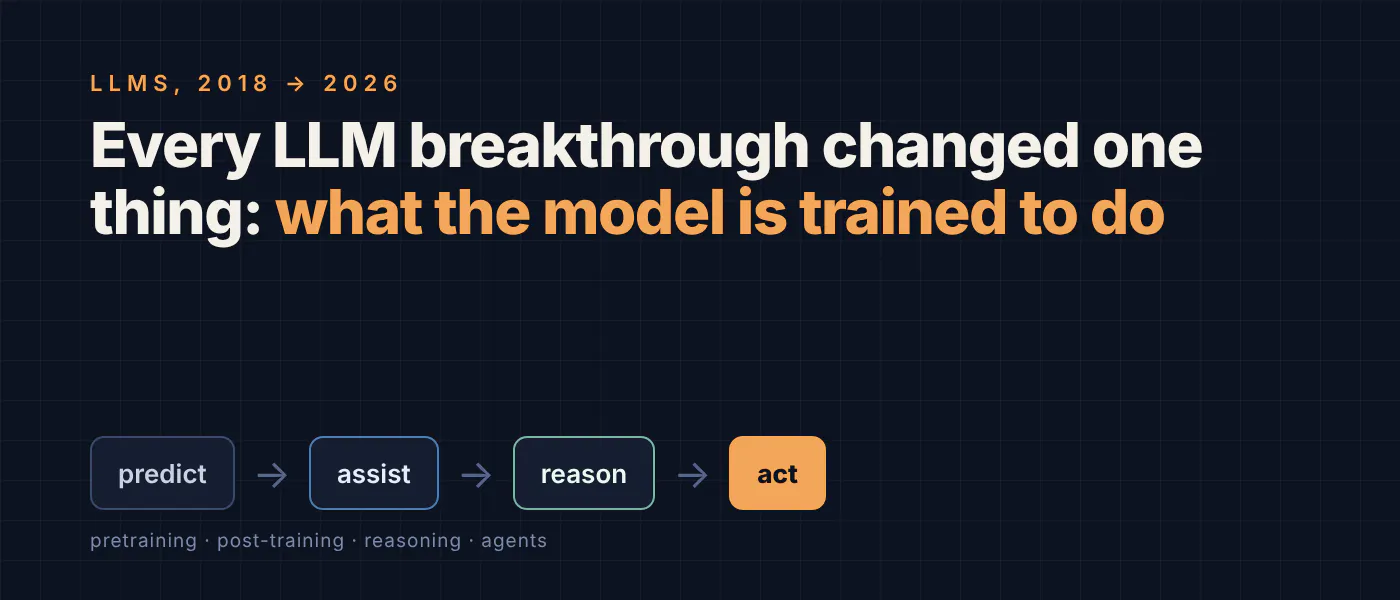
From the debut of early transformer architectures to today’s autonomous software agents, the fundamental mechanism of AI has never truly been thrown away. Instead, each major developmental leap has preserved everything that came before while layering a new training objective on top. Next-token prediction first equipped models with a foundational understanding of human language and worldly facts. Post-training transforms raw statistical engines into compliant, helpful assistants. Advanced reinforcement learning techniques taught these systems how to pause and think logically before generating a response. Finally, the integration of external tools and environment interactions elevated models into autonomous agents capable of executing complex, multi-step workflows.
Act 1: Predict the Next Token (2018 to 2020)
The modern era of large language models truly began with a deceptively simple premise: train a neural network to predict the next word in a sequence. Released in 2018 by OpenAI, GPT-1 was a relatively modest 117-parameter transformer model trained on an unsupervised dataset consisting of roughly 7,000 books. Its singular objective was straightforward text prediction. However, to accomplish this task effectively, the model was forced to independently internalize the intricate rules of grammar, factual knowledge about the world, and semantic meaning. When fine-tuned on smaller, task-specific labeled datasets, GPT-1 managed to outperform purpose-built architectures on nine out of twelve standard benchmarks, proving that next-token prediction was a remarkably potent engine for language acquisition.
By 2019, OpenAI introduced GPT-2, scaling the parameter count to 1.5 billion and feeding the network approximately 40 gigabytes of diverse web text. Without requiring any task-specific fine-tuning, GPT-2 began exhibiting zero-shot capabilities, demonstrating an emergent ability to summarize articles, translate between languages, and answer general knowledge questions. While the generated outputs were often rough around the edges, they offered the first compelling hint that raw scale alone could unlock entirely new capabilities within a transformer architecture.
The culmination of this foundational era arrived in 2020 with the release of GPT-3. Boasting 175 billion parameters, the model eliminated the need for fine-tuning altogether. Users could teach the network a new task simply by providing a natural language description and a few contextual examples directly inside the prompt. Empirical scaling laws demonstrated during this period confirmed that larger models would continue to improve in a predictable, linear fashion.
Despite these triumphs, next-token prediction carried a glaring limitation. The objective taught a model what human text typically looked like, rather than dictating how a system should usefully respond. Pretrained models were notorious for rambling, hallucinating facts, misinterpreting nuanced instructions, or completing harmful prompts instead of refusing them. The underlying capabilities were undeniably present within the network weights, but they lacked a clear, productive direction.
Act 2: Be a Helpful Assistant (2022)
The industry-wide solution to the limitations of raw pretraining introduced a critical second developmental phase known as post-training. OpenAI formalized this approach with InstructGPT in 2022, utilizing a multi-step recipe that involved collecting human demonstrations of desired behavior, training a reward model based on human preferences, and optimizing the language model via reinforcement learning.
The practical impact of this shift was both immediate and dramatic. Human evaluators consistently preferred the outputs of a relatively small 1.3-billion-parameter InstructGPT model over the vastly larger 175-billion-parameter GPT-3. This proved conclusively that employing the correct training objective could easily outweigh a hundredfold increase in raw model parameters.
In November 2022, OpenAI applied this refined post-training methodology to a dialogue-tuned version of GPT-3.5, releasing the application to the public as ChatGPT. Rather than endlessly completing text prompts, the interface answered direct questions concisely, recognized boundaries by declining malicious or harmful requests, and captured the global imagination by reaching an estimated 100 million active users in roughly two months. From that moment forward, the most significant competitive advantages and performance leaps in artificial intelligence occurred after the completion of the foundational pretraining phase.
Act 3: Think Before You Answer (2021 to 2025)
While conversational assistants made AI accessible to the general public, tackling rigorous domains like advanced mathematics and computer programming required an entirely new cognitive tier. Between 2021 and 2024, artificial intelligence research laboratories poured resources into specialized architectures, moving from early models like Codex to automated math verifiers and step-by-step verification frameworks.
Mathematics and software engineering share a unique, highly advantageous property: generated solutions can be evaluated automatically. A mathematical proof either resolves correctly or it contains an error; computer code either successfully passes its automated unit tests or it fails. This structural reality provides a remarkably cheap and reliable reward signal for reinforcement learning loops without requiring expensive human annotators. This specialized paradigm is now widely recognized as reinforcement learning with verifiable rewards, a term formally coined by the Tulu 3 team at the Allen Institute for AI in 2024.
This foundational work paved the way for dedicated reasoning models, epitomized by OpenAI’s o1 release in September 2024. Trained via large-scale reinforcement learning, these models learned to generate extensive internal chains of thought—proposing hypotheses, systematically catching logical errors, and backtracking when a path proved unsuccessful. Every user interaction effectively bifurcated into a hidden computational scratchpad followed by a finalized response.
While technically processed as a single continuous text generation, this mechanism fundamentally changed how artificial intelligence systems scale. Labs could now invest substantial compute resources at inference time when the model is actively answering a prompt, rather than relying solely on pretraining compute. In January 2025, DeepSeek-R1 demonstrated within the open-source community that pure reinforcement learning driven by simple rule-checked rewards was entirely sufficient for long-form reasoning capabilities to emerge organically.
Act 4: Act Until the Job is Done (2023 to 2026)
Even advanced reasoning models, however, remained fundamentally constrained by operating exclusively within a text-based environment. They could analyze problems and synthesize arguments, but they could not independently look up live information, execute computer code to verify hypotheses, or interact with external software systems. The subsequent evolution naturally migrated reasoning capabilities from a purely text-based space into an active operational space: allowing a model to think, execute an external action such as searching a database or running a terminal command, observe the resulting feedback, and iteratively repeat the cycle until a given objective was fully achieved.
This operational paradigm traces its academic origins back to the ReAct framework introduced in late 2022. The practical implementation of function calling streamlined the approach throughout 2023, while architectural standards like the Model Context Protocol introduced in late 2024 provided models with a standardized, secure method for connecting to external tools and enterprise data repositories. By 2025, frontier systems developed by major laboratories were routinely executing complex tool calls embedded directly within their hidden reasoning pathways.
Autonomous agents rapidly began dominating specialized domains, transforming software development, data analysis, customer support operations, and research workflows. The primary deliverable provided to users shifted away from a conversational text response and transformed into finished, executed work.
Where We Are Now and Why It Happened
Progress across the artificial intelligence landscape has shown no signs of plateauing. Modern frontier models regularly achieve scores exceeding human expert levels on complex scientific benchmarks and professional examinations. Yet the frontier remains jagged and unpredictable; a system capable of answering PhD-level physics inquiries can still occasionally struggle with basic visual tasks like reading an analog clock.
The rapid transformation from GPT-1 to general-purpose autonomous agents in under a decade rests upon three foundational pillars. First, engineering breakthroughs in model capacity ensured networks were large enough to represent complex patterns. Innovations such as residual connections introduced in 2015 allowed signals and gradients to bypass intermediate layers safely, preventing ultra-deep networks from destabilizing during training. Combined with effective normalization layers and improved optimizers, these architectural enhancements ensured clean information flow throughout massive neural networks.
Second, the availability of comprehensive training data dictated which skills a model could potentially internalize. Much of the progress achieved since 2018 is fundamentally rooted in the meticulous curation of specialized datasets designed for novel task categories.
Third, the evolution of the training objective continuously redefined what models learned from that data. While supervised fine-tuning relied heavily on the quality of written demonstrations, reinforcement learning introduced dynamic reward signals and detailed evaluation rubrics. Because objectives and data are inextricably linked, the true engine of modern artificial intelligence progress remains the deliberate design of data structures that effectively encode the correct goals.
Despite all these profound architectural advancements, nothing along the path has been discarded. Every autonomous agent deployed in production today remains, at its deepest core, a next-token predictor.
Looking ahead, the trajectory of the field is well-defined. As researchers continue introducing new dataset typologies and refining training objectives, the operational capabilities of artificial intelligence will continue to expand. Significant engineering challenges remain, particularly regarding reliability on extended workflows where an agent must maintain high success rates over hours or days of continuous operation rather than single interactions. The defining characteristics of the next generation of artificial intelligence will depend far less on merely building larger parameter counts and far more on perfecting the objectives that govern how agents are rewarded and how their work is verified.



Comments (0)