


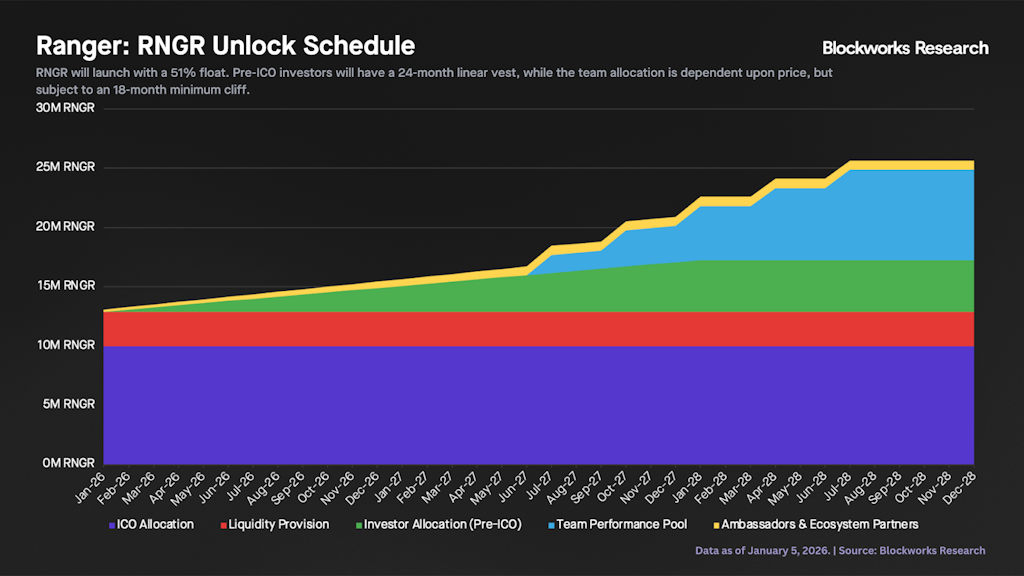
Beyond Ranger’s operational scope, the ICO represents a structural milestone for MetaDAO. It stands as the platform’s very first token sale to feature a project that includes existing pre-ICO investors. The supply distribution outlines a clear distinction between participants: ICO participants who successfully secure an allocation will enjoy 100% liquidity at the Token Generation Event with zero vesting restrictions. Conversely, pre-ICO investors are subject to a 24-month linear unlock schedule with no cliff.
The tokenomics of the Ranger offering also introduce a performance-tied pool for the core team. Up to 7.6 million RNGR tokens, representing 30% of the total supply, become unlockable for the team through five distinct milestone tranches. These are triggered when the token price reaches 2x, 4x, 8x, 16x, and 32x of the initial ICO price. To prevent market manipulation or flash pumps, each milestone must be maintained via a three-month Time-Weighted Average Price, accompanied by a strict minimum 18-month cliff before any team tokens can actually be unlocked. Realized team unlocks will ultimately depend on sustained post-ICO price performance.
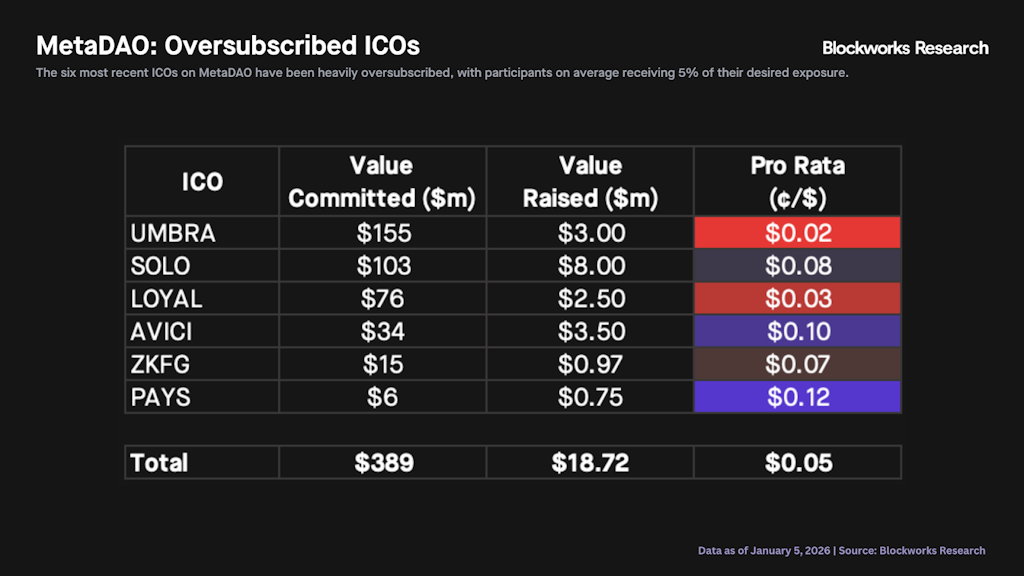
The launch mechanism itself arrives against a backdrop of heavily oversubscribed sales on MetaDAO. The platform’s previous six ICOs experienced immense demand, forcing allocations to be settled on a pro-rata basis. This specific allocation mechanic inherently favors institutional participants and well-capitalized whales who possess the financial capacity to overcommit capital simply to secure a meaningful stake. Across those six previous MetaDAO token sales, general participants received an average of roughly 5% of their desired exposure.

To mitigate this friction, Ranger has implemented a dedicated allocation bucket to guarantee point holders access to the ICO. This structure directly addresses the historical oversubscription dynamic by rewarding early users and active contributors with preferential access. Rather than relying on a traditional airdrop—which often distributes 10% to 30% of a project’s supply upfront, inviting immediate sell pressure and weaker long-term alignment—the point-holder bucket fosters healthier community retention. Any allocation left unclaimed by point holders will automatically roll over and be distributed pro-rata to public ICO buyers.
While Ranger’s ICO offers a compelling structure for market participants, industry observers note that the broader significance lies in what the event signals for MetaDAO as a whole. The launch serves as a potential catalyst capable of reaccelerating both launch cadence and protocol revenue as the market moves further into the year.
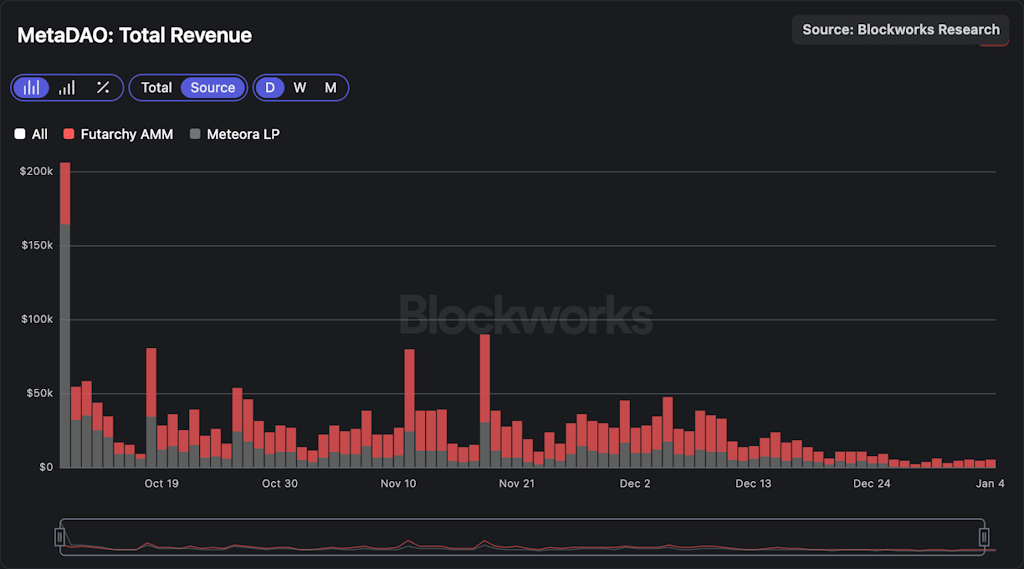
MetaDAO monetizes its ICO infrastructure primarily through swap fees collected on its Futarchy Automated Market Maker and via its Liquidity Provider position on Meteora. The Futarchy AMM originally charged a 0.5% fee on volume, split evenly between MetaDAO and the specific project conducting the raise. However, following mutual agreements with project teams, that split was retroactively adjusted on December 28 so that the full 0.5% fee now accrues directly to MetaDAO.
Since the Futarchy AMM went live on October 10, MetaDAO has generated approximately $2.4 million in total revenue. Roughly 60% of that figure has been driven by the Futarchy AMM, with the remaining 40% originating from its Meteora LP position. Despite this solid foundation, MetaDAO’s revenues have experienced a sharp contraction since mid-December as overall ICO activity temporarily slowed down.
In its current operational phase, MetaDAO maintains a highly curated approach to its token sales. Leadership has placed far greater emphasis on founder quality, operational credibility, and long-term ecosystem alignment than on simply maximizing the sheer volume of token launches. While this deliberate selectivity was crucial for validating the product and building initial trust, it introduced a clear operational tradeoff. Without a steady, uninterrupted stream of new launches, maintaining revenue growth has proven challenging, leading to a dip in platform cadence over the final weeks of the previous year.
Token trading volumes across decentralized exchanges naturally tend to peak around the Token Generation Event and the immediate days following it. Consequently, sustained Futarchy AMM trading volumes—and by extension, protocol revenues—remain heavily dependent on a continuous pipeline of fresh launches.
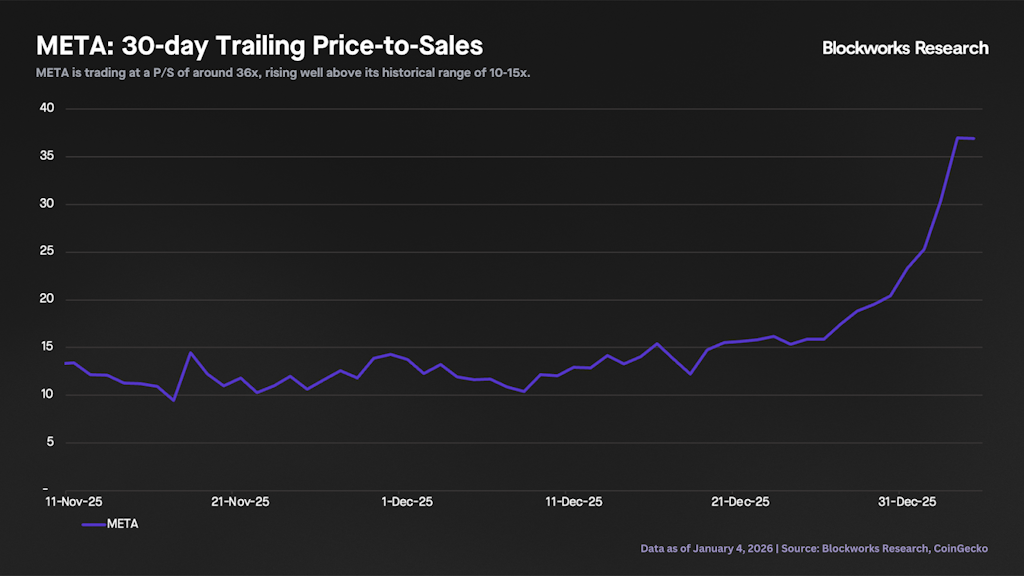
Despite the recent moderation in daily revenue, META token performance has remained exceptionally resilient, rallying roughly 40% over the course of a single week. This price movement pushed META’s 30-day trailing price-to-sales ratio to approximately 36x, sitting well above its historical two-month range of 10x to 15x. Because cryptocurrency markets operate on forward-looking expectations, analysts anticipate that this elevated price-to-sales multiple will naturally compress back toward historical norms over the coming weeks and months, driven primarily by reaccelerating protocol revenues rather than a decline in token valuation.
Near-term growth catalysts are multifaceted. The immediate driver is the Ranger ICO itself, which is widely expected to achieve oversubscription and generate a surge in Futarchy AMM trading volumes post-TGE. Beyond that, the passage of the Omnibus proposal establishes new operational parameters for the ecosystem.
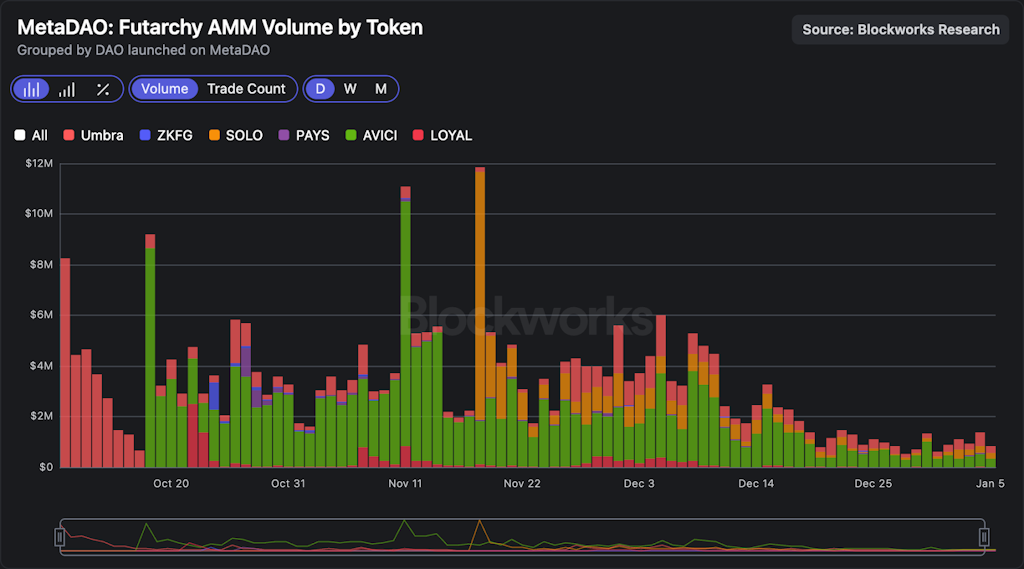
Looking further ahead into the coming months, market watchers expect MetaDAO’s overall revenues to trend upward as launch cadence expands significantly. Two major structural catalysts are expected to drive this shift: the introduction of permissionless launches and the integration of Colosseum’s STAMP initiative.
MetaDAO has engaged in extensive public community debates regarding whether to preserve its fully curated model or experiment with permissionless token launches. While permissionless launches carry inherent risks regarding lower-quality projects, they represent a necessary experiment for testing throughput, scaling platform infrastructure, and proving long-term viability.
Simultaneously, market participants may be underpricing the profound impact that Colosseum’s STAMP could have on MetaDAO’s trajectory. Colosseum operates upstream within the broader Solana startup funnel, managing hackathons, a dedicated accelerator program, and a venture fund. Many of the Solana ecosystem’s most prominent protocols—including Jito, Kamino, Drift, Exponent, and Hylo—trace their foundational origins back to these exact hackathons.
By integrating STAMP, MetaDAO effectively plugs directly into that robust deal flow pipeline. This connection promises a steadier, higher-quality stream of project launches that can seamlessly complement permissionless ICOs, ultimately normalizing launch cadence over time. While the Ranger ICO and recent governance approvals provide the immediate spark for revenue reacceleration, permissionless launches and the Colosseum partnership stand out as the foundational elements capable of driving a dramatic expansion in MetaDAO’s overarching ecosystem activity in the months ahead.




Comments (0)