



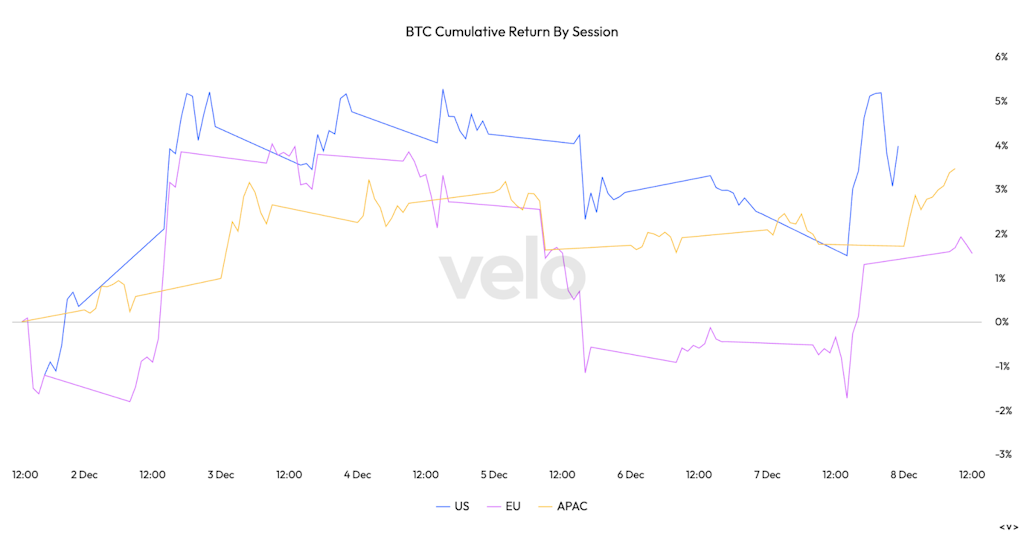
The cryptocurrency market has experienced a notable recovery over the past week, with Bitcoin bouncing back from lows of $85,000 to trade near the $92,000 threshold. Despite this recent upward momentum, digital assets have navigated a landscape of pronounced volatility over the preceding three weeks, posting an overall gain of roughly 5%. Market analysts observing regional trading patterns have noted a distinct divergence in performance across global financial hubs. Specifically, Bitcoin has tended to underperform during the European trading session, while consistently finding renewed strength and outperformance during the US and Asia-Pacific sessions.

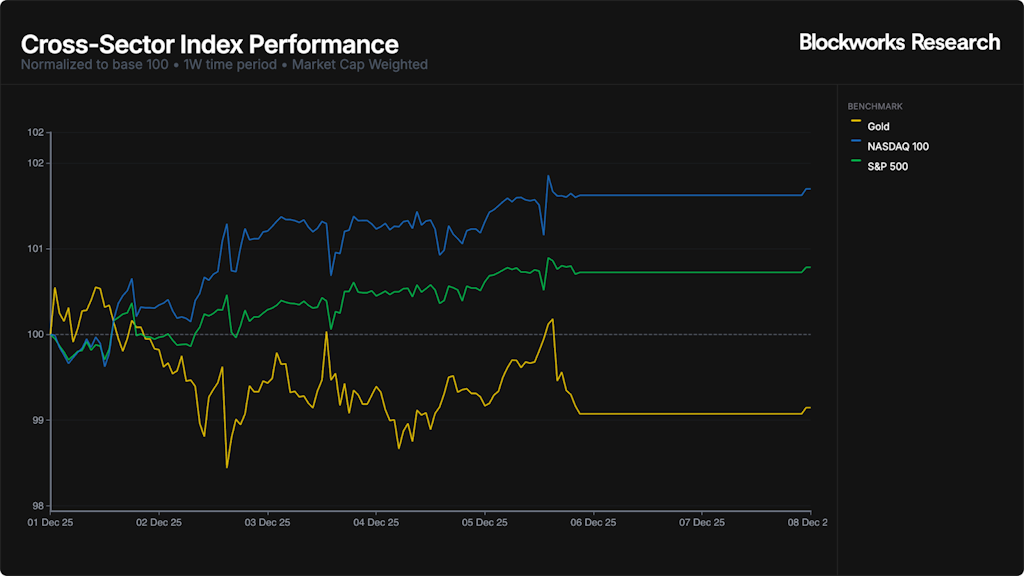
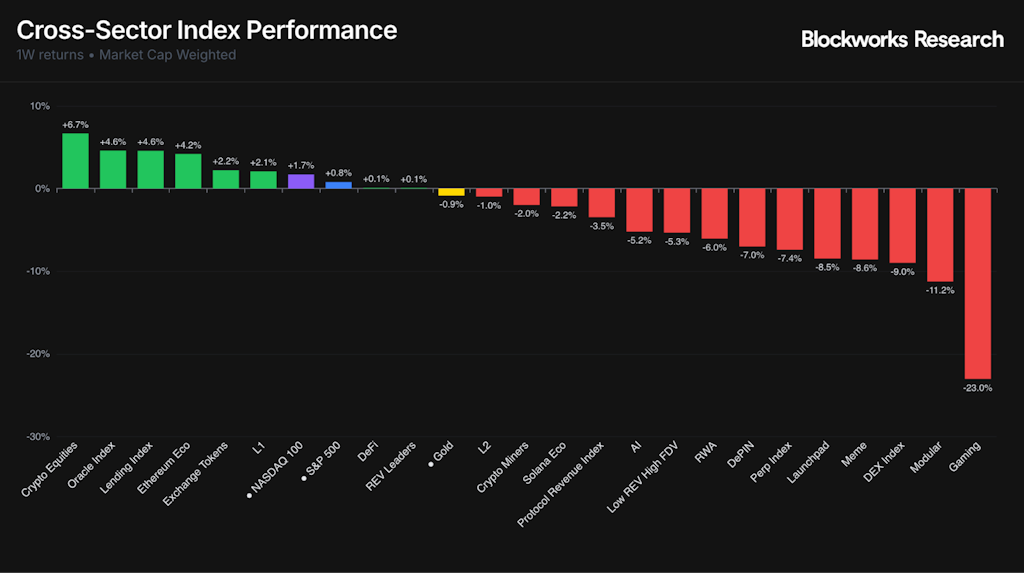
Broader traditional markets have provided a supportive backdrop for risk assets during this period. The Nasdaq 100 has continued its steady upward trajectory, gaining 1.70%, while the S&P 500 has added 0.78%. In contrast, traditional safe-haven assets like gold have faced slight downward pressure, underperforming with a decline of 0.85% over the course of the week.
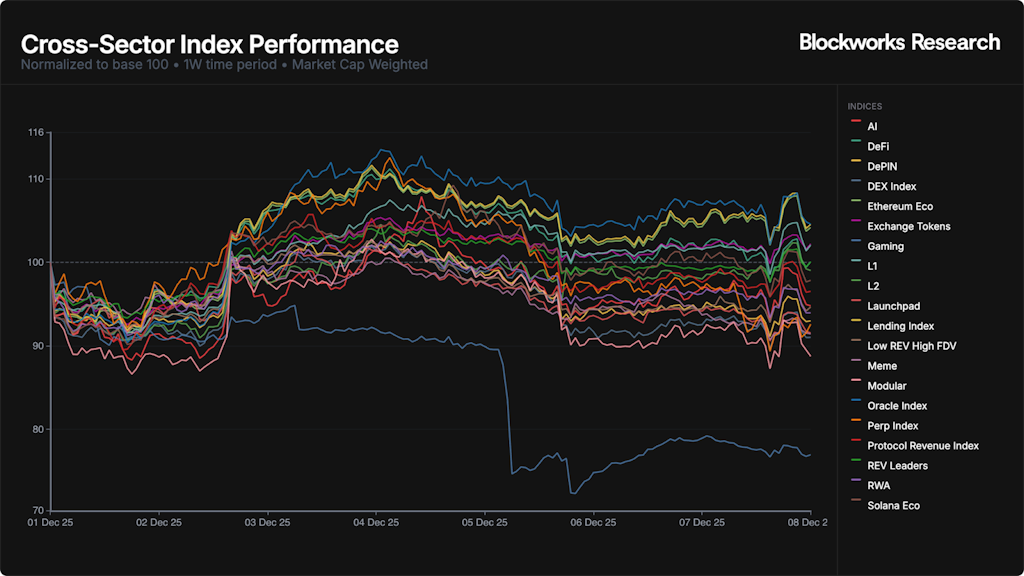
Within the digital asset ecosystem, sector performance has varied significantly. Over the past week, oracles, lending protocols, and Ethereum ecosystem tokens demonstrated resilience and solid investor interest, with each category posting gains of just over 4%. Meanwhile, crypto-linked equities emerged as the top-performing segment, rising by 6.7%. This outperformance in the equity sector was primarily driven by strong individual momentum from Robinhood shares. On the opposite end of the spectrum, the gaming sector suffered severe downside pressure, plunging by an average of 23% over the week. Gaming token LGCT bore the brunt of the sell-off, experiencing a dramatic price contraction of 75% over the same timeframe.
Political speculation and macroeconomic policy expectations have also heavily influenced market sentiment. Prediction markets, notably Kalshi, indicate that betting odds have surged to 78% in favor of Kevin Hassett becoming President Donald Trump’s next nominee for Chair of the Federal Reserve. This potential appointment has gained traction following confirmation from the White House that an announcement regarding the leadership position is imminent. Hassett, recognized as a close ally of the administration, is widely favored by policymakers who align with the president’s persistent calls for significantly lower interest rates. Proponents of this economic stance argue that looser monetary policy is necessary to stimulate consumer borrowing by providing cheaper loans and mortgages.
The shifting macroeconomic landscape coincides with a notable pivot in institutional investment products. Bitcoin exchange-traded funds experienced a sharp reversal of fortune in November, posting significant net outflows that completely interrupted the steady accumulation trend observed from May through October. The month of November alone witnessed approximately $3.46 billion in net redemptions from spot Bitcoin ETFs. This wave of withdrawals effectively erased the $3.42 billion in new inflows recorded during the previous month, marking the worst monthly outflow period for the products since February 2025, when redemptions reached $3.56 billion.
This pronounced reversal highlights how swiftly market sentiment can deteriorate even after prolonged periods of institutional accumulation. Furthermore, the correlation between ETF capital flows and underlying price action remained robust, as November’s heavy outflows closely mirrored Bitcoin’s own double-digit percentage decline over the course of the month.
However, early December has brought a welcome change in momentum for institutional investment vehicles. The first week of December marked the first positive net inflow week for Bitcoin ETFs since the final week of October, registering $70.2 million in net inflows. Ethereum and Solana investment products experienced even stronger relative demand during the same weekly window, attracting $312 million and $108 million in net inflows, respectively, signaling a broader diversification of institutional capital across major digital asset networks.
On-chain metrics and decentralized application revenues have also stabilized following previous contractions. Network revenue figures remained largely consistent with the preceding week, with Hyperliquid maintaining its dominant position by capturing 35% of all network revenues. Tron followed in second place with 20%, while Solana captured 15%. Noticeably, BNB network revenue has remained near cyclical lows following the multi-month highs it achieved in October, with a significant portion of that previously captured economic activity having migrated to competing ecosystems like Hyperliquid and Solana.
Similarly, application-layer revenues have halted their downward trend, reaching $38 million for the week—a 10% increase compared to the prior week. This uptick breaks a four-week streak of consecutive net declines across all tracked decentralized applications. Hyperliquid continued to lead the application sector by generating 35% of total revenue, closely followed by token launchpad pump.fun at 25% and Axiom at 8%.
In tandem with financial metrics, technical governance proposals are beginning to shape the fundamental outlook for major layer-one networks. Within the Solana ecosystem, Helius developers Lostin and Ichigo have formally introduced SIMD411, a proposed change to the network’s tokenomics. The proposal aims to accelerate Solana’s emission schedule by doubling the disinflation rate from its current 15% annual reduction to 30%, while maintaining the existing 1.5% terminal inflation target.
Proponents argue that this simple and predictable parameter adjustment would successfully bring network inflation down from its current level of approximately 4.14% to the 1.5% terminal rate in roughly 3.1 years—around early 2029—rather than waiting the 6.2 years projected under the current schedule, which would reach the target by early 2032. If adopted by the network validators, SIMD411 would effectively cut 22.3 million tokens, valued at approximately $2.9 billion, from anticipated emissions over a six-year horizon when compared against the current inflation trajectory. Advocates believe this acceleration would successfully alleviate ongoing sell pressure stemming from inflationary token unlocks, often described within the crypto community as a leaky bucket dynamic.





Comments (0)