



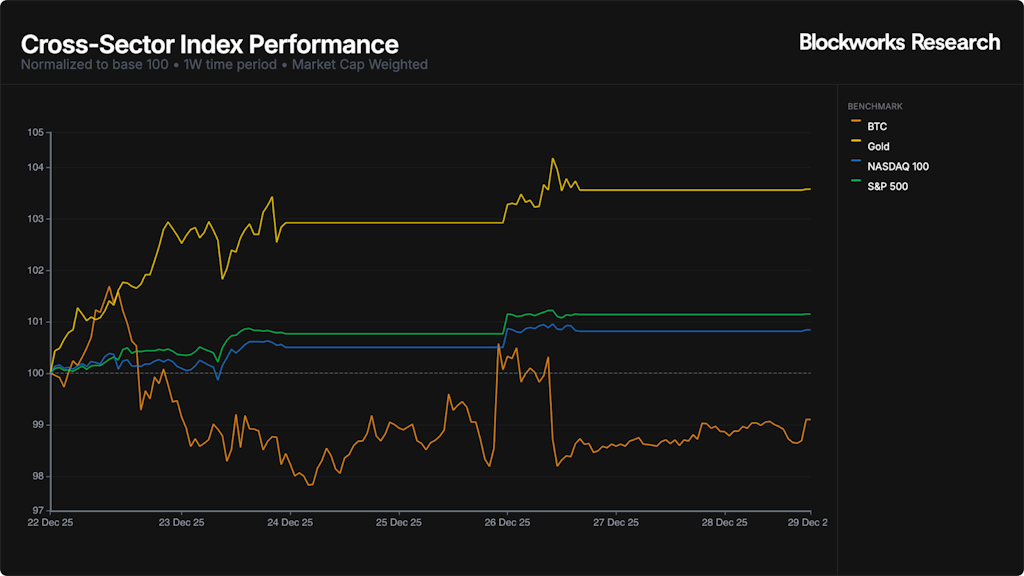
As the global financial markets transition into the final days of the year following the Christmas holiday, the cryptocurrency sector is exhibiting a mixed performance landscape. Traditional benchmarks drifted higher over the past week, led notably by gold, while major digital assets experienced divergence. Bitcoin slipped fractionally, bucking the broader risk-on sentiment observed across traditional equities, whereas specific altcoin sectors—particularly within the Solana ecosystem—captured significant upside momentum amid shifting capital flows and evolving sector narratives.
The broader macroeconomic environment presented a steady picture for traditional risk assets over the week. Gold led all traditional benchmarks with a notable advance of 3.57%, appealing to investors seeking alternative stores of value. Meanwhile, major equities indices posted modest gains, with the S&P 500 rising 1.15% and the Nasdaq 100 advancing 0.84%. In contrast, the flagship cryptocurrency, Bitcoin, slipped approximately 0.90%, decoupling momentarily from the general risk-on mood prevailing in traditional financial markets.

Indices Performance and Sector Divergence
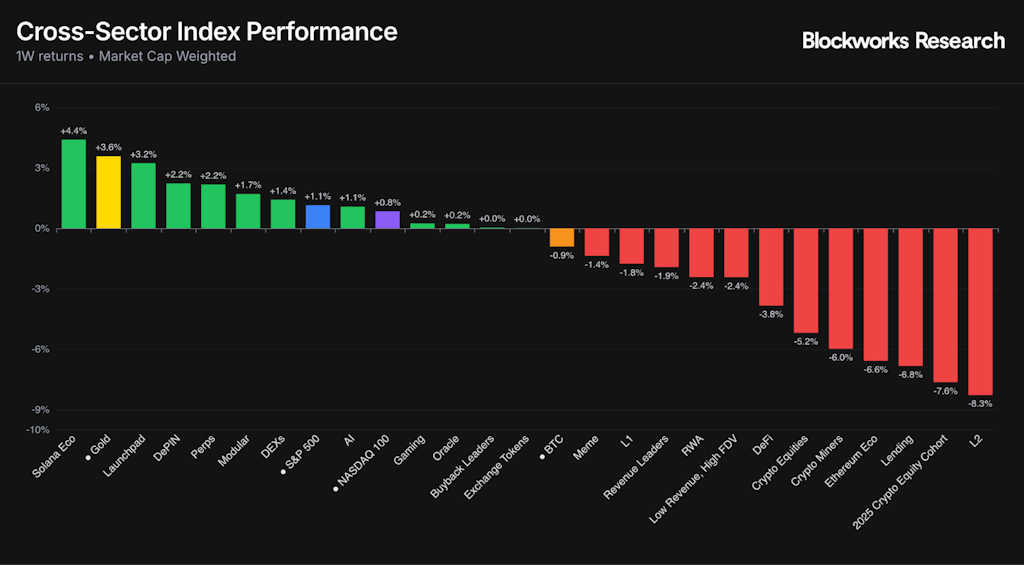
Within the digital asset class, crypto sector indices displayed starkly contrasting results over the seven-day period. On the winning side, the Solana Ecosystem index led gains with a 4.4% increase, benefiting from renewed enthusiasm for liquid staking and perpetual protocol narratives. Other notable outperformers included launchpad-focused tokens, which rose 3.23%, decentralized physical infrastructure networks (DePIN) advancing 2.23%, perpetual protocols gaining 2.17%, and modular blockchain solutions moving up 1.7%. Decentralized exchanges (DEXs) and artificial intelligence-linked crypto tokens also posted modest gains of 1.42% and 1.07%, respectively.
Conversely, significant downward pressure weighed heavily on other major sectors. Layer-2 scaling solutions suffered the steepest losses, dropping 8.27%, closely followed by lending protocols which contracted by 6.82%. The broader Ethereum ecosystem index fell 6.57%, and crypto mining equities retreated 5.97% as investors rotated capital away from Ethereum-centric infrastructure and toward competing high-throughput networks.
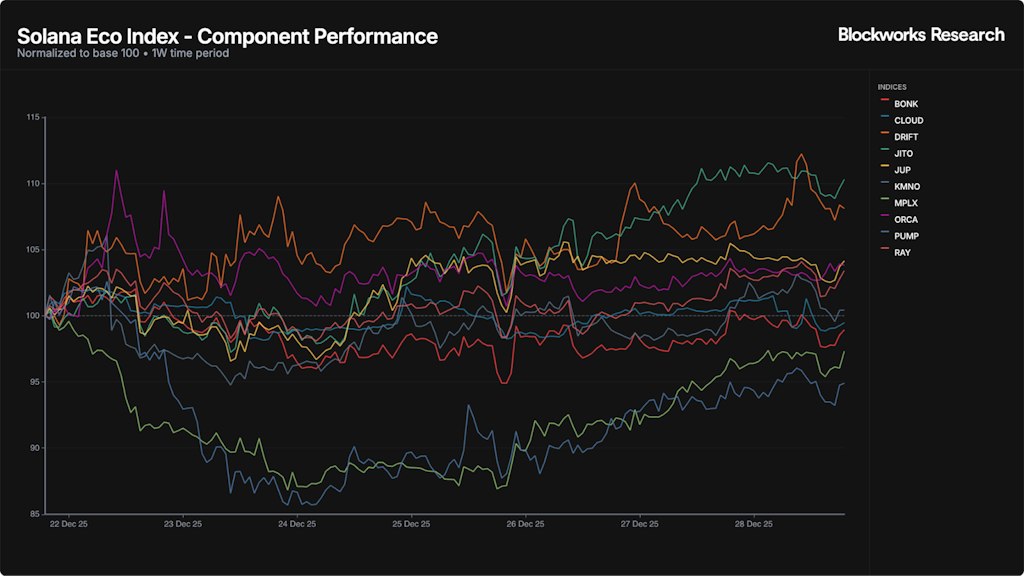
Drilling down into the Solana ecosystem, specific assets drove the weekly outperformance. JTO led the sector index with a robust 10.30% gain, followed closely by DRIFT, which added 8.10%. Other components of the Solana DEX and DeFi ecosystem also registered solid advances, including JUP up 4.14%, ORCA up 3.81%, and RAY rising 3.40%. However, not all assets in the ecosystem shared the momentum. MPLX struggled to find a solid footing, declining 2.68%, while PUMP emerged as the clear underperforming asset with a 5.11% drop, reflecting ongoing fatigue surrounding memecoin launchpads and speculative token generation events.
Charts for the Week: Aave’s Dominance and Rising Challengers
An examination of the decentralized finance landscape reveals both the enduring strength of market leaders and the persistent nibbling at their market share by innovative new entrants. Throughout 2025, Aave has maintained a commanding presence in the DeFi lending sector, capturing 86% of total protocol revenue and generating an impressive $120.9 million year-to-date.
Nevertheless, Aave’s ironclad grip has loosened slightly over the course of the year. In January, the protocol commanded a 91% market share of revenue, a figure that has gradually compressed to 86% by December. Newer entrants have successfully chipped away at this dominance. HyperLend, which launched in March, and Jupiter Lend, introduced in July, have collectively carved out a 3.4% market share. Meanwhile, Fluid has more than doubled its market share over the period, climbing from 2.4% to 4.9% and establishing itself as one of the fastest-growing competitors among established decentralized lending protocols.
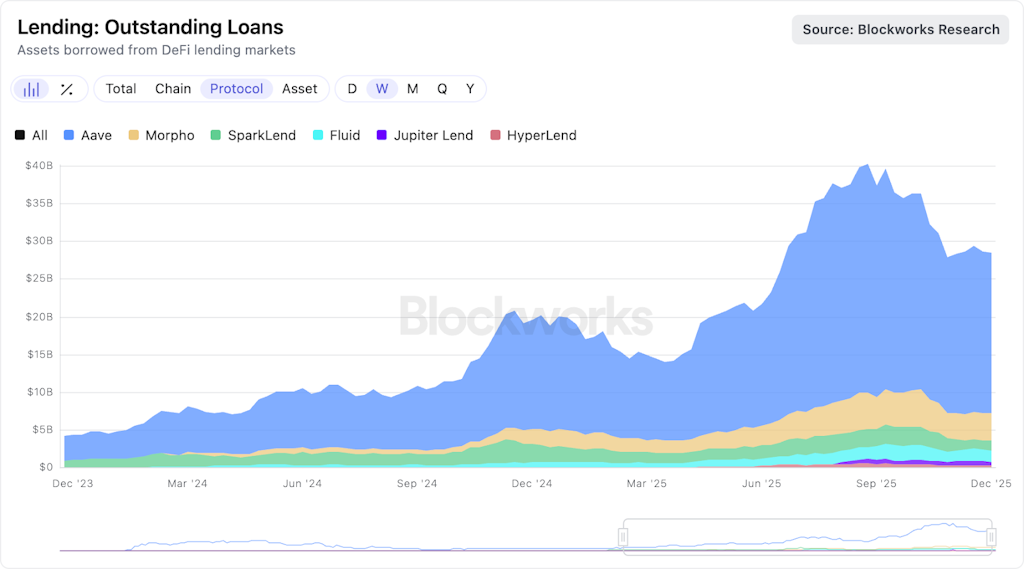
A parallel narrative unfolds when evaluating outstanding loans across the lending market. Aave currently holds $21.3 billion in outstanding loans, representing 74.7% of the total market—a metric that has remained relatively flat since the beginning of the year. The genuine market share movement has occurred among challengers. Morpho expanded its footprint, growing from 10.6% to 12.8% of outstanding loans. In contrast, Spark experienced a sharp contraction, watching its share collapse from 11.5% down to just 4.7%. Fluid nearly doubled its share of outstanding loans from 3.6% to 5.0%, while newer entrants Jupiter Lend and HyperLend secured 2.1% and 0.7% respectively, establishing small but tangible footholds in the competitive lending economy.
Network Revenues and Perpetual Exchange Dynamics
The broader contraction in network revenues persisted across major blockchain ecosystems. Total weekly network revenue dropped by 21% to $26.4 million, marking the lowest level recorded in at least a month. Among major chains, Hyperliquid experienced the sharpest revenue decline, falling 40% from $11.8 million down to $7.1 million. Ethereum network revenue similarly declined by 38% to reach $2.2 million.
In contrast, Solana demonstrated greater resilience, slipping just 2% to maintain $4.7 million in weekly revenue. Tron remained the second-highest revenue generator behind Hyperliquid, capturing $6.1 million despite experiencing an 11% decline of its own. The only notable positive revenue movements were concentrated among smaller-scale players, including Arbitrum up 37%, Polygon up 50%, and Binance Smart Chain rising 2%, though these percentage gains represented relatively minor absolute dollar amounts.
The competitive landscape for perpetual swap volume and market share also revealed intriguing shifts. Earlier in the year, particularly in August 2025, Hyperliquid achieved massive milestones, registering $396 billion in trading volume and $121 million in revenue, with its trailing 30-day volume peaking at $395 billion while commanding over 80% of the decentralized finance perpetuals market share.
Recent weekly data, however, highlights aggressive competition from rising protocols. Lighter recorded $30.9 billion in perpetual trading volume over the past seven days and an impressive $203.7 billion over the past month, backed by $1.48 billion in open interest. Similarly, Aster captured $26 billion in weekly volume and $160.6 billion over 30 days, accompanied by a substantially larger open interest pool of $7.4 billion. Hyperliquid has momentarily fallen behind on weekly volume, registering $21.5 billion, though it continues to maintain a commanding lead in open interest, holding more than double the combined open interest of its emerging rivals at $2.4 billion. Market observers note that with an incoming airdrop for Lighter, ongoing volume metrics may be partially inflated by incentives, leaving open questions regarding how the perpetual exchange landscape will evolve once points programs conclude and organic activity is tested.





Comments (0)