



The cryptocurrency derivatives market is undergoing a structural transformation, driven by an innovative protocol-level mechanism pioneered by Hyperliquid. By decoupling transaction execution from the user-facing interface, Hyperliquid has introduced a feature known as builder codes, fundamentally altering how decentralized perpetual exchanges acquire users, distribute volume, and distribute revenue. This shift is steering the decentralized finance (DeFi) ecosystem away from the traditional, fully-integrated crypto exchange model and pushing it toward a layered intermediation framework reminiscent of traditional equity markets.
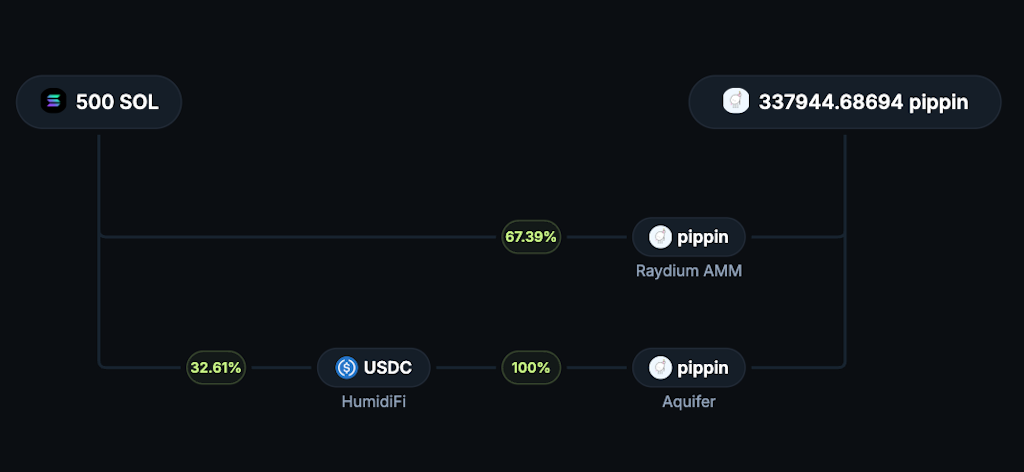
At the heart of this architecture are builder codes, which function as protocol-level parameters embedded directly into transaction payloads. These parameters allow third-party interfaces to append a specific builder address for automated, onchain fee capture. Through this mechanism, external developers and platform operators can attach a surcharge of up to 100 basis points, or 1%, on spot trades, and up to 10 basis points, or 0.1%, on perpetual contracts.
This design completely decouples the execution layer from the settlement layer. Consequently, third-party frontends can monetize proprietary user flow without enduring the heavy technical complexities of maintaining a high-performance orderbook or the capital inefficiency traditionally required to bootstrap liquidity from scratch. Third-party frontends routinely integrate Hyperliquid perpetuals and layer their own variable fee tiers on top, creating a differentiated pricing landscape for the exact same underlying execution.

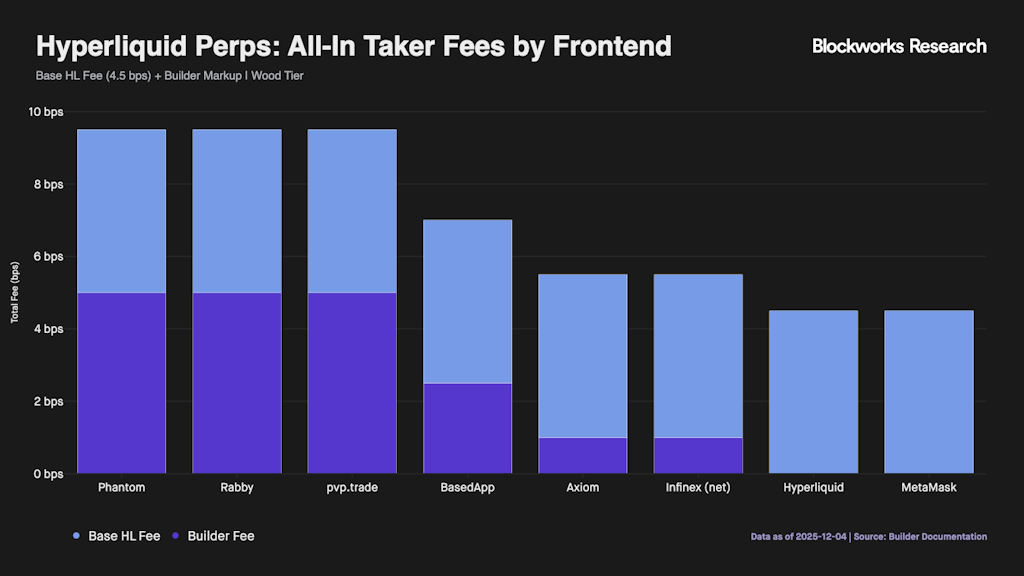
This mechanism has unlocked a powerful distribution flywheel for the network. Nearly 40% of daily active users now execute trades through third-party frontends rather than Hyperliquid’s native user interface, a share that briefly crossed the 50% threshold in late October. The top three builders in the ecosystem—Based, Phantom, and pvp.trade—have collectively captured more than $31 million in fees, demonstrating the lucrative nature of owning the consumer-facing layer.
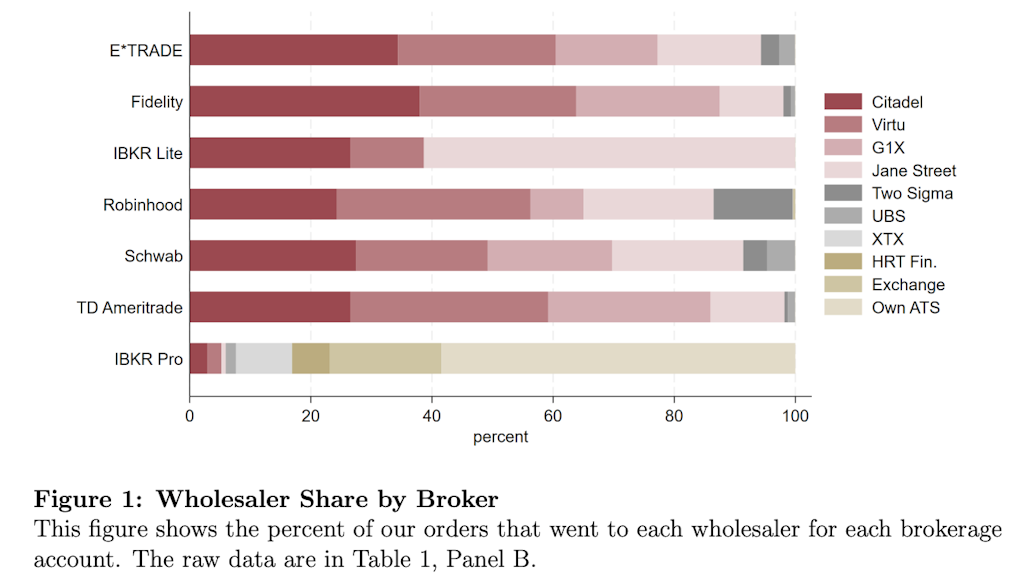
From a broader market structure perspective, this dynamic moves Hyperliquid away from the fully-integrated crypto exchange model seen in centralized giants like Binance, where a single corporate entity controls the entire stack across user onboarding, order routing, trade matching, and asset custody. Instead, Hyperliquid’s design closely mirrors the structure of the modern US equity market. In traditional equities, retail brokers such as Robinhood and Charles Schwab own the client relationship and monetize distribution, while routing orders to wholesale market makers like Citadel Securities and Virtu Financial, which handle execution and clearing.
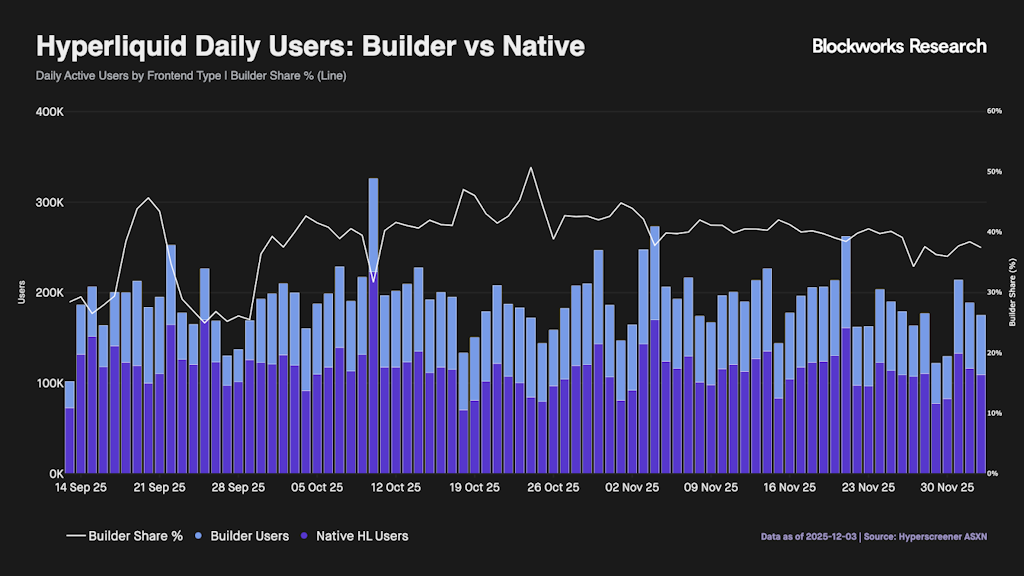
This division creates a distinct two-tiered stack. While this modular decoupling mechanism is relatively new to the decentralized perpetuals sector, a very similar pattern has already played out across the Solana ecosystem. On Solana, high-speed trading terminals like Photon and Axiom successfully captured massive user flow by focusing intensely on the consumer experience. Photon initially gained dominance by operating as the fastest memecoin sniping tool, while Axiom later challenged it with a broader product suite alongside more aggressive points systems and rebate structures.
These trading terminals essentially functioned as proto-builders: they sat directly on top of decentralized exchanges, bolted on their own custom fee markups, and managed internal accounting manually. Hyperliquid’s builder codes have essentially transformed that organic, ad-hoc pattern into a native, secure protocol primitive.
However, the Solana ecosystem also serves as a cautionary tale regarding the structural risks of this model. Solana trading terminals managed to capture 77% of total decentralized exchange revenue over the course of a single year, generating $633 million compared to just $188 million for the underlying decentralized exchanges themselves. This 3.4x multiple underscores a critical lesson in modern market design: owning the customer-facing frontend is frequently far more economically valuable than owning the backend infrastructure. This dynamic raises a pressing question for the industry: Is the frontend layer simply too valuable for a protocol like Hyperliquid to give away?
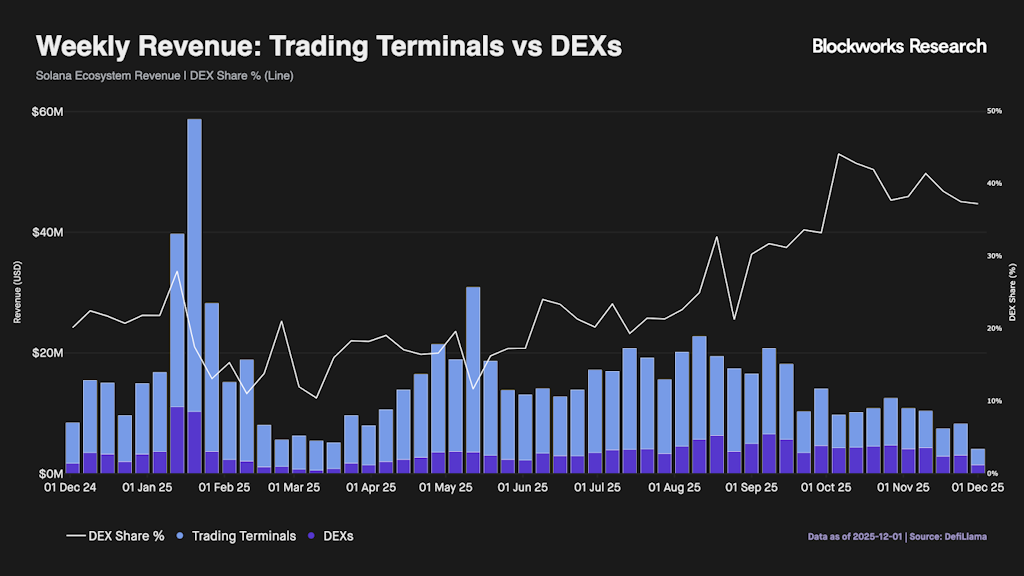
The commercial relationship between frontends and backends is rarely purely symbiotic over the long term. Major frontend aggregators like Jupiter aggregate various underlying decentralized exchange backends—such as Meteora, Raydium, and Orca—and dynamically route user trades to provide the best execution given size, fee, and slippage constraints. This severe power asymmetry forces underlying backend liquidity providers into intense margin compression. Lacking a structural economic moat, backend venues must strive to be the absolute cheapest execution route to win order flow.
Because backends do not own the direct customer relationship, they are perpetually vulnerable to being replaced. This risk was clearly illustrated when pump.fun bypassed Raydium as its liquidity backend entirely, deploying its own in-house automated market maker and severely impacting Raydium’s overall volume share.
At present, Hyperliquid does not face this specific existential threat. By pioneering builder codes natively on perpetual contracts, it currently operates as a singular-builder code environment. Yet, if third-party builders eventually evolve from simple user interfaces sitting on top of Hyperliquid into true, multi-chain smart-order routers capable of directing order flow to competing backend venues, they will begin to closely resemble traditional financial smart-order routers. In that scenario, builders gain the leverage to extract better economic terms, auction off order flow, or prioritize venues that offer the highest rebates.
A similar competitive struggle defines traditional finance, where wholesale market makers aggressively compete with broker-dealers for order volume. Retail brokerages route customer orders based strictly on which wholesale market maker provides the best execution quality and the most favorable payment for order flow.
Although rival perpetual DEXs like Drift and Ostium have integrated builder codes into their own systems, none have yet emerged as a genuine, systemic threat to Hyperliquid’s dominant market share. Nevertheless, a significant structural risk persists across the sector. If a competing liquidity venue—such as Lighter—were to combine aggressive builder rebates with a zero-fee trading model, it could theoretically enable popular digital wallets like Phantom and Rabby to completely bypass Hyperliquid’s standard 4.5 basis point fee. Such a move would allow frontends to capture the entire fee stack, effectively doubling their revenue per trade compared to what they earn under the current Hyperliquid architecture.
Platforms like LiquidTrading serve as a leading indicator of this evolving multi-venue future. The Paradigm-backed trading terminal, which successfully raised $7.6 million in a seed funding round, has already facilitated $5.6 billion in trading volume on Hyperliquid. Crucially, however, the platform also allows users to execute trades on alternative perpetual protocols like Ostium and Lighter through the exact same interface. If larger builder frontends follow this multi-venue trajectory and begin actively routing order flow based primarily on venue-level rebates rather than brand loyalty, Hyperliquid’s builder frontends could eventually commoditize into general perpetual aggregators, directly challenging the protocol’s long-term value capture capabilities.
Despite these theoretical risks, a fundamental technical difference separates spot markets from perpetual derivatives markets. Spot trading is relatively straightforward to aggregate because each swap is atomic, and digital assets are fully fungible across different liquidity pools. A single transaction can easily be filled by a router splitting an order across multiple decentralized venues simultaneously.
With perpetual contracts, however, positions are persistent, leveraged, and strictly venue-specific. A Bitcoin perpetual position opened on one venue is fundamentally non-fungible with a position opened on another due to critical discrepancies in index composition, funding rate mechanisms, liquidation engines, and individual risk management limits. To route perpetual positions across disparate venues meaningfully, the market would require complex structural solutions that are difficult to implement seamlessly.
While this structural non-fungibility provides a strong short-term defense for specialized execution venues, the harsh economic reality is that frontends operate as rational economic actors. They will naturally migrate their order flow if a competing venue offers superior profit margins. Even so, current onchain data indicates that this competitive threat remains effectively contained for now. Despite the impressive user counts recorded across third-party interfaces, the vast majority of total trading volume—exceeding 90%—still originates directly from Hyperliquid’s native user interface.
Furthermore, the native HYPE token introduces an additional retention and loyalty layer into the ecosystem. Builders can acquire and hold HYPE to unlock exclusive fee discounts, allowing them to effectively stack multiple revenue streams, including referral kickbacks, custom builder fees, and volume-based trading discounts. Because of these integrated economic incentives, the real-world cost of switching to an alternative backend for marginally better fees may simply not be worthwhile for established frontends. Finally, empirical evidence suggests that the order flow originating from third-party builders is largely additive rather than cannibalistic. These are predominantly brand-new users entering the broader crypto ecosystem via external wallets and specialized terminals, rather than existing users migrating away from Hyperliquid’s native interface.
Therefore, while builder codes have proven to be an exceptionally effective expansion vector for growing network activity, expecting Hyperliquid to maintain absolute dominance over its entire distribution layer indefinitely is unrealistic. As the decentralized derivatives sector continues to mature, the protocol will undoubtedly face a tougher competitive grind to defend its market leadership against emerging aggregators and aggressive low-fee competitors.
Building a highly performant, scalable onchain orderbook remains an immense technical moat that is difficult to replicate. With frontend profit margins remaining healthy across the board, the near-term economic incentives for builders to abandon the platform are remarkably low. In a rapidly expanding global market, the challenge is no longer just about retaining existing volume, but rather participating in a fiercely competitive race for broader market expansion where Hyperliquid remains the heavyweight contender to beat.





Comments (0)