



The relationship between two of Solana’s prominent decentralized finance protocols has shifted dramatically over the past several days, transforming from a spirit of healthy ecosystem competition into an open and public dispute. The friction centers on the rapidly evolving money market sector within the Solana blockchain, where protocols vie intensely for user deposits, liquidity, and total value locked.
The latest escalation began on November 27, when Jup Lend introduced a refinancing tool directly on its user interface. Designed to streamline the user experience, the feature allowed traders to migrate their leveraged looping positions from Kamino Multiply directly into Jup Lend using a single click. Behind the scenes, this refinance operation executed an automated atomic transaction designed to handle complex debt and collateral transfers seamlessly.
However, the aggressive customer-acquisition move was short-lived. On December 2, Kamino responded by updating its smart contracts to block Jupiter’s program entirely, effectively shutting down the one-click refinancing pipeline. The defensive maneuver drew immediate pushback. Both the Jupiter team and the Fluid team—which provides the underlying backend infrastructure for Jup Lend—publicly criticized the move, framing Kamino’s actions as anti-competitive and fundamentally at odds with open-finance principles.

The public debate intensified on December 6 when a Kamino co-founder took to social media to explain the rationale behind blocking the migration tool. According to the executive, Jupiter had previously and repeatedly suggested to users that borrower collateral on Jup Lend was strictly isolated, implying it was neither rehypothecated nor exposed to cross-contamination risks. Kamino argued that this narrative was misleading, pointing out that even Fluid’s co-founder later acknowledged that rehypothecation does indeed occur within Jup Lend.
Despite accusations of stifling interoperability, industry observers noted that Kamino’s actions did not trap users on its platform. Investors were never prevented from manually repaying their loans, withdrawing their capital, and depositing it into Jup Lend on their own terms. Whether the move violated the ideological ethos of open finance or not, analysts point out that blocking the automated refinancing program was fundamentally a business decision. Similar competitive maneuvering has characterized the ecosystem elsewhere, such as Jup Lend’s own decision to keep its code proprietary for the time being, though the team has indicated plans to open-source it eventually.
To understand the intensity of this rivalry, it is necessary to examine the broader competitive dynamics that have played out between the two money markets over recent months. Since its launch in late August, Jup Lend has experienced explosive growth, rapidly scaling to $1.6 billion in deposits and $610 million in active borrows. During roughly the same operational window, Kamino has seen a contraction in its core metrics, with its deposits dropping by $1.3 billion, representing a 28% decline, and its borrows decreasing by $460 million, or 26%.
A closer look at asset inflows highlights the specific areas where Jup Lend has captured market share. The top five assets driving deposit growth since Jup Lend’s debut include USDC at $485 million, JLP at $225 million, SOL at $206 million, syrupUSDC at $174 million, and jupSOL at $85 million. Over that exact timeframe, Kamino has experienced sizeable capital outflows across nearly all of these major assets, with the sole exception of syrupUSDC. Even in the case of syrupUSDC, Jup Lend managed to attract approximately three times more inflows than its rival.
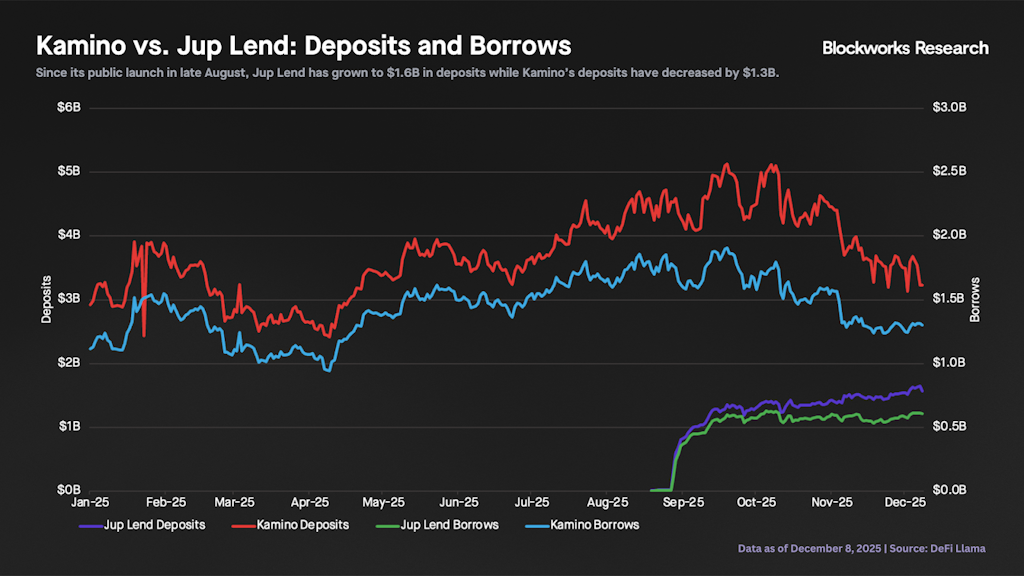
Faced with intense pressure in major asset categories, Kamino has pivoted its growth strategy toward specialized assets and alternative niches that are not yet supported by Jup Lend. For instance, Kamino’s stablecoin inflows during the fourth quarter have been significantly bolstered by assets such as PYUSD, which brought in $42 million, and Phantom’s CASH stablecoin, which contributed $125 million. Furthermore, Kamino has maintained an aggressive posture in onboarding exotic liquid staking tokens from DATCO, most notably dfdvSOL and more recently fwdSOL.
Looking ahead, Kamino is betting on innovative integrations to serve as a catalyst for net-new inflows into its money market. A primary example is its integration with PRIME, a feature designed to grant users exposure to a regulated credit pool backed by US real estate loans. These loans are originally sourced and serviced through Figure, providing a yield source that is largely uncorrelated with broader crypto market cycles. Protocol developers hope this unique offering will attract a new wave of institutional borrowers who demand diversified yield profiles.
Ultimately, both Kamino and Jup Lend remain key pillars of the Solana ecosystem, and industry participants widely agree that competition ultimately drives technological innovation and benefits end users. Nevertheless, prominent figures in the ecosystem have urged a broader perspective. As Solana Foundation leader Lily Liu recently noted, rather than engaging in territorial infighting, protocols like Kamino and Jupiter would be better served by focusing on expanding the overall market and capturing market share from competing blockchain networks and traditional finance. Combined, the two Solana money markets still account for a fraction of the deposits seen on massive multi-chain giants like Aave, leaving substantial room for collaborative growth rather than internal friction.





Comments (0)