


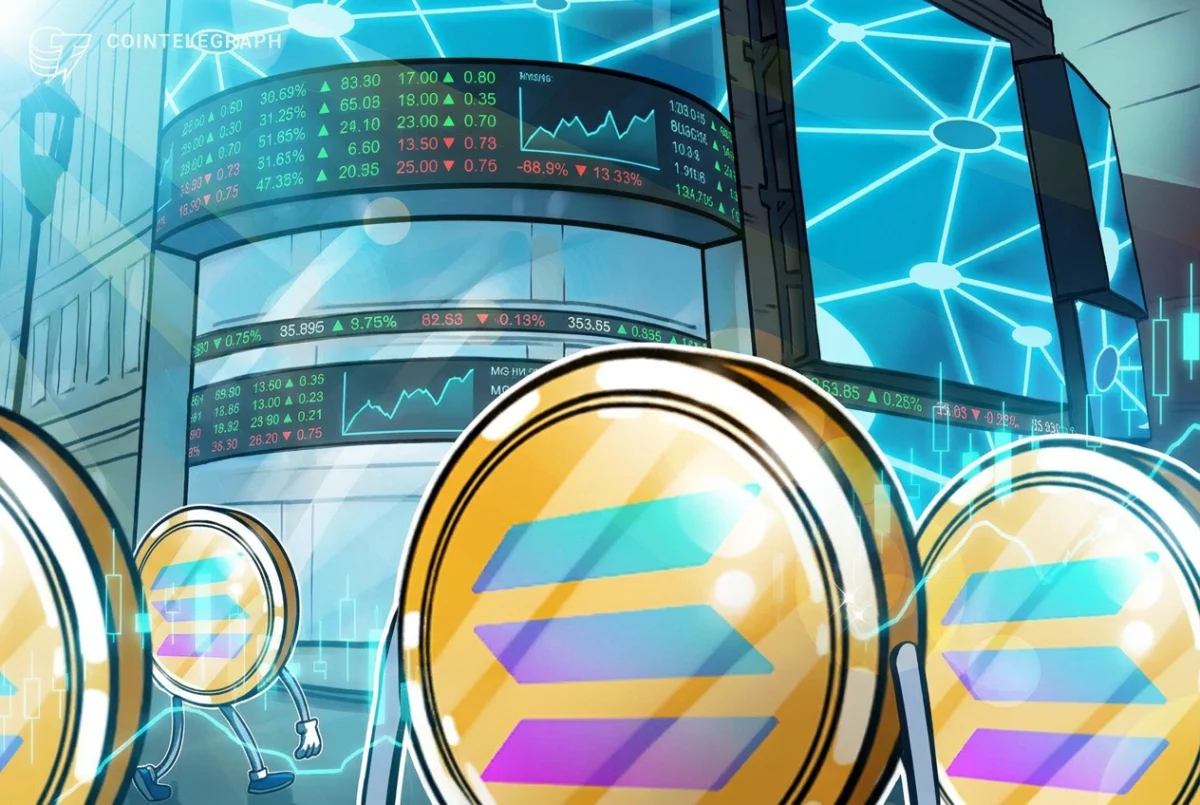
Formation Securities, a newly established financial technology firm that licenses core infrastructure and technology from the decentralized exchange Orca, has officially notified the United States Securities and Exchange Commission (SEC) regarding its strategic plans to launch a pioneering tokenized stock trading venue on the Solana blockchain in early 2027.
The announcement, made public on Monday, outlines a marketplace designed to bridge traditional equity markets with high-performance decentralized finance infrastructure. According to the company’s disclosure, tokenized shares of prominent digital asset and technology entities—including Galaxy Digital, Exodus Movement, and Forward Industries—are expected to be readily available for trading at the time of the platform’s official launch.
The proposed venue is intended to operate under the regulatory framework of the SEC’s temporary Innovation Exemption, which was formally introduced in September. This regulatory pathway allows verified investors to trade specific United States-listed equities around the clock. Importantly, participants on the platform will retain full traditional shareholder privileges, encompassing voting rights, dividend distributions, and other corporate governance entitlements associated with the underlying equities.
To build and support this ecosystem, Formation Securities anticipates collaborating with major tokenization providers such as Superstate and Securitize to bring tokenized shares onto the marketplace. Furthermore, the firm has stated its explicit intention to develop the venue in close cooperation with public companies themselves, contrasting sharply with models that bypass issuer input. The proposed trading venue will leverage advanced automated market maker (AMM) technology, enabling investors to retain custody of their securities within their own self-hosted wallets while settling trades directly onchain against stablecoins and other eligible digital assets.
In this operational model, traditional transfer agents will continue to maintain official shareholder records. This crucial structural feature ensures that public companies preserve their direct relationships with their registered shareholders, mitigating concerns regarding corporate governance, proxy voting integrity, and regulatory compliance.
The selection of the Solana blockchain highlights its growing prominence in the real-world asset (RWA) tokenization sector. Solana is already positioned among the leading blockchain networks for tokenized equities. Industry data from RWA.xyz indicates that as of Monday, Solana hosted approximately $575 million in tokenized stock value. While this figure places Solana behind competitors—such as Ethereum, which accounted for approximately $747 million, and BNB Chain, which held roughly $1.7 billion in tokenized stock value—the network’s high throughput and low transaction fees continue to attract institutional interest and innovative trading venues seeking scalable infrastructure.
Tokenized Stock Plans Draw Issuer Concerns
Formation Securities’ proactive, issuer-focused approach arrives at a time of intensifying debate across global financial markets regarding how publicly traded shares should be brought onto distributed ledger technology networks. The question of consent and corporate oversight has become a central point of contention between decentralized finance proponents and traditional corporate issuers.
As of early November, more than 50 publicly traded companies had formally objected to having their shares tokenized on OKXICE, an ambitious proposed venue backed jointly by prominent crypto exchange OKX and Intercontinental Exchange, the parent company of the New York Stock Exchange. These objections reflect widespread apprehension among corporate executives regarding unauthorized tokenization, potential market fragmentation, and the secondary implications of trading company stock outside traditional clearing and settlement channels.
Under the guidelines established by the SEC’s Innovation Exemption, prospective trading venues are legally required to notify corporate issuers in writing. Furthermore, these platforms must observe a mandatory waiting period of at least 30 calendar days before commencing the trading of shares that have been tokenized by unaffiliated third parties. This regulatory buffer is specifically designed to provide companies with adequate time and opportunity to review the arrangements and raise objections if they deem the tokenization contrary to corporate interests.
The cautious stance adopted by corporate issuers is echoed by traditional market infrastructure operators. In September, Nasdaq published comprehensive guidance warning market participants that the widespread expansion of tokenized stock trading could trigger unforeseen consequences. Specifically, the exchange operator cautioned that fragmented liquidity pools, alterations in traditional price discovery mechanisms, and potential impacts on long-term shareholder value warrant rigorous regulatory scrutiny and deliberate, measured implementation by market participants and financial authorities alike.



Comments (0)