


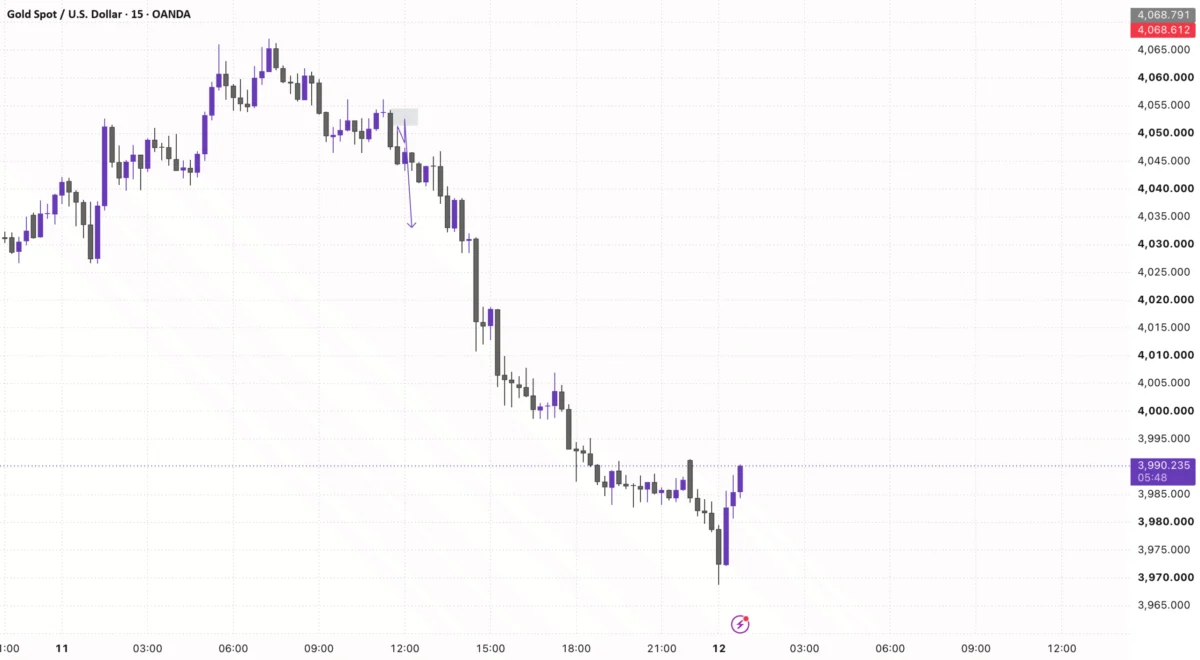
Gold is currently navigating a critical juncture in the global financial markets, trading within a tight range of 3987 to 3989 following another significant wave of selling pressure. As precious metals traders and macroeconomic analysts assess the damage from the latest session, the overarching question dominating trading floors is whether this recent price action represents merely a temporary, oversold relief recovery or the foundational beginning of a much stronger, sustained bearish trend reversal.
To understand the gravity of the current market positioning, it is essential to step back and examine the broader technical landscape across multiple timeframes. A comprehensive multi-timeframe analysis reveals that momentum has heavily favored the selling side for several consecutive sessions, leaving bulls fighting an uphill battle to regain structural control.
On the 1-hour chart, Gold exhibits a distinctly strong bearish moving-average structure, reflecting relentless downward pressure over the intraday horizon. Concurrently, the Relative Strength Index (RSI) on this shorter timeframe has dipped to approximately 29, flashing classic oversold conditions. While this oversold reading theoretically leaves the door open for a minor relief rally or a corrective bounce in the immediate term, seasoned market participants note that an oversold condition alone does not constitute a confirmed trend reversal. Short-term bounces in a broader downtrend often trap aggressive buyers before the dominant macro trend resumes.
Moving out to the 4-hour chart, the broader bearish momentum remains overwhelmingly dominant. Price action is currently situated well below all major moving averages, signaling that sellers continue to dictate the terms of engagement. The recent wave of aggressive selling pressure successfully dragged Gold downward, testing the crucial 3968 support area. This region has emerged as a major psychological and technical battleground for market participants, acting as the immediate threshold separating a controlled pullback from a deeper structural decline.
Looking at the broader daily chart, the technical rating for Gold remains firmly in SELL territory. The daily RSI hovers around 43, indicating that downward momentum still has room to maneuver before reaching extreme exhaustion levels. Furthermore, spot Gold is trading comfortably below both the 20-day and 50-day Exponential Moving Averages (EMAs), which historically serve as reliable dynamic resistance levels during pronounced pullbacks. For the broader market outlook to shift from bearish to bullish, buyers will need to orchestrate a coordinated push to reclaim these major moving averages and break through stubborn overhead resistance barriers.
Given this multi-timeframe confluence, traders and institutional analysts are closely monitoring a distinct set of key technical levels that are expected to dictate price action in the upcoming trading sessions.
On the upside, immediate resistance is clustered heavily between the 3993 and 4000 zone. If bulls manage to pierce this initial barrier, the next significant hurdles lie in the 4025 to 4040 range, followed by the more formidable 4055 to 4067 resistance ceiling. Conversely, on the downside, support is anchored firmly between 3980 and 3968. A decisive breakdown below this immediate support cluster exposes the market to deeper losses, with subsequent downside targets resting at the 3950 mark and the deeper 3920 threshold.
The structural path forward largely depends on how price reacts to these predetermined zones, paving the way for two distinct market scenarios.
Under the primary bearish scenario, if Gold fails to mount a successful challenge above the psychological 4000 handle and selling pressure swiftly returns to the market, a confirmed break below the 3968 support zone would likely trigger accelerated liquidations. Such a breakdown would expose the precious metal to further downside exposure, paving a clear path toward the secondary support targets at 3950 and subsequently 3920.
On the other hand, a bullish recovery scenario remains entirely contingent on buyers regaining aggressive control of the order books. If market bulls manage to decisively reclaim the 4000 handle and establish sustained price acceptance above the 4025 to 4040 resistance band, market sentiment could shift rapidly. Such a development would likely invalidate the immediate bearish bias and open the door for a much stronger structural recovery targeting the 4055 to 4067 resistance region.
Assessing the current market landscape reveals an overall bias that remains decidedly bearish. However, chasing fresh short positions immediately following such a sharp and aggressive decline carries inherent execution risks, as oversold conditions frequently trigger sharp, unpredictable counter-trend bounces. Rather than aggressively shorting at current depressed levels, many disciplined market participants prefer to wait for a corrective recovery rally back toward established overhead resistance areas before assessing the next optimal bearish opportunity.
Ultimately, the defining catalyst for the days ahead will be whether sellers can successfully defend the 4000 threshold or if an influx of dip-buying interest enables the bulls to stage a meaningful recovery. As the market digests these developments, traders across global exchanges continue to debate whether Gold is destined to breach the 3968 support floor or if a resilient bounce is waiting in the wings.

Comments (0)