


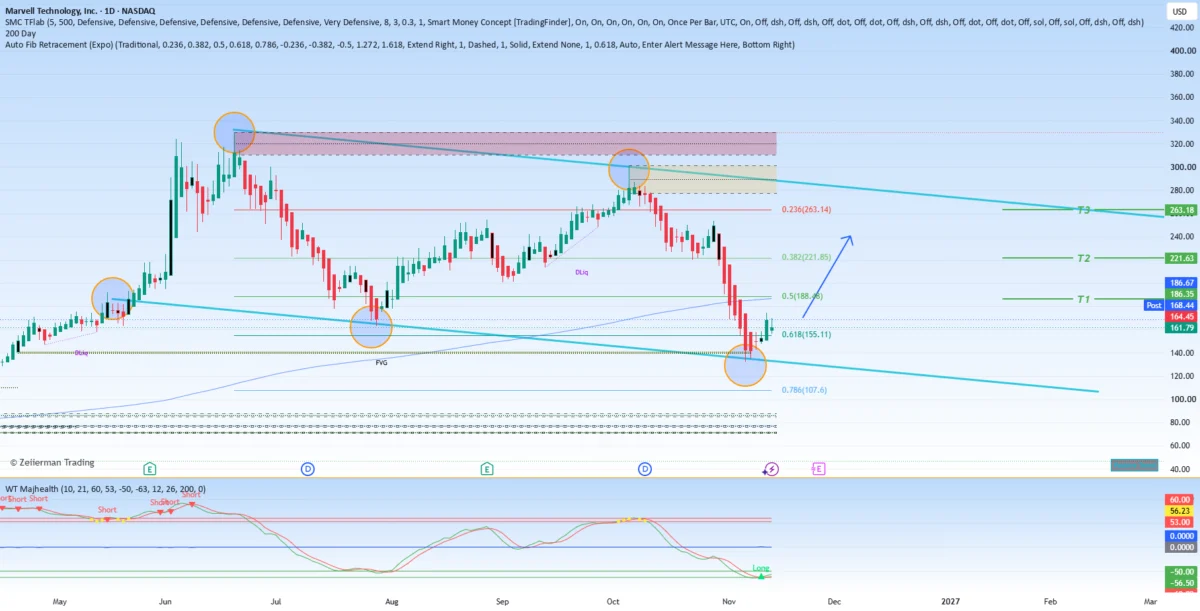
Marvell Technology (NASDAQ:MRVL) has found itself at the center of intense Wall Street scrutiny, drawing two prominent analyst downgrades in the wake of its blockbuster agreement to acquire Lumentum in an all-stock transaction valued at approximately $115 billion, including debt. The transformative deal, which immediately sent shockwaves through the market and triggered a roughly 13% sell-off in Marvell shares, has forced institutional investors, portfolio managers, and market analysts to drastically reconsider both the long-term strategic upside and the severe near-term risks associated with the massive corporate combination.
The immediate reaction from top-tier financial institutions underscored the contentious nature of the transaction. Vivek Arya, an influential analyst at Bank of America, swiftly moved to downgrade Marvell from a Buy rating to a Neutral stance, while drastically slashing his price target on the semiconductor and networking stock from $400 down to $225. Shortly thereafter, TD Cowen followed a similar playbook, shifting its official rating from Buy to Hold and reducing its price target from $350 down to $175. These aggressive downward revisions reflect a profound market anxiety regarding the sheer scale of the transaction, the financing mechanics involved, and the intricate execution hurdles that now lie ahead for Marvell’s executive leadership team.
Strategic Rationale: Capturing the Optical Layer of AI Infrastructure
To understand the core motivation driving Marvell to pursue such a monumental transaction, market observers must examine the rapidly evolving architecture of modern artificial intelligence data centers. Marvell has long established itself as a critical player in the semiconductor ecosystem, designing specialized application-specific integrated circuits (ASICs), custom silicon, and high-performance networking gear that move vast quantities of data within hyperscale AI data centers. Lumentum, on the other hand, operates as a premier manufacturer of advanced optical components, including lasers and transceivers, which are essential for carrying that same data across networks in the form of light.
By bringing these two distinct yet highly complementary technologies under a single corporate umbrella, Marvell aims to forge a commanding, vertically integrated position in the optical connectivity layer of next-generation AI infrastructure. As artificial intelligence computing clusters continue to scale exponentially in size and computational power, the physical movement of data threatens to become the ultimate operational bottleneck. In this context, the acquisition represents an aggressive strategic maneuver by Marvell to capture a substantially larger share of total capital expenditure dedicated to AI infrastructure, expanding its addressable market far beyond its traditional chip and networking footprint.
The Financing Structure and Shareholder Dilution Debate
Despite the compelling long-term technological vision underpinning the merger, the financial architecture of the deal has become the central flashpoint for widespread market skepticism. Because Marvell has chosen to fund the roughly $115 billion acquisition entirely through an all-stock transaction rather than cash or debt financing, the company must issue a massive volume of new equity. Consequently, existing Marvell shareholders will find themselves owning a significantly smaller slice of a much larger, highly complex corporate entity.
This equity dilution is not a minor footnote; it is a critical variable that fundamentally alters the risk-reward profile for current investors, particularly at a time when the broader financial markets are attempting to accurately price a combined business before management has proven how smoothly the two disparate product lines can actually integrate. The sudden, roughly 13% plunge in Marvell’s stock price immediately following the announcement indicates that public market participants are aggressively discounting the transaction’s execution risks, the immediate dilutive impact on earnings per share, and the lingering concern that Marvell may be paying a premium valuation for optical exposure precisely when AI infrastructure valuations are widely perceived as stretched.
Divided Wall Street Sentiment and Competing Narratives
Importantly, the reaction from major financial institutions has not been entirely uniform, highlighting a deep philosophical divide on Wall Street regarding how to evaluate the transaction. Standing in stark contrast to the conservative postures adopted by Bank of America and TD Cowen, analysts at UBS reaffirmed their bullish stance on November 3, reiterating both their Buy rating and their ambitious $350 price target. This vote of confidence signals that at least some major market participants view the combination as fundamentally visionary and strategically imperative for maintaining leadership in the hardware stack supporting artificial intelligence.
Meanwhile, Cantor Fitzgerald opted for a middle-ground approach, maintaining a Neutral rating while adjusting its price target down to $225. This fragmented analyst consensus is highly instructive, illustrating that professional investors are intensely weighing two competing realities. On one side of the ledger is the promise that proprietary optical capabilities will grant Marvell a meaningfully larger portion of future AI hardware spending. On the other side is the immediate threat that integration hurdles, product roadmap complications, and substantial equity dilution will weigh heavily on existing stakeholders long before any tangible synergies materialize on the balance sheet.
Navigating Product Integration and Execution Risk
Looking ahead, market participants will monitor how Marvell plans to operationally harmonize its product portfolio with Lumentum’s specialized optical hardware. Success will ultimately require Marvell’s existing strengths in data-center silicon and networking switching to seamlessly mesh with Lumentum’s optical components, giving rise to robust cross-selling initiatives and compelling bundled offerings rather than simply creating a bloated and unwieldy corporate conglomerate.
These integration concerns are especially poignant because the underlying skepticism voiced by market bears predates the Lumentum announcement entirely. Weeks prior to the deal’s unveiling, the small cohort of analysts who refrained from issuing Buy ratings on Marvell were already publicly raising questions regarding stretched valuations, potential execution missteps, and the ultimate durability of Marvell’s long-term AI growth trajectory. Rather than sparking an entirely new conversation, the Lumentum acquisition has dramatically amplified and crystallized an existing debate. The prevailing bull thesis asserts that advanced optics permanently widen Marvell’s total addressable AI market, while the persistent bear thesis warns that painful equity dilution and complex integration hurdles will severely penalize shareholders before any strategic payoff can be definitively proven.


Comments (0)