


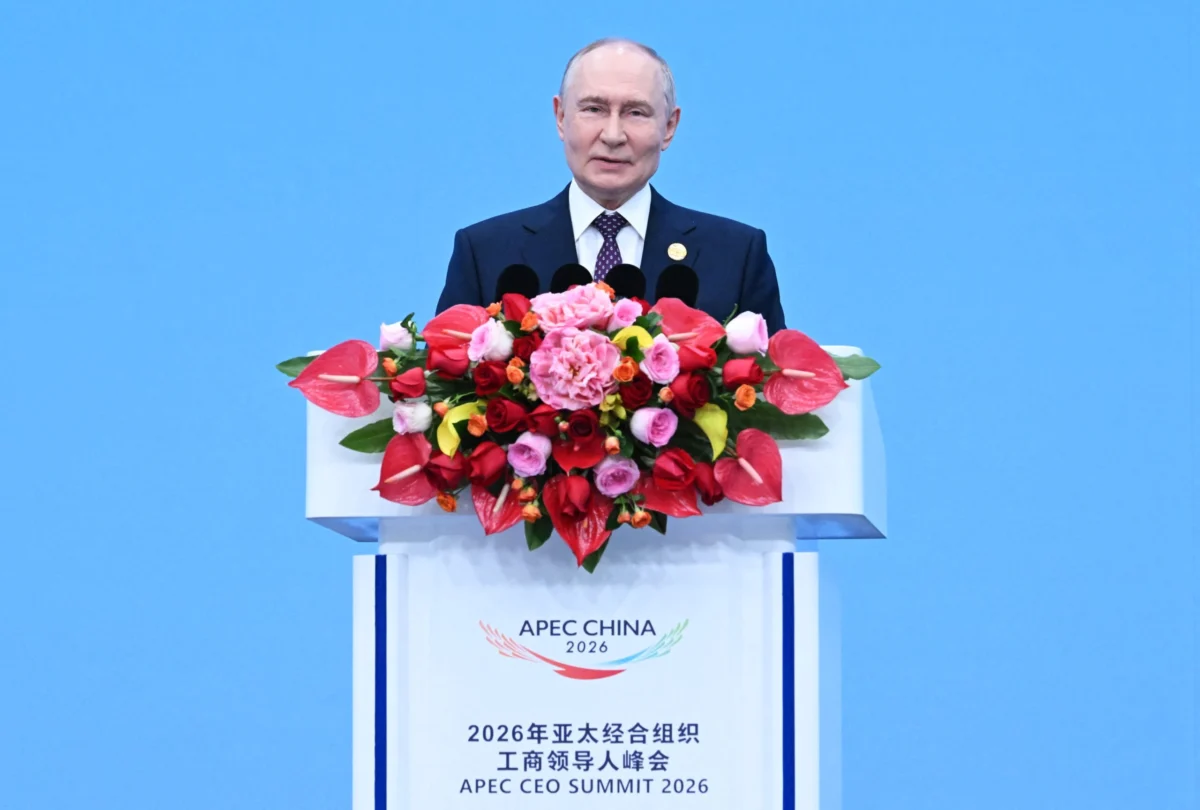
Speaking to business leaders and international delegates gathered ahead of the main Asia-Pacific Economic Cooperation (APEC) leaders’ meeting in the southern Chinese industrial hub of Guangdong Province, Putin pointed to what he described as structural decline within Western Europe.
"The EU is now losing its industrial capacity and it’s losing in the competition," Putin said, delivering his remarks according to an official English translation provided at the venue.
The address by the Russian leader was part of a high-profile lineup at the summit, making him the third APEC leader to take the stage following earlier remarks delivered by Chinese President Xi Jinping and Malaysian Prime Minister Anwar Ibrahim. Rather than focusing solely on geopolitical grievances, Putin utilized the platform to project economic stability, emphasizing Russia’s ongoing economic resilience in the face of extensive Western and U.S. sanctions. He actively pitched the Russian market to regional business figures, highlighting lucrative commercial and developmental opportunities spanning high-technology sectors and broader regional infrastructure projects.
A central theme of Putin’s address was Russia’s successful pivot away from Western financial systems following years of punitive measures. He highlighted Moscow’s demonstrated ability to withstand a severe, deliberate contraction in its transactions denominated in U.S. dollars and euros, framing the shift as proof of macroeconomic adaptation. Looking toward the future of regional cooperation, Putin also used his platform to urge APEC member states to back Russia’s upcoming bid to host the high-level economic summit in 2035.
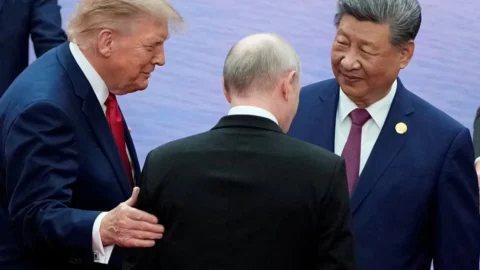
Beyond the CEO podium, the Russian president’s presence in Shenzhen serves as the prelude to a series of high-stakes diplomatic engagements. Putin is scheduled to hold critical bilateral and trilateral talks on Thursday involving Chinese President Xi Jinping and U.S. President Donald Trump. This historic convergence of world leaders is expected to touch upon a vast and complex agenda, including global nuclear non-proliferation efforts and prospects for addressing the ongoing war in Ukraine.
Prior to the broader multi-party discussions, Putin met directly with President Xi on Wednesday, according to reports from Chinese state media. Russian presidential aide Yuri Ushakov noted in statements last week, cited by state-controlled Russian outlet Russia Today, that the Shenzhen diplomatic schedule is designed to sustain momentum toward achieving a negotiated political settlement regarding the conflict in Ukraine.
Despite the gravity of the diplomatic schedule, independent geopolitical analysts suggest that immediate breakthroughs may be limited. David Roche, a veteran strategist at Quantum Strategy, told CNBC’s "Access Middle East" earlier in the week that the gathering is likely to yield minimal concrete policy results. Instead, Roche characterized the summit as an "almost 100% photo op" that significantly bolsters China’s geopolitical prestige and cements its status as a central player at the top table of global diplomacy.
The ongoing summit continues to draw intense international scrutiny as business and political leaders navigate a shifting landscape of global trade, economic fragmentation, and major power competition.

Comments (0)