


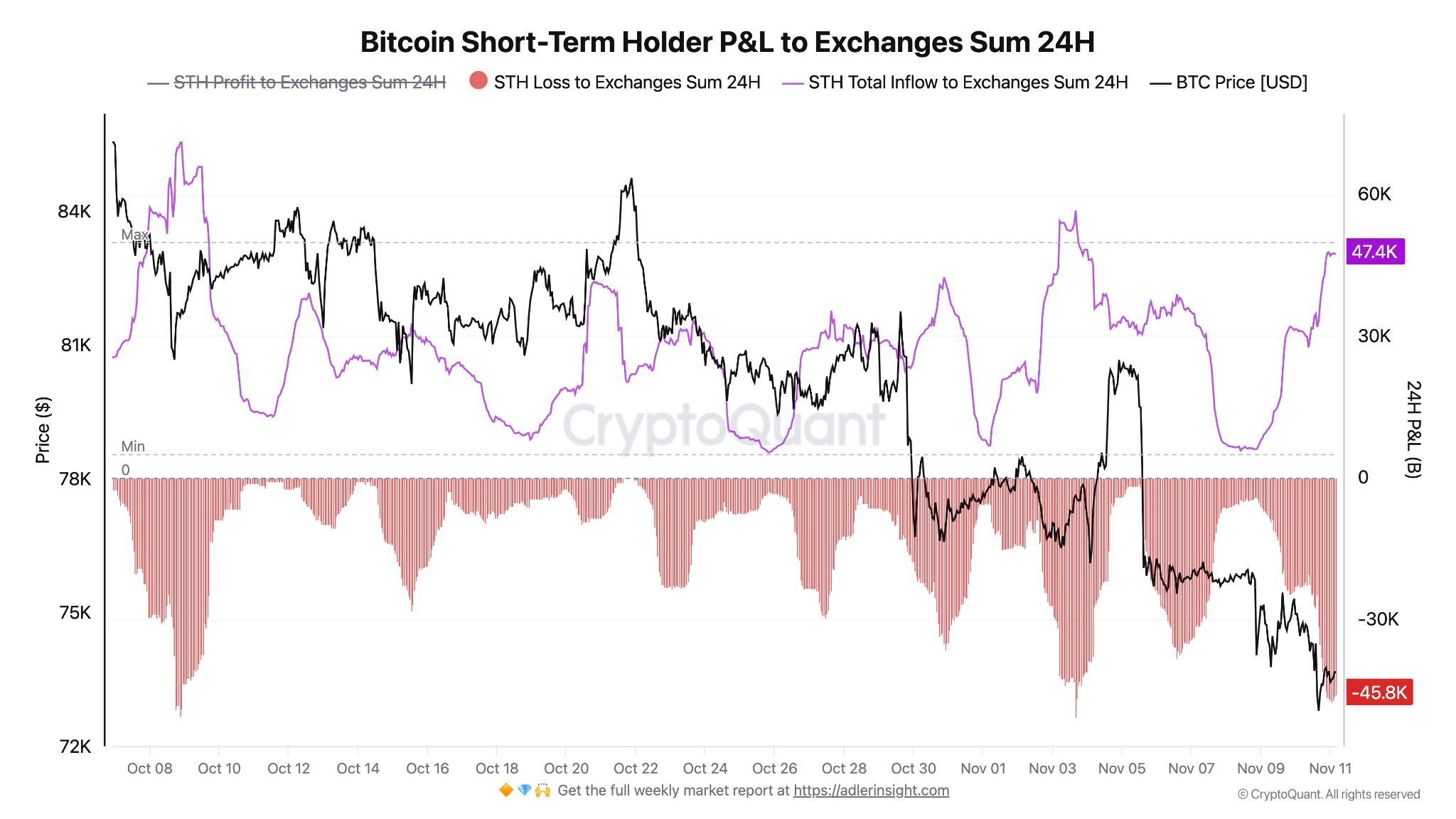
Bitcoin short-term holders capitulated in significant numbers on Tuesday, transferring more than 47,000 BTC to cryptocurrency exchanges while nursing steep unrealized losses. The wave of underwater deposits coincided with a sharp market pullback that dragged the world’s largest cryptocurrency down to an 11-week low, reigniting concerns among analysts that the broader bearish trend initiated late last year may still be firmly in control.
Short-Term Holders’ Underwater Exchange Inflows Rank Third Since July
Data published by onchain analytics platform CryptoQuant reveals that short-term investors sent a staggering 47,025 BTC carrying unrealized losses to centralized exchanges during the 24-hour window leading up to midnight UTC at the start of Wednesday. This massive influx ranks among the largest single-day volumes recorded over the four months of historical metrics tracked by the platform.
The capitulation event materialized as Bitcoin’s price slipped to $72,670, marking its weakest valuation since August 20. In the context of onchain analytics, the short-term holder (STH) cohort encompasses addresses holding coins for up to 155 days. Market participants in this group are historically recognized as being far more reactive to short-term price fluctuations, demonstrating a heightened propensity to panic-sell or cut losses when macroeconomic conditions deteriorate or local supports break.
The severity of the sell-side pressure is further highlighted by the stark ratio of profitable versus unprofitable transfers entering exchanges. CryptoQuant noted that on November 10, profitable transfers hovered near a meager 1,700 BTC. This imbalance meant that approximately 27 bitcoins were deposited at a loss for every single bitcoin transferred at a profit.
Prior to this week, the largest 24-hour inflow of underwater Bitcoin assets since late July was recorded on October 8, occurring just hours after the asset retreated to the $80,000 threshold. During that event, rolling 24-hour inflows peaked at roughly 50,500 BTC, demonstrating a recurring behavioral pattern among retail-heavy and newer cohorts whenever crucial psychological price supports give way.
CryptoQuant Analyst Flags $73,000 as Bitcoin Tests August Lows
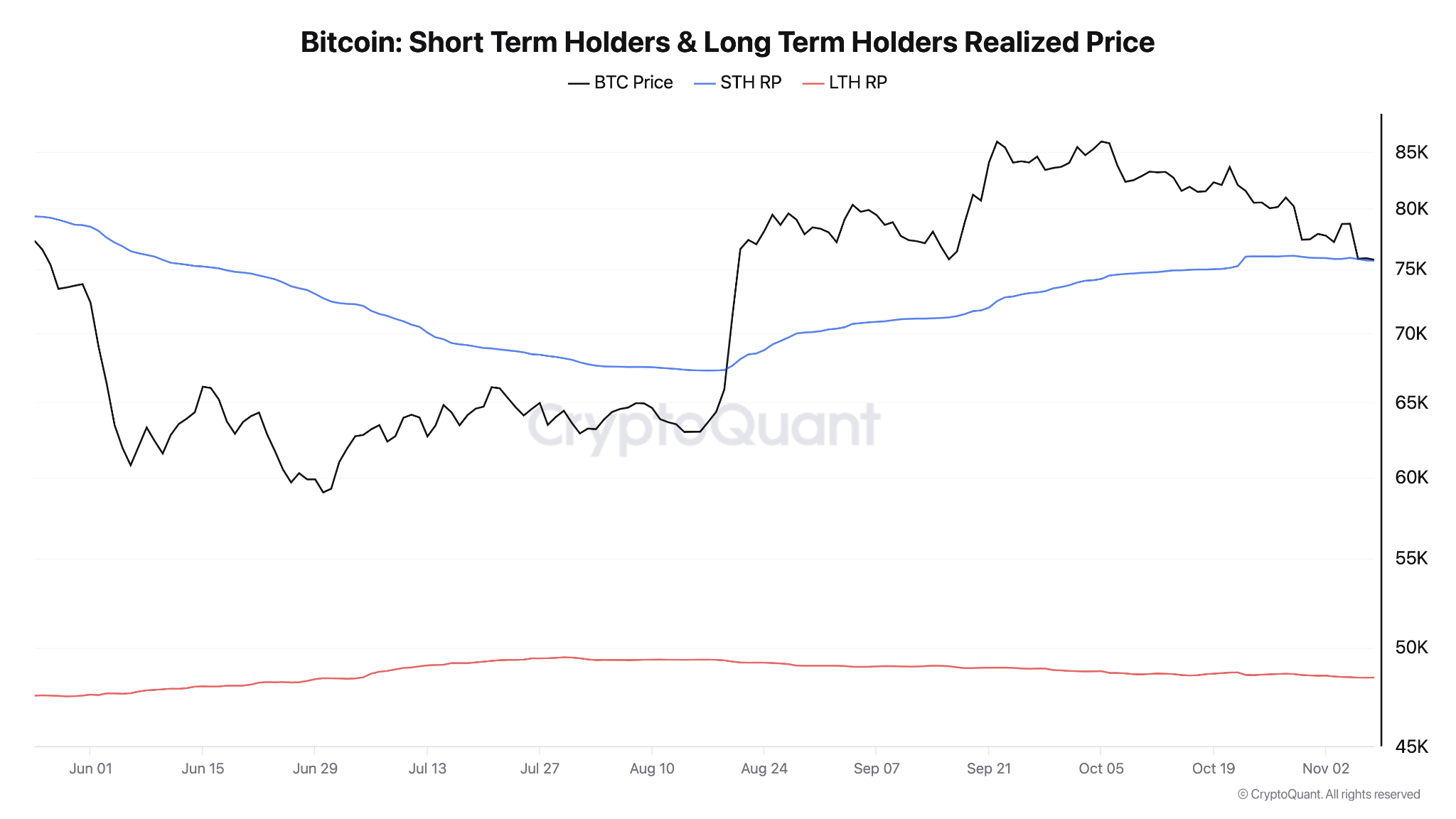
The psychological and financial threshold for newer market participants has become a central focus for analysts examining current market structures. Previous reports from market researchers outlined that the average cost basis for short-term holders hovered near $75,700, meaning a vast majority of coins accumulated over the past five months were technically under water once prices slid beneath that level.
Throughout the summer, this cohort experienced shifting market dynamics. Short-term holders successfully transitioned into an aggregate unrealized profit position on August 20 as Bitcoin staged a vigorous rebound toward the $80,000 mark. However, deteriorating market conditions rapidly eroded those gains, pushing the cohort back into an aggregate unrealized loss by Friday.
Julio Moreno, head of research at CryptoQuant, suggested that the recent price action indicates Bitcoin may still be trapped within the broader downtrend that originated back in November 2025. In market commentary shared on Monday, Moreno cautioned that persistent failures to break out above the cohort’s aggregate cost basis point to underlying structural weakness.
"If rallies keep stalling near the cohort’s cost basis and net unrealized losses deepen, the August rebound starts to look like a pause in the broader downtrend," Moreno wrote. "A sustained break below $73,000 followed by a failed retest from below would strengthen the case for bear-market continuation."
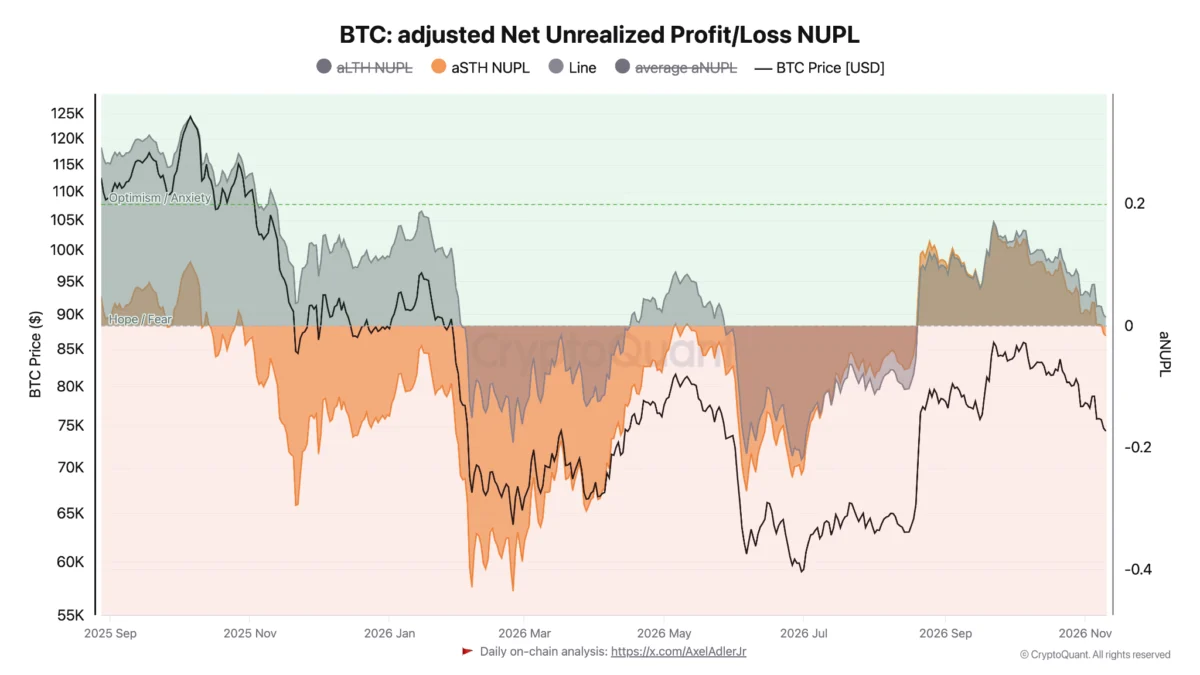
Additional insights from CryptoQuant’s net unrealized profit and loss (NUPL) indicator illustrate the magnitude of the recent sentiment shift. The metric reveals that short-term investors enjoyed their highest level of unrealized profitability since November 2025 during September, when Bitcoin climbed aggressively toward $87,200. The swift reversal from September’s euphoric highs to the current wave of distress underlines the volatile nature of holding digital assets through macro-driven market cycles.





Comments (0)