


Crypto markets and broader risk assets are continuing to display pronounced weakness as the year draws to a close, offering little in the way of holiday cheer for investors and traders alike. Across both traditional and digital asset classes, market participants are actively searching for a durable fundamental floor. This search is increasingly being driven by fundamental underlying flows, such as institutional capital entering via exchange-traded funds (ETFs) or aggressive token buyback programs executed directly by decentralized finance protocols.
The persistent downward pressure underscores a broader sentiment of caution as liquidity thins out heading into the final weeks of the year. While macroeconomic headwinds continue to weigh heavily on investor appetite, market analysts are closely monitoring specific sectors and token categories to gauge where structural support might finally materialize.

Indices
This week closes out with continued weakness across the board, and in crypto risk in particular. Both the S&P 500 and the Nasdaq 100 moved over one percent lower this week, reflecting a broader risk-off sentiment sweeping through global financial markets. Amid this widespread pullback, gold stood out as virtually the only major instrument showing consistent resilience and relative strength.
Concurrently, every single cryptocurrency index tracked by analysts traded lower throughout the week, painting a grim picture for digital asset holders. Notably, however, a few specific segments showed relative resilience. Exchange tokens, buyback leaders, and the 2025 crypto equity cohort managed to outperform bitcoin intra-week, whereas almost everything else underperformed significantly.
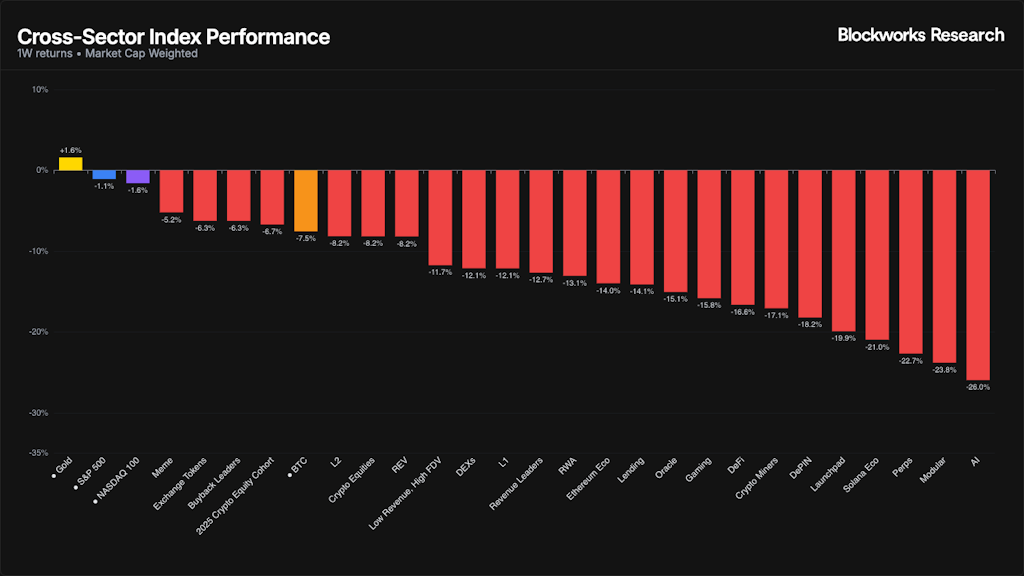
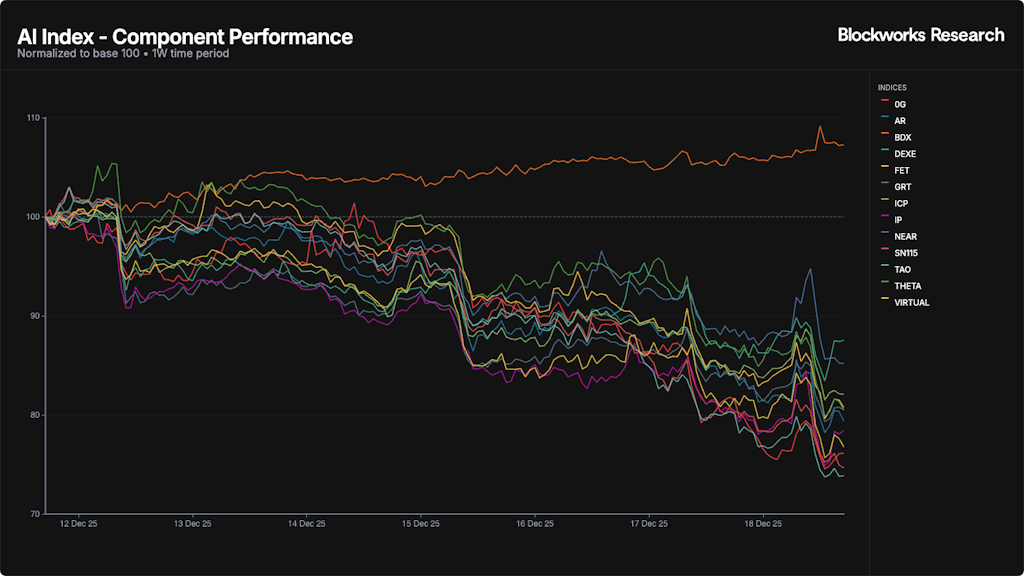
The artificial intelligence sector bore the brunt of the selling pressure, emerging as the top loser on the week with a staggering 27 percent decline. This downside was spearheaded by TAO, which notched troubling new multi-month lows. The sharp reversal is particularly stark given that TAO had reigned as one of the market’s top-performing assets just a couple of months prior in October.
Broadly speaking, the crypto market continues to grind lower in a persistent downtrend. Major digital assets such as bitcoin, ethereum, and solana are all exhibiting notable weakness, while longer-tail alternative tokens are suffering even more severe downward movements. The overarching narrative remains centered on risk assets hunting for a fundamental floor. Market observers suggest that prices may continue to drift lower until valuations and protocol buybacks become far too compelling to ignore, allowing cashflow-driven buyback flows to establish a definitive cyclical low. Similarly, major assets like bitcoin and ethereum likely require a meaningful uptick in spot ETF inflows to cement their bottoms, a stark contrast to the anemic support provided by these investment vehicles over the past several weeks.
Weekend Reading
As market participants navigate the ongoing market downturn, several key industry commentaries, research reports, and structural critiques have captured the attention of analysts and investors looking to understand the deeper forces shaping the financial landscape.
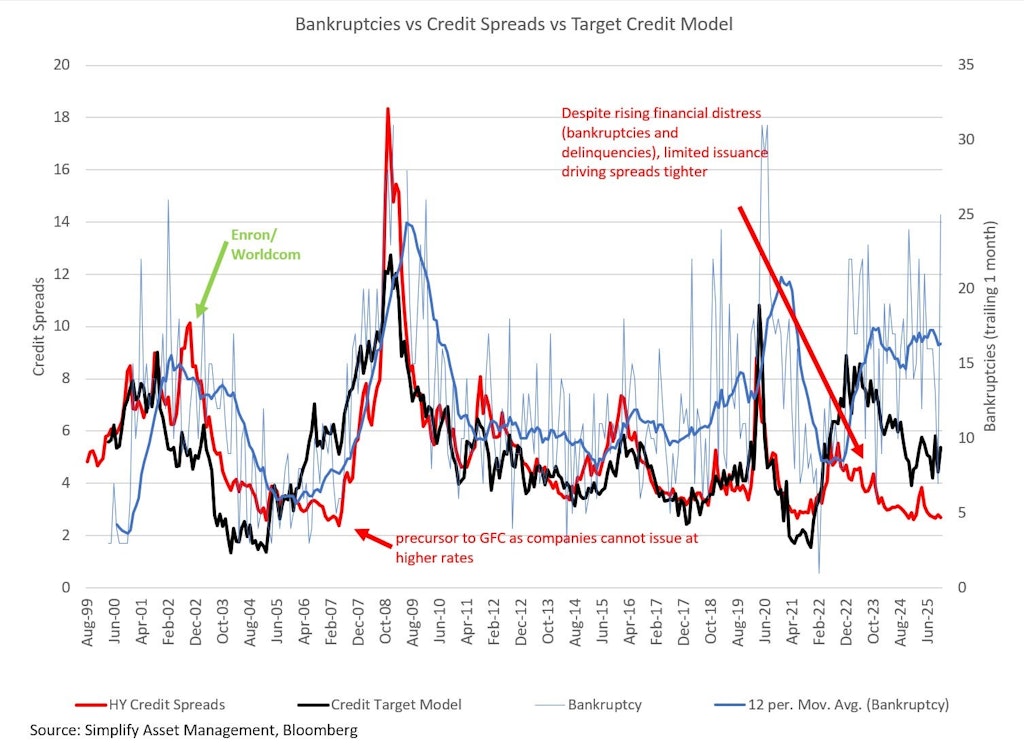
In a newly published blog post titled "Taking a Step Back to Step Forward," Michael W. Green reframes the precarity of the United States economy through a rigorous structural and mathematical lens. Drawing heavily upon Ole Peters’ theoretical framework known as the "Equation of Life," Green argues that wealth naturally tends to concentrate in the absence of explicit redistribution mechanisms, ultimately fueling systemic wealth inequality. Furthermore, he offers sharp critiques regarding distorted consumer price index (CPI) measurements, technocratic complacency among policymakers, and systemic housing scarcity, characterizing all of these factors as core mechanisms of economic extraction. With credit spreads remaining artificially tight despite a rising tide of corporate and consumer defaults, Green warns of underlying financial fragility. He ultimately issues a call for heightened civic engagement and institutional accountability, setting the groundwork for subsequent essays and political interviews centered on systemic financial reform.
Meanwhile, the Sky Frontier Foundation released a comprehensive research report titled "Annual State of Sky Ecosystem," detailing the protocol’s major operational milestones and robust financial growth throughout 2025. According to the report, the Sky Ecosystem witnessed an impressive 86 percent expansion in the supply of its USDS stablecoin, bringing total circulation to $9.86 billion and comfortably outpacing the growth rate of the broader stablecoin sector. Furthermore, the Sky Protocol demonstrated significant economic viability by generating $435 million in revenue and $168 million in net profits, which in turn facilitated substantial SKY token buybacks and attractive staking rewards. Bolstered by newfound regulatory clarity stemming from the GENIUS Act and the rollout of multiple Sky Agent products, the report projects strong institutional adoption and continued protocol expansion moving into 2026, solidifying Sky’s position as a prominent leader in the decentralized, yield-bearing stablecoin market.
In the realm of institutional adoption and tokenization, Omid Malekan published a critical blog post titled "Beware the Lofty Promises of TradFi Firms Embracing Tokenization." The piece offers a scathing critique of traditional financial institutions—including heavyweights like the DTCC, Visa, SWIFT, Stripe, and PayPal—for selectively embracing the technical benefits of blockchain infrastructure while conveniently ignoring the existential threats such technology poses to their legacy business models. Malekan argues that while these legacy firms loudly tout the virtues of tokenization, they actively avoid true decentralization, thereby risking the co-optation of crypto’s core values. He warns that the proliferation of permissioned, private chains combined with heavy regulatory lobbying threatens to dilute crypto’s foundational principles. While acknowledging the necessity of engaging with traditional finance, Malekan urges the digital asset community to vigorously defend public, permissionless networks and resist compromising core decentralization in pursuit of mainstream corporate adoption.

Finally, a widely discussed commentary published on social media by user @DeFi_Cheetah tackled the complex mechanics of stablecoin adoption, arguing under the title "It’s Not ‘No One Wants Non-USD Stables’ — It’s ‘No Banks Want Non-USD Inventory.’" The analysis posits that the primary barrier hindering the widespread adoption of non-USD stablecoins is not a lack of organic market demand, but rather deep-seated structural limitations embedded within the global banking system. The piece dissects how stringent Basel III banking regulations, ongoing liquidity constraints, and punitive G-SIB (Global Systemically Important Bank) capital penalties actively discourage traditional financial institutions from holding non-USD currency inventories or servicing emerging market corridors. The resulting dynamic creates a severe liquidity vacuum within non-USD foreign exchange markets. The author concludes by advocating for decentralized finance-native solutions to bootstrap non-USD stable liquidity from the ground up, warning that relying on legacy traditional foreign exchange infrastructure is an approach bound to fail by design.





Comments (0)