



The cryptocurrency market experienced a fragmented and turbulent holiday-shortened trading week, with Bitcoin managing to secure marginal gains while wider asset classes experienced sharp divergences across various sectors. As investors closed the books on a dramatic prior year marked by rapid narrative shifts and evolving macroeconomic pressures, capital flows remained deeply uneven. While foundational heavyweights like Bitcoin finished the week in the green, underlying market dynamics revealed a stark contrast in performance, highlighted by an unexpected resurgence in historically beaten-down sectors alongside continued sluggishness in digital asset treasuries and institutional-facing yield plays.

During the truncated equity and derivatives trading week, Bitcoin managed a modest 1.6% advance, weathering ongoing chop and volatile market liquidity. However, this headline stability masked a volatile undercurrent running through the broader altcoin economy. Market participants entering the new trading period found themselves navigating a landscape where capital rotated rapidly, resulting in profound performance gaps between disparate crypto sub-sectors.
The most notable development of the week materialized in the form of a sharp, counter-trend rally across Decentralized Physical Infrastructure Networks (DePIN) and the gaming sector. Both categories led all tracked market indices with impressive weekly gains of 13.1% and 12.6%, respectively. This sudden outperformance caught many market analysts off guard, particularly given that both DePIN and gaming endured a punishing prior year, having suffered steep annual drawdowns of roughly 79.5% and 81.3% throughout the course of 2025.
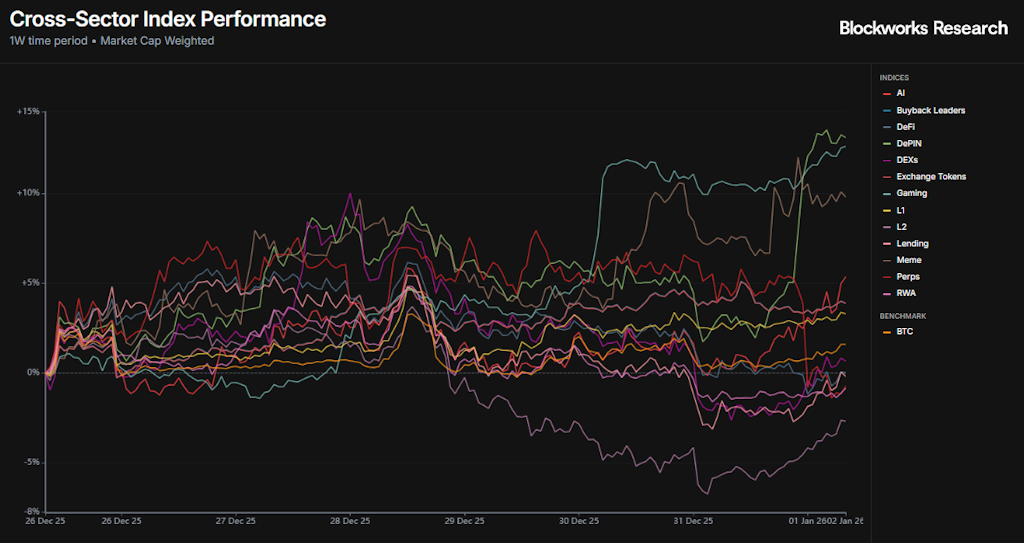
A closer examination of the underlying asset movements reveals that the DePIN sector’s strength was propelled largely by Filecoin and Render, which posted weekly advances of 22% and 13% respectively. Together, these two prominent assets account for nearly half of the sector’s total index weighting. The gaming sector mirrored this concentration of momentum, with Immutable (IMX) surging 11% to provide the primary catalyst and heavy lifting for gaming tokens as a whole.
Conversely, other prominent sectors faced persistent headwinds. Layer-2 scaling solutions and Real-World Asset (RWA) tokens lagged the broader market, slipping 2.67% and 0.84% respectively over the course of the week. Weakness within the Layer-2 ecosystem was spearheaded by tokens such as MNT and ZORA, which retreated by 5.7% and 6.4%. Interestingly, this downward pressure was not uniformly distributed across the scaling ecosystem; other major Layer-2 assets including Optimism, Arbitrum, and ZK registered robust weekly gains ranging between 10% and 20%, further underscoring the high degree of fragmentation and sector-internal divergence characterizing the current market cycle.
Meanwhile, the Real-World Asset segment faced downward pressure primarily driven by a broader macroeconomic pullback in gold following its stellar performance throughout the previous year. Tokenized gold products such as PAXG and XAUT both retreated by roughly 3.4% over the weekly tracking period, reflecting the sensitivity of crypto-native RWAs to traditional commodity market corrections.
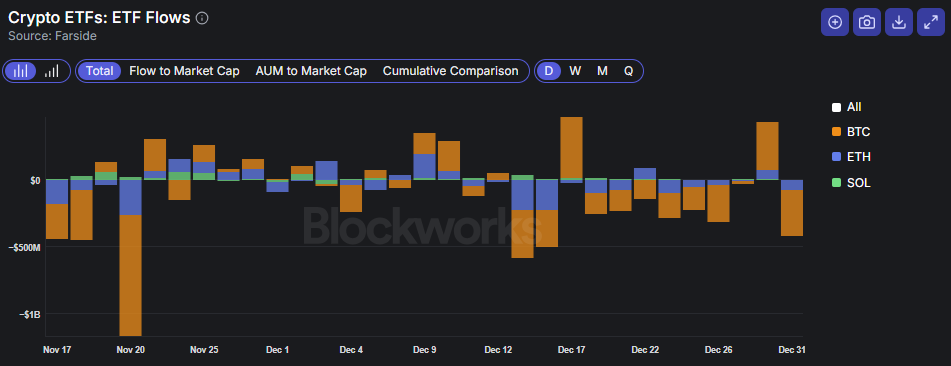
Overall capital flows continued to exhibit extreme choppiness, reflecting an institutional and retail investor base still hesitant to commit definitive directional capital as the new calendar year commenced. This choppy behavior was vividly demonstrated in exchange-traded fund flow data. On the final day of December, spot exchange-traded funds experienced significant net outflows totaling $417.8 million. This substantial withdrawal of capital almost entirely erased the $428.2 million in net inflows recorded during the preceding trading session, illustrating the day-to-day volatility and lack of sustained directional conviction among institutional market participants.
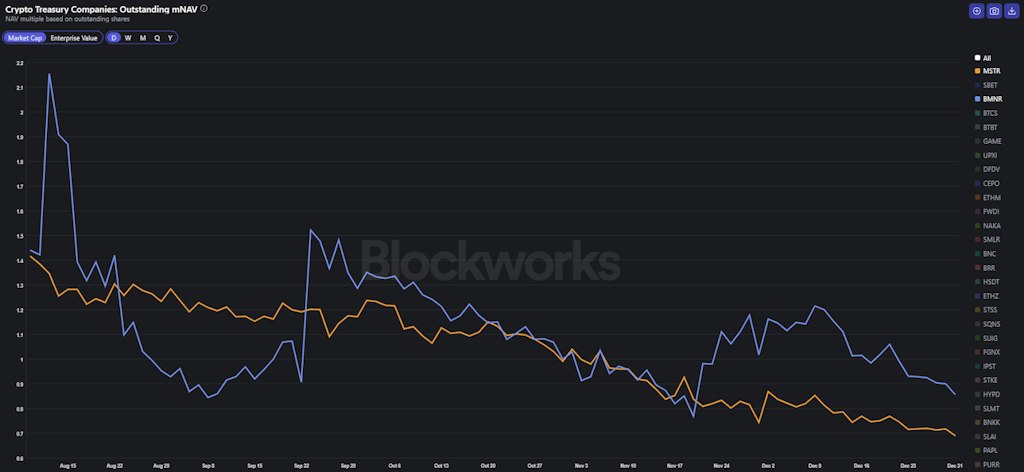
Digital asset treasuries also continued to feel intense market strain as the new year dawned, with modified net asset value multiples experiencing continued compression. Prominent corporate and institutional treasury vehicles such as MicroStrategy and other digital asset holding structures traded at compressed mNAV levels of 0.69 and 0.85, respectively. These compressed multiples highlight the ongoing financial pressures facing the corporate crypto treasury trade, signaling a more conservative valuation environment as firms navigate the opening weeks of the year.
As market participants search for structural insight and thematic direction for the year ahead, industry research groups have released a series of comprehensive end-of-year analyses examining the evolutionary trajectory of stablecoins, payment rails, cross-chain infrastructure, and the underlying speed of narrative cycles.
One prominent analysis focuses on the evolving landscape of institutional-grade yield generation within the stablecoin economy. Observers note that new decentralized finance primitives are successfully bridging traditional over-the-counter arbitrage mechanisms into standardized stablecoin wrappers. By offering market-neutral yields that remain less dependent on traditional perpetual funding rate cycles than earlier synthetic dollar models, these emerging frameworks are capturing early institutional attention. Analysts point out that sustainable long-term success in this arena will heavily depend on robust counterparty execution, sophisticated liquidity management, and scalable deployment into hedged over-the-counter deals. If these emerging yield structures can maintain attractive double-digit returns while expanding their total value locked, they threaten to establish a new structural baseline for institutional stablecoin adoption.
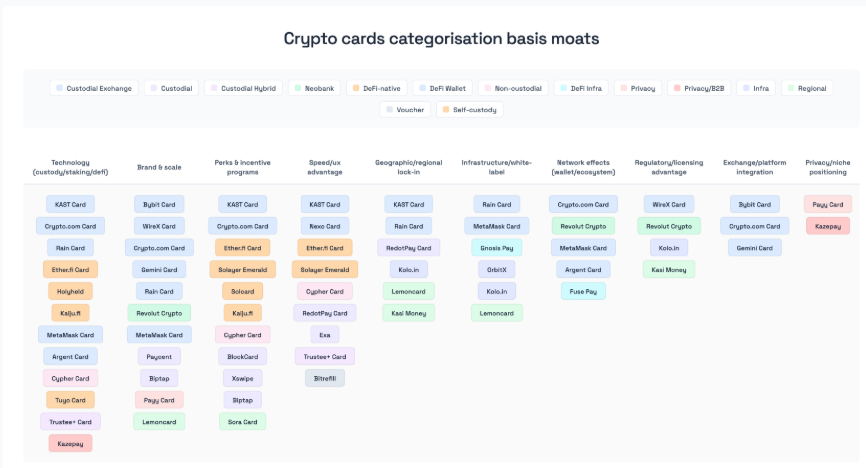
Simultaneously, research examining the payments and neobank landscape indicates that the crypto-powered card sector has reached a critical strategic inflection point. Value creation within this space is visibly shifting away from superficial consumer rewards, cashback incentives, and marketing-driven branding toward foundational infrastructure, regulatory compliance, and direct liquidity control. Industry evaluations suggest that the most durable competitive moats belong to entities that own critical primitives, such as regulated access points, programmable liquidity layers, and deep banking integrations. As global regulatory oversight tightens across major jurisdictions, future market dominance will increasingly favor infrastructure providers and DeFi-native card models that retain firm control over licensing, settlement mechanics, and compliance workflows rather than consumer-facing distribution platforms relying purely on unsustainable subsidies.
On the infrastructure front, comprehensive reviews of cross-chain activity throughout the past year demonstrate that interoperability has definitively graduated from theoretical architecture to become the default foundational layer for the digital asset economy. Data underscores a structural shift where tokenized assets and stablecoins are increasingly distributed across a vast array of distinct blockchain networks rather than remaining siloed within isolated ecosystems. This seamless connectivity has dramatically accelerated asset velocity, capital mobility, and global access. Rather than individual layer-1 networks competing in isolation, the modern cryptocurrency economy increasingly operates as a unified, interconnected network where capital and data move fluidly to wherever economic demand dictates. The adoption of message-based transfer primitives has successfully reduced friction and transaction overhead, rendering cross-chain interactions increasingly akin to traditional backend software rather than cumbersome financial transfers.
Finally, macroeconomic and sector retrospectives examining the frantic pace of market trends over the previous twelve months highlight a year defined by rapid narrative cycles that frequently generated public attention and speculative fervor far faster than they could be fundamentally validated. This velocity led to widespread market fatigue and heightened skepticism among retail and institutional observers alike. While many high-flying narratives faded rapidly into obscurity, a select subset successfully translated into tangible, real-world use cases that propelled the industry forward, particularly in areas characterized by frictionless, intuitive onboarding. Memecoins vividly demonstrated the extreme velocity with which users can be onboarded into decentralized networks, while simultaneously exposing the inherent fragility of engagement lacking structural retention mechanisms. Conversely, experimental incentive-driven models highlighted persistent quality and trust challenges. The most definitive and lasting progress materialized precisely where the asset class demonstrated undeniable product-market fit, most notably within stablecoins, decentralized prediction markets, and robust payment rails. This divergence reinforces the underlying reality that durable, long-term market value ultimately emerges only when speculative narratives align directly with genuine structural utility.





Comments (0)