



Published August 19, 2026
The race for dominance in the artificial intelligence application layer is evolving past simple user interfaces, standard workflows, and go-to-market strategies. Industry leaders increasingly view the competition as a fundamental battle for the intelligence layer itself. As adoption matures across sectors, the core question facing enterprises is no longer just how to integrate AI, but who should ultimately own the intelligence driving their business operations.
This strategic shift has sparked widespread debate among technology leaders. Palantir CEO Alex Karp recently urged enterprises to "own the means of production," a call to action mirrored by Microsoft CEO Satya Nadella, who cautioned that purchasing intelligence from a frontier lab carries a hidden toll. According to Nadella, relying entirely on external labs means paying twice: once with monetary capital and a second time with the proprietary domain knowledge revealed to make those general models useful.
Industry observers emphasize that owning core intelligence does not serve as a mandate to abandon frontier labs entirely. For numerous general workloads, frontier APIs and off-the-shelf agents remain the most practical solution. However, across prominent venture portfolios and tech ecosystems, a growing number of companies are actively building internal AI capabilities. These organizations are vertically integrating to shape their own model weights for specific product segments, shifting the strategic landscape of enterprise software.

To examine this transition, venture capital firm Sequoia recently hosted a gathering of AI founders and builders to discuss the mechanics of owning the AI stack. The event featured operational insights from legal AI pioneer Harvey, alongside technical breakdowns from companies like Mercor, Langchain, Trajectory, and Fireworks, highlighting how the independent post-training stack has evolved to support enterprise autonomy.
Why Now? The Maturity of Open-Weight Models and Post-Training
Two major developments are driving this movement toward intelligence ownership. First, the open-weight frontier has advanced at a pace that has consistently exceeded expectations. Platforms such as Kimi K3 and GLM 5.2 have demonstrated exceptional performance capabilities, fundamentally altering the economics of model deployment. In earlier phases of the AI boom, training or fine-tuning on open models often felt like running on a treadmill; engineering teams could spend months optimizing an open model only for a subsequent frontier release to instantly erase their competitive gains. Today, teams can begin from an open baseline that sits remarkably close to the frontier.
Second, the independent post-training stack has reached a level of maturity that was unavailable just a year ago. Through infrastructure providers like Mercor and Fireworks, enterprises now have access to the comprehensive technology stack previously restricted to frontier research labs—spanning from large-scale training and inference to human and synthetic data generation. Equipped with robust evaluation frameworks, harness engineering, advanced post-training, and online learning loops, open models can now outperform general frontier models within distinct, specialized domains.
While utilizing open weights once required significant compromises in performance and reliability, it has rapidly transformed into an existential and strategic decision. The new battleground is no longer confined to user interfaces or proprietary product wrappers; it centers directly on foundational intelligence.

When Enterprises Choose to Make the Move
There is no universal blueprint for deciding when to transition from renting intelligence to owning it. Beyond raw performance metrics, companies often encounter architectural and economic constraints when relying exclusively on external APIs. These limitations generally stem from four primary pressures.
The first factor is cost. As an AI-powered product scales and achieves market success, its underlying AI cost of goods sold (COGS) scales in tandem. When inference expenses are directly tied to user volume, owning and self-hosting an optimized model becomes the most viable method for protecting operating margins.
The second factor is speed. In high-velocity domains such as real-time code autocompletion or cybersecurity threat detection, a smaller, highly distilled custom model frequently outperforms a massive general-purpose model simply because latency is paramount.
The third factor involves proprietary data. When user feedback, rigorous evaluations, customer interactions, and deeply guarded domain data constitute the primary catalysts for system improvement, enterprises often prefer keeping those operational feedback loops strictly within their internal perimeters.
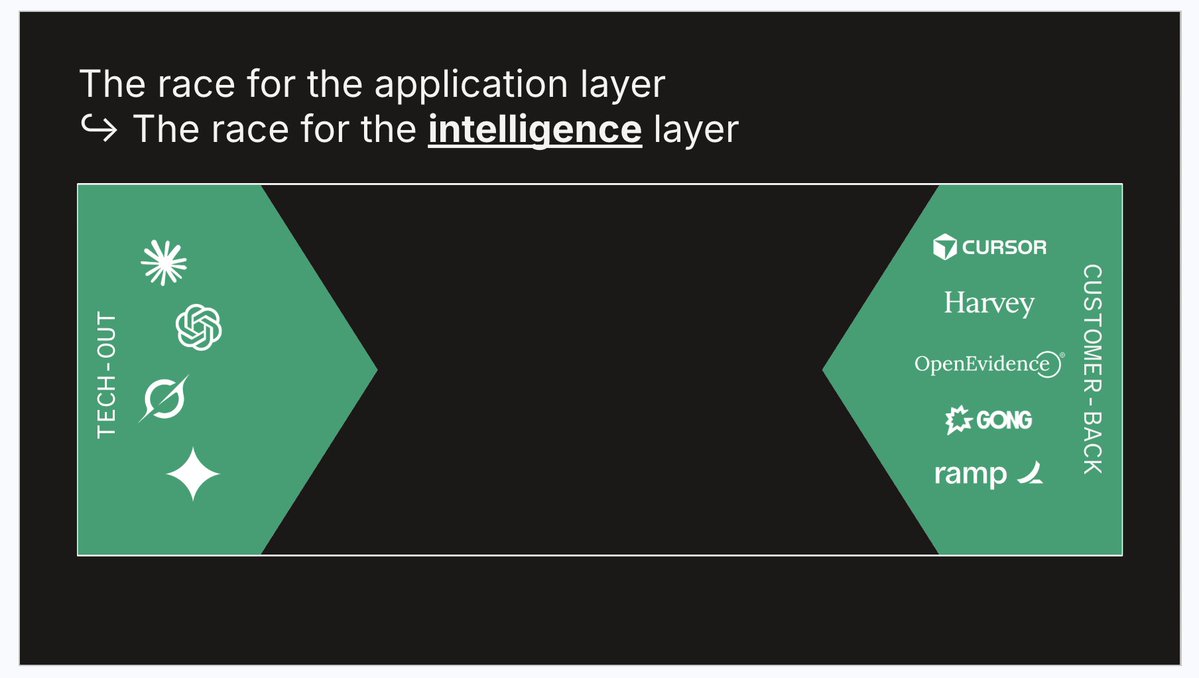
Finally, companies are seeking to control their own long-term destiny. The application layer and the intelligence layer are increasingly converging. Frontier labs are pushing upward into traditional application software, while application companies are moving downward into the training loops that dictate how their products think. Controlling the product experience increasingly means retaining direct authority over the underlying learning loop and the intelligence itself, a strategy championed by modern tech firms including Harvey, RampLabs, Glean, and Factory.
Building the Team and the Technical Roadmap
For organizations that decide to establish ownership over their intelligence layer, the immediate challenge lies in navigating the transition from zero to one. Industry leaders advise against shoehorning AI model development into an existing, generic platform team. Instead, successful initiatives typically rely on small, dedicated teams playing an offensive strategy—focusing on building evaluations, shaping proprietary datasets, experimenting with open-source models, tuning harnesses, and driving domain-specific performance. Notable innovators have demonstrated that remarkably lean groups can achieve outsized results; legal tech firm Harvey, for instance, conducted substantial model research with a core research team of just seven individuals.
Furthermore, technical leadership requires making development work visible to the broader ecosystem. As enterprise buyers evaluate potential AI partners, published research, transparent benchmarks, and technical documentation frequently serve as the ultimate tiebreaker.
The technical execution of this strategy generally follows a four-part framework encompassing evaluations, harness engineering, post-training, and online learning.

Establishing rigorous evaluations—or evals—serves as the foundational prerequisite. As observed by Harvey’s Gabe Pereyra, operating without a reliable benchmark makes systematic model training impossible. An eval consists of a standardized set of tasks measuring whether a system can execute specific work, paired with context and an automated or expert grader. Harvey demonstrated this approach by constructing its Legal Agent Benchmark, which translates real-world legal workflows into discrete tasks spanning multiple practice areas and evaluated against thousands of expert rubric criteria. Maintaining clear evals allows organizations to make objective, data-driven decisions regarding model selection rather than relying on subjective intuition.
Once evaluation metrics are established, organizations must focus on harness and context engineering. An AI agent fundamentally comprises three components: the model, the context, and the harness. The harness governs the product logic surrounding the model, handling routing, data retrieval, tool execution, memory management, fallback protocols, and operational traces. As LangChain founder Harrison Chase noted, the primary responsibility of the harness is supplying the model with the correct context at the precise moment it is needed. A well-engineered harness enables developers to route specific tasks to the most suitable model, apply uniform evaluations across various architectures, and maintain full inspectability over every agent action.
Post-training techniques represent the next phase, with the specific methodology determined by the precise bottleneck a team wishes to address. Industry practitioners note that if a model simply lacks factual knowledge, post-training is unnecessary; standard retrieval-augmented generation (RAG) or context expansion will suffice. If a model struggles with output formatting or behavioral consistency, supervised fine-tuning is typically applied. For challenges related to subjective product taste, preference tuning is preferred, while reinforcement learning is utilized to enhance specialized task execution. When models prove too slow or resource-intensive for production environments, distillation techniques are deployed to reduce overhead while preserving capability.
The final operational layer involves online learning. While frontier models continuously advance in general intelligence, deploying a powerful model into a specific enterprise environment often resembles a new employee’s first day on the job. Without domain-specific experience, even the most capable intelligence lacks contextual familiarity. AI agents generate that operational experience dynamically as they operate in production. By capturing trajectories—the specific context observed by the model, the tools and sub-agents invoked, the generated answers, and subsequent user modifications—teams can establish a continuous production feedback loop. Failed tasks are converted into new evaluation benchmarks, missing information is integrated into context systems, and suboptimal tool responses drive immediate harness improvements.

Ultimately, navigating this architectural shift opens up new possibilities for product differentiation. While relying entirely on the closed-model stack offers simplicity, high baseline performance, and rapid initial deployment, it also imposes a restrictive ceiling on long-term capability. Taking control of the intelligence stack requires accepting greater operational complexity, but it unlocks unprecedented potential for customization and competitive advantage.
While major AI laboratories will continue to develop massive general-purpose models that serve as valuable foundational tools for the broader industry, the most innovative product companies are simultaneously cultivating their own specialized intelligence systems. These localized models are fast, highly opinionated, domain-obsessed, and precisely tuned to the unique workflows they encounter, pointing toward an ecosystem where enterprise individuality and customized intelligence thrive in tandem.




Comments (0)