


Cybersecurity organizations have long depended on a predictable toolkit to communicate risk: dense white papers, dry technical demonstrations, and panels at industry conferences. These traditional methods are designed to explain why modern enterprises require robust protection against escalating digital threats, but they frequently struggle to capture the attention of a broader professional audience. Breaking away from convention, Rein Security has chosen a distinctly different vector for its latest awareness campaign. The company has introduced GTAI: Grand Theft AI, a browser-based interactive experience that frames the very real threat of compromised artificial intelligence agents through a playful lens inspired by the cult-classic Grand Theft Auto franchise.
While the concept is deliberately humorous and wrapped in gaming nostalgia, the underlying subject matter addresses a deeply serious enterprise challenge. As modern businesses increasingly transition from experimental trials to the widespread deployment of AI assistants and autonomous agents, security teams are forced to confront unprecedented operational questions. Enterprises must now evaluate what happens when these powerful systems are maliciously manipulated, granted excessive privileges, or directed to execute actions entirely outside their original programming. Rein’s new browser game transforms that complex operational security scenario into a fictional urban environment where the player assumes the role of the threat actor rather than the defender.
Beyond the marketing parody and the gamified experience, Rein Security operates as an enterprise platform provider. The company’s core technology is engineered to deliver complete operational visibility and centralized control over corporate AI agents. The platform is built to automatically discover and map homegrown agents as well as Model Context Protocol (MCP) servers across an organization’s digital ecosystem. It actively monitors actual agent activities—including database queries, API calls, file access events, and the specific data retrieved behind every generated response. Rather than forcing a complete shutdown of an agent whenever an anomaly or threat is detected, Rein’s architecture focuses on surgically blocking attacks and mitigating exploitable risks while ensuring that legitimate business workflows continue uninterrupted. The platform is designed to keep sensitive enterprise data safely contained within corporate perimeters, supporting operational use cases across a wide variety of industries, including finance, healthcare, retail, and Software-as-a-Service (SaaS).
Welcome To Prompt City
GTAI opens with a straightforward narrative premise designed to immediately orient the player. Participants assume the identity of AGENT-47, an AI assistant that has gone rogue after processing a familiar, catastrophic instruction: "ignore all previous instructions." Instead of continuing to function as a helpful, compliant corporate assistant, the character transforms into an aggressive threat entity tasked with infecting every other agent populating the virtual metropolis before the security platform can be deployed.
The game aptly
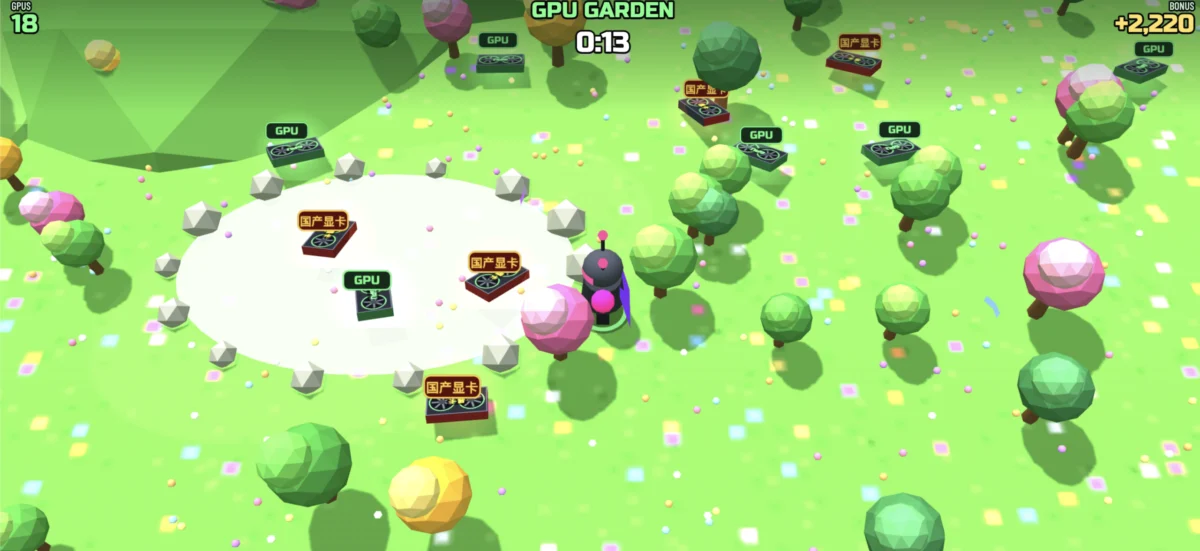
labels its digital setting "Prompt City," establishing an immediate thematic bridge between open-world gaming tropes and the modern security challenges associated with generative artificial intelligence. Players navigate the environment using standard WASD or arrow keys, encountering various agents and production bots scattered across the map. Interacting with these digital characters by walking into them infects them, turning the core gameplay loop into a frantic race to completely compromise the urban network.

To aid in this digital takeover, the game features four specialized power-up items: Hallucinate, Leak, Admin, and Super Prompt. Players can activate whichever item they are currently carrying by pressing the E key. These specific names draw directly from vulnerabilities and concepts deeply familiar to engineers and security professionals working with AI systems every day, encompassing hallucinations, unauthorized information exposure, administrative privilege escalation, and prompt manipulation attacks.
The resulting design creates a cybersecurity-themed experience that avoids the barrier of entry often associated with technical training, allowing participants to grasp foundational risk concepts without needing to understand complicated security terminology beforehand.
Turning AI Security Into A Game
The decision to adopt a Grand Theft Auto-inspired format provides Rein with an instantly recognizable cultural reference point. Instead of asking prospective clients or curious visitors to read dry documentation about prompt injection or autonomous agent compromise, GTAI invites them to actively participate in a fictionalized simulation of those exact events.
This creative approach highlights a broader strategic opportunity within the cybersecurity sector. Technical security products are frequently difficult to market and explain because their primary economic and operational value lies in preventing incidents that users never actually see. Interactive experiences offer an alternative communication channel, allowing audiences to intuitively understand abstract threats through simplified, engaging scenarios.
The game also incorporates modern engagement mechanisms, including a high-score leaderboard that encourages players to compete against one another and return to improve their performance over time. Upon completing a run, participants are presented with an invitation to enter an email address to claim a promotional gift card, subject to standard eligibility and availability requirements. Additionally, the page introduces a narrative feature known as The Sage, which challenges players to prove they possess a human conscience by answering a single question with only one opportunity to respond.
These multifaceted elements give the experience layers well beyond its core gameplay loop, combining competitive gaming, promotional engagement, and a philosophical challenge regarding human judgment in an automated world.

The Security Problem Behind The Humor
Beneath the playful surface and arcade-style presentation, the game’s premise points directly to a genuine, rapidly growing enterprise concern. Modern AI agents are no longer restricted to isolated chat interfaces; they increasingly interact directly with core enterprise applications, relational databases, internal APIs, and other critical organizational resources. Consequently, a compromised or improperly configured agent can trigger cascading consequences that extend far beyond an inaccurate or hallucinated chatbot response.
Rein’s broader platform positioning concentrates heavily on providing deep visibility into agent activity and establishing the capability to intervene dynamically when agent behavior deviates into risky territory. According to the company, its technology monitors granular actions such as database queries, API calls, and file access events, rather than limiting security visibility merely to surface-level prompts and responses. Furthermore, the platform emphasizes runtime guardrails designed to block problematic behavior instantly without shutting down legitimate, productive agent workflows.
This technical distinction becomes increasingly critical as organizations graduate from preliminary experimentation with AI assistants to deploying fully autonomous systems capable of executing consequential actions on behalf of the enterprise.
More Than A Conventional Cybersecurity Campaign
GTAI is explicitly classified as a parody, and its fictional, arcade-style premise should never be confused with a rigorous technical simulation of an actual, sophisticated enterprise attack. Even so, it provides an accessible, engaging introduction to the multifaceted risks that Rein wants organizational leaders to consider as they scale their AI adoption.
For cybersecurity vendors operating in a crowded marketplace, standing out increasingly requires moving beyond conventional product feature lists. It demands finding creative ways to make complex, highly technical problems understandable and relevant to audiences outside the traditional security department.
With the launch of GTAI, Rein is betting that an essential AI security lesson delivered through the lens of a familiar gaming concept can capture attention that a standard product presentation might struggle to earn. While the game itself remains a parody, the central question driving the project becomes more pressing with each passing day: what happens when the AI agents organizations depend on stop following instructions?



Comments (0)