



Global financial and cryptocurrency markets experienced a tumultuous week characterized by steep sell-offs, regulatory shifts, and high-profile corporate drama. Bitcoin tumbled more than $10,000, sliding into a four-month low near $62,000 before staging a modest recovery above the $65,000 threshold. Market analysts have pointed to a convergence of factors driving the correction, ranging from intense capital flight out of United States spot Bitcoin exchange-traded funds to broader macroeconomic anxiety regarding potential interest rate hikes.
Historical patterns, however, suggest that current market pain may mirror previous cycles. Market observers note that Bitcoin successfully found its cyclical bottom following the U.S. midterm elections in both 2018 and 2022. Following those historical corrections, the leading digital asset more than doubled in price within twelve months, offering a glimmer of hope to long-term investors amid the prevailing market gloom.
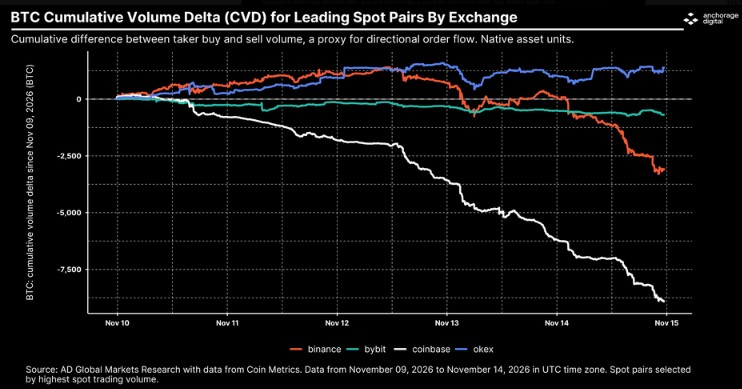
Despite the historical parallels, the immediate selling pressure has been intense and concentrated. According to Anchorage Digital researcher David Lawant, the primary driver of the recent downturn originates domestically within the United States. Lawant highlighted network flow charts showing continued heavy net taker sell pressure predominantly originating on Coinbase, contrasting sharply with activity on overseas cryptocurrency exchanges.
This domestic sell pressure has manifested clearly within U.S. spot Bitcoin ETFs. These investment vehicles suffered massive outflows over a two-week period, shedding a staggering $2.35 billion. Farside Investors data revealed that spot Bitcoin ETFs lost $1.07 billion over a single five-week period, following $1.28 billion in redemptions the previous week, marking the largest weekly outflows since late June. The bleeding culminated in a seven-session streak of consecutive net withdrawals, with approximately $1.71 billion pulled from the funds since November 5. Social media market commentators, such as Axel Bitblaze, underscored the persistent nature of the trend, noting that Bitcoin prices fell in the hour preceding the opening of traditional U.S. markets on all but two of the past fifteen trading days.

Amid the market carnage, Binance founder Changpeng Zhao stepped forward to forcefully rebuff speculation that his exchange played a role in instigating the crash. Posting on social media, Zhao stated that Binance did not sell crypto assets and revealed that he had actually purchased cryptocurrency during the preceding days. Instead, Zhao attributed the downward market momentum to a broader rotation of capital into the Anthropic initial public offering, relentless spot Bitcoin ETF outflows, lingering security anxieties across the crypto sector in the wake of a recent Binance security breach, and hotter-than-expected U.S. inflation data. The inflation figures have driven markets to fully price in a quarter-point interest rate hike by the Federal Reserve in December. Consequently, the Crypto Fear and Greed Index plummeted to 10, firmly entering the territory of "Extreme Fear."
Jensen Discusses Nvidia Comeback Days After Resigning
Outside of the digital asset sphere, Silicon Valley and the broader technology sector were shaken by ongoing developments at artificial intelligence titan Nvidia. Following a determined push by tech industry allies to pressure the board of directors, reports from the Financial Times indicated that Jensen Huang is actively plotting a dramatic comeback to the chief executive officer position.
Nvidia shares plunged significantly after Huang abruptly resigned as CEO and board member on November 12, prompting the appointment of Chief Financial Officer Colette Kress as interim CEO. The resignation followed damaging reports regarding personal conduct, including disclosures that Huang had engaged in past affairs, with an independent board probe examining allegations regarding a relationship with a subordinate. Furthermore, independent investigations by the board have been scrutinizing allegations that Huang was romantically involved with an individual suspected of being a foreign intelligence agent connected to semiconductor transfers to China.
Despite the severity of the allegations, Huang has maintained active discussions with confidants regarding his potential reinstatement. Sources cited by the Financial Times revealed that supporters have established a dedicated "war room" to orchestrate his return. A public petition advocating for Huang’s reinstatement quickly amassed over 100,000 signatures, including backing from 5,600 current Nvidia employees, alongside high-profile technology executives such as SpaceX and Tesla leader Elon Musk and Epic Games CEO Tim Sweeney.
The leadership crisis at Nvidia has exerted substantial downward pressure on artificial intelligence equities and broader risk-on assets, including cryptocurrencies. The fallout has also triggered legislative action in Washington, where U.S. congressional members are advancing three distinct bills aimed at severely tightening AI chip export restrictions to China. Meanwhile, reporting from the New York Times indicated that U.S. intelligence officials briefed President Trump regarding allegations concerning Huang’s ties to a foreign operative approximately a year ago, though no official action was taken at the time.
Ethereum Should Become Post-Quantum in 2027: Ethlabs
In the blockchain protocol sector, Ethereum research group Ethlabs announced it is withdrawing its "Quick Slots" proposal from the forthcoming Hegotá network upgrade. Simultaneously, the organization urged core developers to urgently accelerate preparations to protect the network against potential quantum computing threats by 2027.
Detailing their stance on an Ethereum developers’ forum, the group outlined "pqai27," a proposed strategic roadmap designed to safeguard the Ethereum network against emerging vulnerabilities from both artificial intelligence and quantum decryption capabilities. While the formal published protocol roadmap currently targets a post-quantum transition by December 2029, prominent researchers like Justin Drake expressed hope during Devcon that the timeline could be accelerated closer to 2028, reflecting growing urgency within the developer community.
Strategy Gets Booted From MSCI Indexes

Institutional exposure to cryptocurrency faced another hurdle as index provider MSCI confirmed that Bitcoin treasury firm Strategy will be officially removed from its global equity indexes. The decision follows months of rigorous industry debate regarding whether corporate entities holding massive digital asset reserves genuinely qualify as traditional operating businesses.
In addition to Strategy, Japanese corporate Bitcoin holder Metaplanet and digital asset treasury firm Upexi have also been slated for removal, while Ether treasury firm Sharplink has been placed on an official review watchlist. The index rebalancing changes take effect following the market close on November 30.
Market commentators noted that the removal will have immediate implications for passive investment vehicles. Ryan Kirkley, CEO of Global Settlement Network, explained that index inclusion previously meant that ordinary, passive investors holding global index funds through pension vehicles were inadvertently gaining leveraged Bitcoin exposure that they never actively chose, an outcome the MSCI adjustment effectively rectifies. Following the announcement, Strategy shares fell 6.49%, extending a monthly decline exceeding 25%.
Winners and Losers
As the trading week drew to a close, major digital assets remained deeply entrenched in the red. Bitcoin finished the weekly period down 12.4% at $65,116, while Ethereum slumped 14.4% to $1,822. Ripple’s XRP dropped 13.3% to trade at $0.96. Total cryptocurrency market capitalization contracted to approximately $2.2 trillion, according to CoinMarketCap metrics.

Among the top 100 digital assets by market valuation, the weekly altcoin gainers were led by Kite, which notched a 35.5% increase, followed by Pieverse with a 33.8% gain, and Midnight, which rose 28.7%. Conversely, the most significant downward pressures were felt by Zcash, dropping 25.4%, Uniswap, down 23.2%, and Aero, which fell 23.1%.
Prediction of the Week
Despite the pervasive market pessimism, some prominent figures view the downturn as an unprecedented entry point. Mark Moss, co-founder of the Bitcoin Opportunity Fund, asserted that the convergence of traditional banking integration and ETF accessibility has established what he terms the "best buying opportunity ever." Moss expressed confidence that Wall Street’s deepening embrace of the asset class will ultimately propel Bitcoin toward a new record high in 2027.
Top FUD of the Week
In broader technology news, Microsoft successfully resolved a massive global technical outage that disrupted core enterprise services, including Outlook and Microsoft Teams, for more than 24 hours. The technology giant explicitly ruled out any connection to a cyberattack or artificial intelligence agent malfunction, attributing the global disruption instead to a technical error introduced during an earlier network capacity upgrade that triggered unforeseen complications following a routine network adjustment.

Meanwhile, corporate restructuring continued across the blockchain industry. MEGA, the parent organization behind the Ethereum layer-2 network MegaETH, executed a 20% workforce reduction following months of internal reorganization. The staff cuts coincide with a strategic pivot toward expanding into artificial intelligence products, with MEGA having committed $30 million toward developing AI-enabled services natively on the MegaETH network.
Corporate financial strain was further illustrated by Metaplanet. The Japanese firm, recognized as the world’s second-largest publicly traded corporate Bitcoin holder, reported a net loss of 27.16 billion yen, equivalent to approximately $170 million, for the first nine months of the fiscal year. This marked a stark reversal from a net profit of 13.53 billion yen recorded during the corresponding period in the previous year. The financial loss was heavily compounded by a 19.17 billion yen loss stemming from the sale of 10,000 Bitcoin to demonstrate liquidity and capital-raising capabilities, alongside an 8.04 billion yen markdown reflecting the broader decline in the market valuation of its remaining Bitcoin treasury holdings.





Comments (0)