


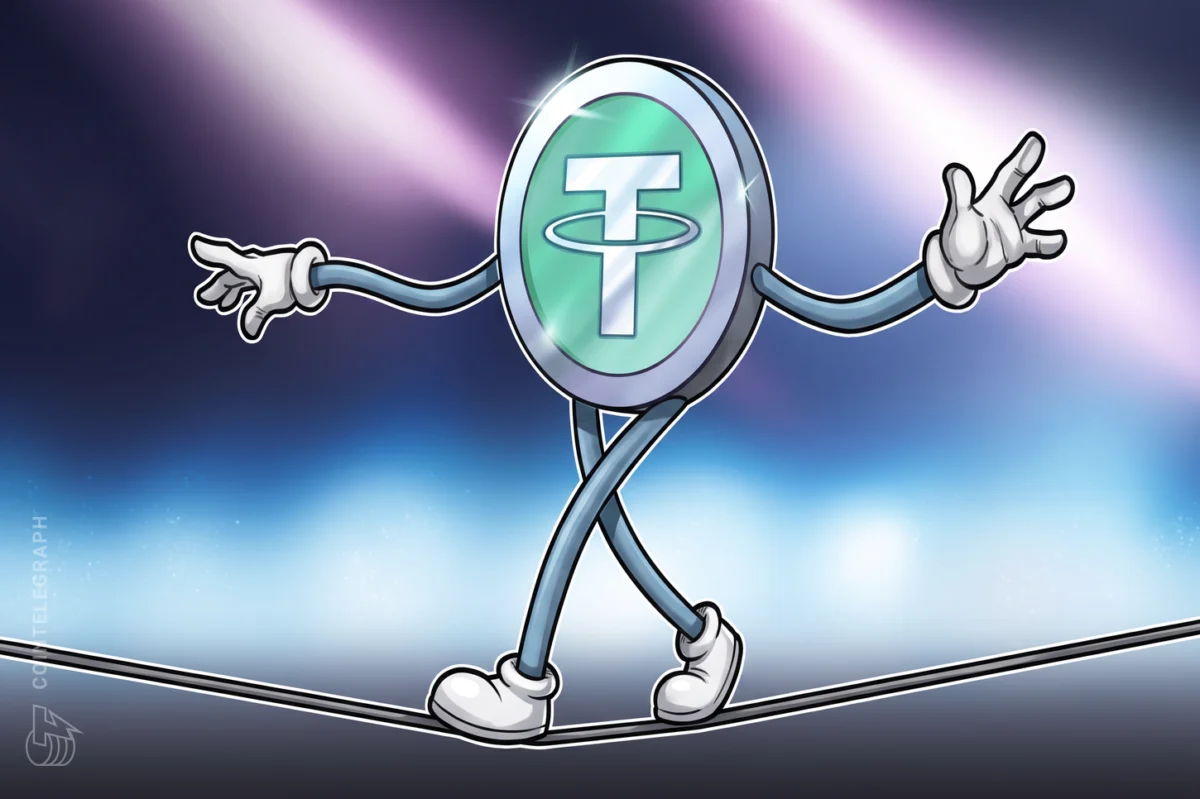
S&P Global Ratings has chosen to maintain Tether’s USDt at the very bottom of its stablecoin stability scale, pointing to an increasing reliance on riskier assets within the token’s underlying reserves. Despite various developments and financial disclosures by the stablecoin issuer over the past year, the rating agency remains cautious about the asset’s structural integrity and long-term peg maintenance capabilities.
In an official report published on November 18, S&P assigned USDt an assessment score of 5, which designates a "weak" ability to hold its vital one-to-one dollar peg. This latest evaluation leaves the score completely unchanged from the rating agency’s previous assessment conducted in November 2025.
According to the rating agency’s findings, higher-risk holdings—a category that encompasses gold, Bitcoin, public equities, secured loans, and corporate bonds—accounted for approximately 28% of all USDt tokens in active circulation as of September 30. This represents a noticeable increase from the 24% recorded exactly a year earlier. S&P warned in its report that a significant, sudden drop in the market value of these non-traditional or volatile assets could potentially lead to USDt becoming undercollateralized.
Tether, however, pushed back firmly against the methodology and conclusions drawn by the rating agency. In a statement provided to Cointelegraph, the company argued that the fundamental issue lies with S&P’s evaluation framework rather than the actual quality or safety of its reserves. Tether further suggested that the rating agency’s own institutional history highlights underlying systemic flaws, drawing a sharp parallel to the cinematic depiction of the 2008 global financial crisis in the film The Big Short.
Tether’s internal reserve report for the period ending September 30, which was subjected to attestation by auditing firm BDO, detailed approximately $191.5 billion in total assets against roughly $183.5 billion in total liabilities. This balance sheet left the company with an estimated $7.95 billion in excess assets over liabilities. S&P acknowledged these figures in its commentary, but noted that it had identified additional structural weaknesses that it ultimately could not factor into a lower rating, explaining simply that its assessment scale "cannot be lower than 5."
S&P Questions Reserve Oversight Safeguards
Among the primary additional weaknesses highlighted by S&P in its November report were questions surrounding the regulatory oversight framework of El Salvador, the jurisdiction to which Tether officially relocated its operations in January 2025.
According to the assessment, the National Commission of Digital Assets of El Salvador (CNAD)—the regulatory authority tasked with overseeing Tether within the country—mandates that 70% of the company’s reserves must be held in assets capable of being liquidated within a 30-day window. S&P remarked that it considers this regulatory framework to be broad, noting that it permits the inclusion of relatively high-risk assets such as gold, Bitcoin, and secured loans within that liquid bucket.
Furthermore, S&P pointed out a distinct lack of regulatory requirements compelling Tether to legally segregate its reserve assets from broader corporate funds, a safeguard that is typically expected and enforced by mainstream financial regulators in major jurisdictions like the United States and Europe. Because there is currently no publicly available information detailing asset segregation practices, the report states that external observers are left with zero insight into how these massive reserves are insulated from broader corporate risks or potential operational liabilities.
Audit Disclosure Remains a Concern
The transparency and public disclosure of Tether’s financial audits also remained a central point of contention for the rating agency. Earlier in August 2026, Tether announced that accounting firm KPMG had confirmed issuing an unqualified opinion on the stablecoin issuer’s 2025 accounts, marking what the company hailed as its first full independent audit. Tether executives repeatedly highlighted this milestone as proof of the strength and accuracy of the financial statements issued by the organization.
However, S&P countered that these audited statements and the official auditor’s report have not been made fully public, which severely limits the agency’s ability to independently verify the underlying data. S&P also noted that Tether’s routine reserve reports continue to omit the specific names of the custodians and financial counterparties holding its vast array of assets. Additionally, the agency pointed out that Tether’s formal attestations remain on a quarterly schedule, whereas many competing stablecoins in the digital asset market have shifted toward monthly reporting cycles.
Despite these ongoing disclosures and criticisms, tensions between Tether leadership and traditional financial rating agencies are nothing new. At the time of S&P’s initial downgrade of USDt in 2025, Tether leadership aggressively disputed the agency’s conclusions. Chief Executive Officer Paolo Ardoino took to social media platform X to express defiance, writing that the company wears the rating agency’s "loathing with pride" and pointing to historical financial system collapses as definitive proof that traditional regulatory and rating frameworks are fundamentally broken.
Even with the lowest possible stability score maintained at 5, S&P concluded its November 18 report by conceding that Tether has historically maintained a strong record of price stability, successfully defending its dollar peg particularly well over the preceding 12 months.




Comments (0)