



As market dispersion continues to characterize the current financial landscape, recent sessions have pointed to concrete structural shifts rather than mere narrative noise. Across both traditional and digital asset classes, investors are navigating a complex environment where protocol unit economics are rapidly evolving, institutional adoption is taking on a more deliberate shape, and underlying trading infrastructure is pushing closer to conventional financial market benchmarks.
In the decentralized finance sector, notable fundamental improvements have begun to materialize. Aerodrome’s net income has moved steadily toward breakeven as token emissions fell directly in line with protocol revenue. At the same time, the total value locked within USDai has demonstrated a distinct pattern of stepwise growth, signaling an institutional approach to balance sheet deployment. Concurrently, the tokenization of real-world assets has continued to scale across private credit, United States government debt, and commodities, while emerging trading infrastructure—ranging from ultra-low latency execution networks like Fogo to equity perpetuals—moves closer to matching the standards expected by traditional institutional market participants.

Indices
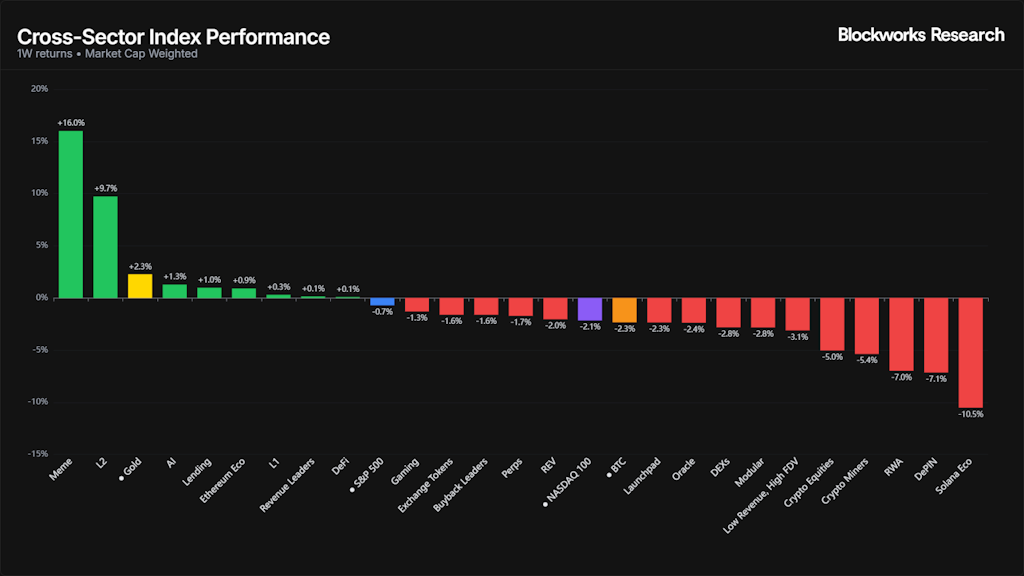
Financial markets leaned firmly into a risk-off posture over the past week, with dispersion widening across both traditional equities and digital assets. Bitcoin slipped 2.3%, mirroring a softer macroeconomic backdrop that also pulled traditional indexes lower. The Nasdaq 100 declined 2.1%, while the S&P 500 lost 0.7% by the close of the weekly trading period. Amid this general retreat from risk, gold stood out as one of the few reliable macro hedge bids, advancing 2.3% and suggesting an incremental rotation toward defensive positioning as institutional portfolios reset ahead of the year-end.
Crypto sector indices told a much sharper and more fractured story beneath the macro headline. On the positive side of the ledger, memecoins surged 16.0% and Layer 2 scaling networks gained 9.7%, dominating weekly performance charts. These gains pointed directly to short-term speculative capital flows while demonstrating renewed investor enthusiasm for scaling narratives and higher-beta digital assets. Other sectors managing modest green prints included artificial intelligence tokens up 1.3%, lending protocols gaining 1.0%, and the broader Ethereum ecosystem edging up 0.9%.
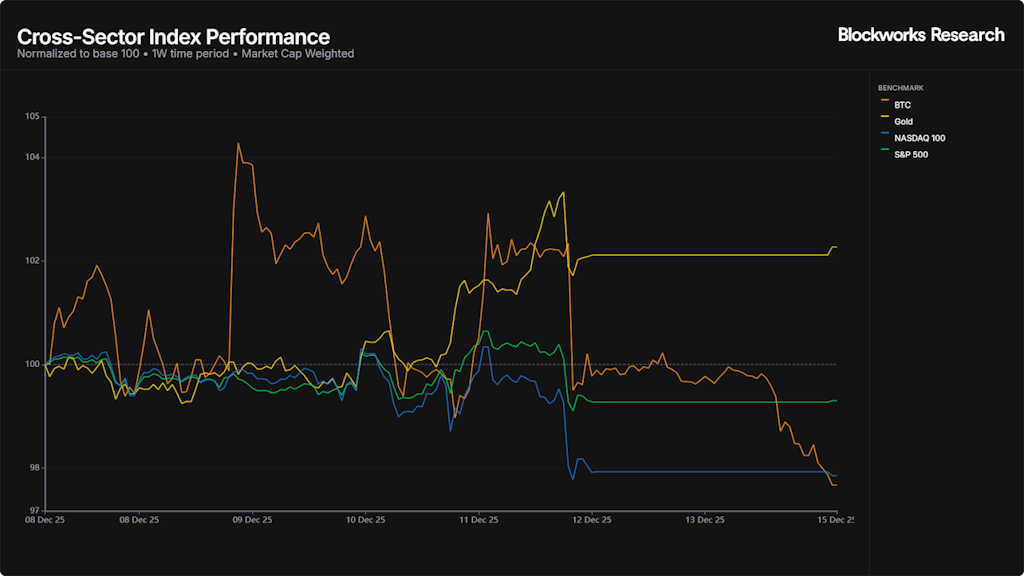
In stark contrast, heavy weakness was pronounced across several key thematic sectors. The Solana ecosystem dropped 10.5%, decentralized physical infrastructure networks declined 7.1%, tokenized real-world assets fell 7.0%, and crypto miners retreated 5.4%. This widespread underperformance underscored mounting pressure on structurally levered or capital expenditure-heavy themes within the digital asset economy. Meanwhile, launchpads down 2.3% and decentralized exchanges down 2.8% also lagged the broader market as trading volumes cooled across spot venues.
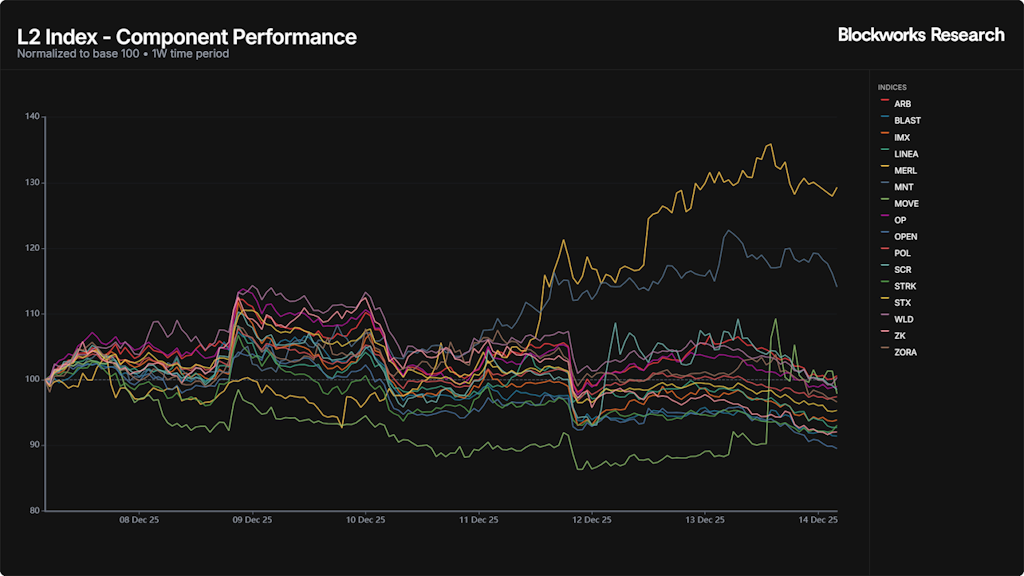
Even within outperforming sectors like Layer 2 networks, under-the-hood dispersion remained exceptionally notable. MERL emerged as the standout performer of the group, ripping higher into the weekly close and finishing well north of its peer group. MNT also exhibited strong relative strength, grinding steadily upward and successfully holding its gains even as the rest of the digital asset complex chopped sideways. Industry staples like Optimism and Arbitrum tracked much closer to the index average, posting modest gains but failing to display the same upside convexity. On the lagging end of the scaling category, BLAST remained a clear underperformer, trending lower consistently throughout the weekly session.
Charts for The Week
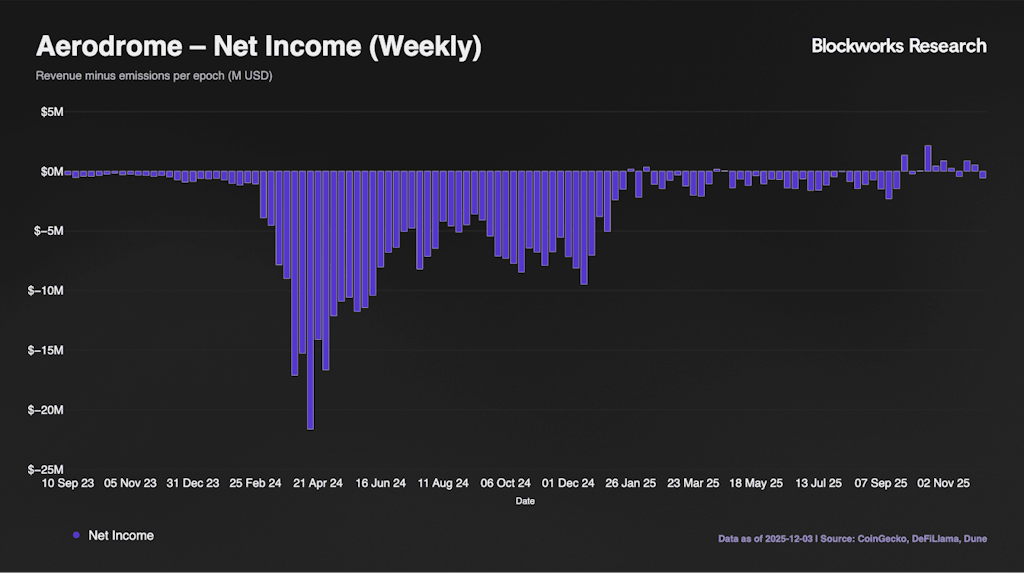
A closer examination of fundamental metrics highlights several pivotal developments across protocols and networks. Aerodrome’s weekly net income, calculated as protocol revenue minus token emissions, is successfully transitioning away from a prolonged period of heavy financial losses and moving toward near-breakeven territory and occasional profitability. Throughout most of the previous year, token emissions materially exceeded protocol revenue, with weekly net losses reaching as high as approximately $20 million at their trough. This historical deficit reflected aggressive liquidity incentive programs designed to bootstrap early platform usage.
However, starting in the early weeks of the new year, those losses narrowed sharply as emissions naturally declined and protocol revenue stabilized. Recent weekly figures have oscillated tightly around the zero line, occasionally turning modestly positive. This clear inflection strongly supports the view that Aerodrome’s underlying unit economics are fundamentally improving, marking the first sustained period since launch where protocol revenue is broadly keeping pace with token emissions.
Meanwhile, the total value locked trajectory of USDai reflects a classic step-function adoption curve that aligns more closely with institutional balance sheet deployment than with organic retail inflows. The TVL metric accelerated sharply during September as several large capital allocations entered the system. These discrete upward jumps strongly suggest tranche-based deployments tied directly to predefined institutional mandates and risk frameworks. The subsequent plateauing of TVL above the $550 million mark into November implies significant capital stickiness and remarkably low redemption pressure, reinforcing the perspective that USDai is increasingly functioning as a sophisticated balance sheet instrument rather than a transient trading vehicle.
Tokenization has similarly evolved from a niche experimental use case into a core strategic priority for major global financial institutions. Today’s expanding tokenized asset market is anchored by approximately $300 billion in stablecoins, alongside $17.4 billion in private credit, $8.2 billion in United States government debt, $2.3 billion in commodities, and $1.4 billion in public equities. Widely cited industry projections underscore the immense scale of this ongoing structural shift. A comprehensive report published by BCG and ADDX projects that up to $16 trillion worth of real-world assets could be tokenized by the end of the decade, spanning public equities, private markets, real estate, and fixed-income debt instruments. Similarly, independent forecasts from banking giant Citi estimate between $4 trillion and $5 trillion in tokenized digital securities, alongside an additional $5 trillion in tokenized trade finance volume over the exact same timeframe.
In the realm of core execution infrastructure, Fogo stands out distinctly by offering industry-leading 40-millisecond block times and approximately one-second finality. This technical architecture delivers materially faster execution speeds than Solana’s 400-millisecond blocks and provides far superior responsiveness compared to the multi-minute finality traditionally associated with Ethereum. While competing networks like Hyperliquid and Solana continue to post higher theoretical peak transaction-per-second figures on paper, Fogo’s unique combination of ultra-low latency and sub-second finality positions its technology much closer to traditional financial market infrastructure. This performance profile reinforces its core thesis as an institutional-grade trading chain rather than a generalized consumer-facing Layer 1 network.
Decentralized artificial intelligence infrastructure is also showing signs of healthier maturation and broader participation. Outside of the foundational Root network, the top nine subnets currently account for approximately 44% of all TAO staked across subnets and receive 37.4% of total TAO token emissions. This concentration metric has been steadily declining from a peak of roughly 52% recorded earlier in the year, as an increasing volume of TAO flows continuously into smaller or emerging subnets. This encouraging trend suggests a gradual broadening of community participation and a significantly healthier, more decentralized distribution of stake over time as the network matures.




Comments (0)