



While cryptocurrency prices have managed to stage a modest recovery over the short term, lingering negative market breadth and relative underperformance compared to traditional finance benchmarks on a monthly basis suggest that a prevailing bearish environment continues to grip the digital asset ecosystem.
As traders and institutional participants evaluate recent price action, market analysts are increasingly looking past short-term volatility to focus on broader secular growth trends. In particular, structural expansion within stablecoins and decentralized lending markets is emerging as a durable engine for multi-year growth, highlighting a stark contrast between short-term spot market headwinds and the long-term maturation of onchain financial infrastructure.

Cryptocurrency markets have remained largely rangebound following a severe market-wide selloff that materialized in November. Over the past week, the market has shown signs of a tentative recovery, with Bitcoin (BTC) hovering around $90,400. This price level marks a roughly 12% rebound from its recent correction low of $80,700, offering a temporary reprieve to market participants who weathered the previous month’s steep declines.
Looking at sector-specific performance over a trailing 24-hour window, the artificial intelligence and modular blockchain sectors emerged as the top winners of the recent short-term strength. Notable contributors included Bittensor (TAO), which posted a 6.4% gain, and Celestia (TIA), which advanced by 6.2%. Conversely, the perpetual swaps index lagged behind as the top loser in the short-term snapshot, weighed down by downward pressure on tokens such as DYDX, which dropped 3.1%, and HYPE, which slipped 0.6%.
Zooming out to a monthly perspective, however, the broader market picture remains decidedly unfavorable for crypto asset holders. Traditional finance benchmarks, including gold, the Nasdaq, and the S&P 500, are all trading in positive territory over the past month. In sharp contrast, every major crypto index tracked by analysts is currently measuring negative monthly returns.
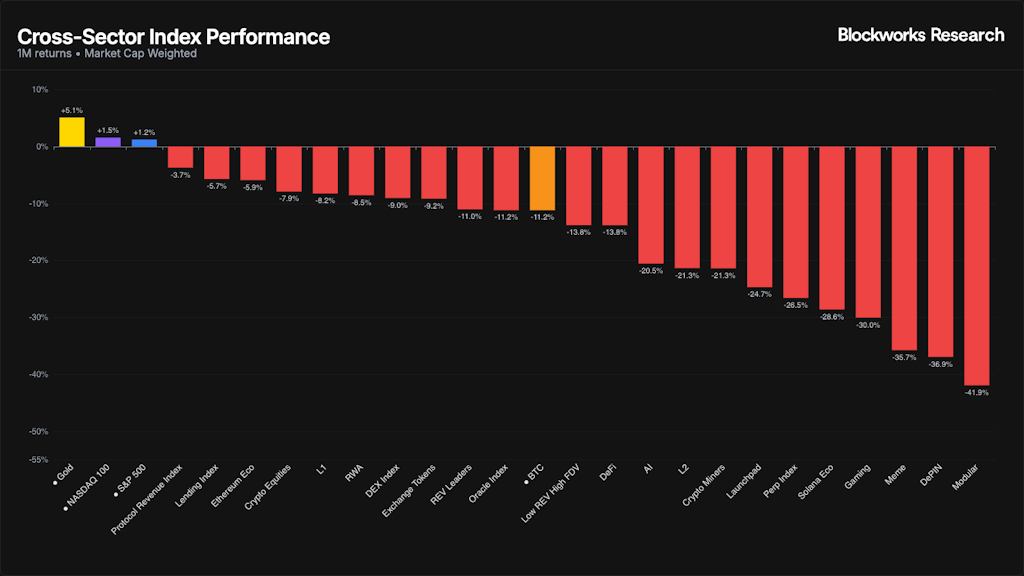
Market breadth is decisively negative across all crypto indices on a monthly timeframe, indicating that the recent downturn has been broad-based with virtually no safe havens available to investors. Within this challenging environment, the Protocol Revenue index has managed to stand out as the top-performing crypto sector. This relative strength suggests that capital is concentrating within protocols that boast strong fundamental positioning and genuine revenue-generating capabilities, rather than speculative assets driven purely by market sentiment.
Despite these pockets of resilience, market participants remain divided on the ultimate trajectory of the market. It remains to be determined whether the current relief rally is merely a countertrend bounce within a more prolonged and entrenched downtrend, or if the cyclical low has officially been established for the remainder of 2025.
Amid the ongoing price consolidation and macro downtrend, market observers emphasize the importance of maintaining perspective on the broader evolution of the digital asset economy. Taking a moment to evaluate how far the industry has come reveals profound structural expansion that starkly contrasts with historical troughs.
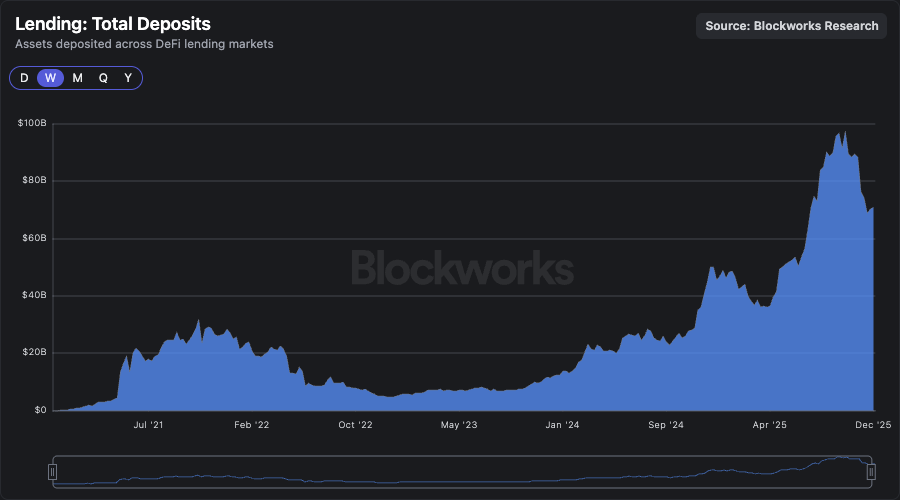
At the depths of the previous bear market, lending applications operating within decentralized finance (DeFi) accounted for a modest $5 billion in total deposits—a figure that amounted to little more than a rounding error within the context of the broader global financial system. In the years since that low point, that foundational metric has undergone dramatic expansion, climbing to $71 billion in active deposits after having recently flirted with the $100 billion threshold.
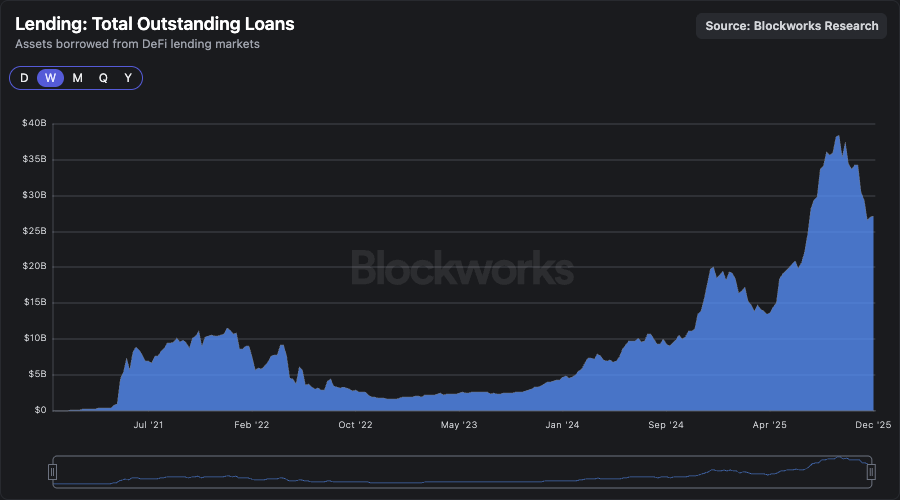
A similar trajectory of growth is evident in the volume of active loans issued across these decentralized platforms. During the bear market low, total outstanding loans on these applications amounted to a meager $1.6 billion. Since then, active loans have expanded significantly, rising to over $27 billion and recently touching highs above $38 billion.
These figures have grown to a scale that demands the attention of traditional finance participants, moving far beyond the scope of crypto-native enthusiasts alone. While financial variance can cut in both directions—leading to rapid appreciation or sharp drawdowns for both key network metrics and spot prices—a twentyfold expansion in topline metrics over the course of just a few years strongly suggests that this sector is still a long way off from reaching its terminal growth rate.
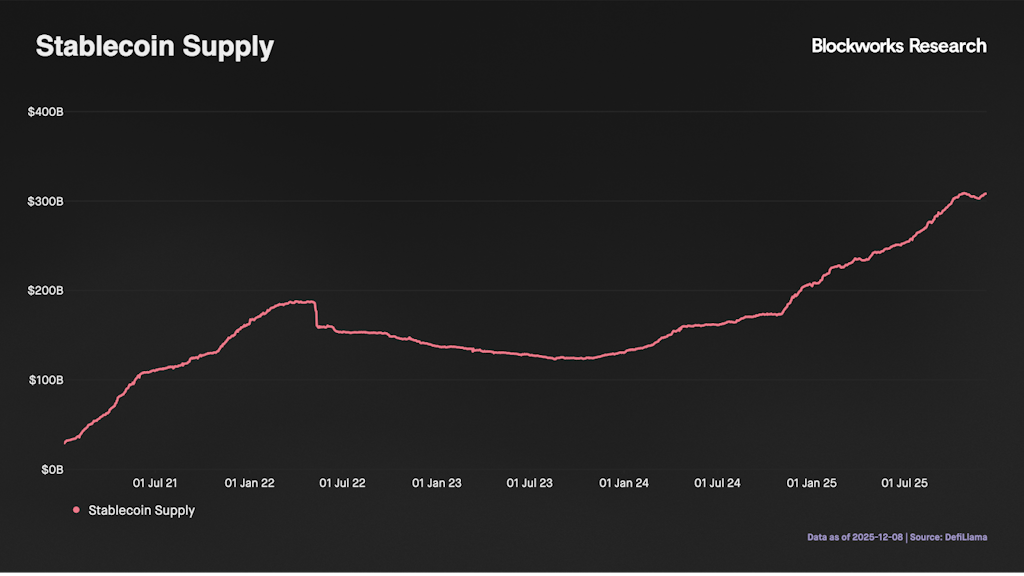
This fundamental expansion is further underscored by the behavior of stablecoins, which serve as the primary liquidity layer for the entire onchain economy. Despite the significant drawdown in broader crypto asset prices, the aggregate global stablecoin supply has successfully retraced back toward its all-time high of $310 billion. This robust recovery follows a brief period of capital flight that saw approximately $10 billion in net outflows from stablecoin ecosystems.
The sustained and structural growth in stablecoin supply is a macroeconomic trend that few market participants are willing to bet against. Onchain money markets stand out as the primary beneficiaries of this expanding capital base, functioning as the fundamental applications for stablecoin utilization. Within these environments, stablecoin lenders seek out yield for their idle capital, while borrowers look for efficient access to leverage. While spot crypto assets will undoubtedly remain volatile in the near term, this powerful secular trend is expected to persist as a durable tailwind for decentralized finance applications going forward.
At the same time, this ongoing expansion faces interesting economic dynamics regarding interest rates and yield generation. Notably, the continued growth in the aggregate stablecoin supply is occurring amid remarkably modest onchain yields. Benchmark supply rates across major lending applications are currently hovering around 3.6%, representing a discount relative to the Secured Overnight Financing Rate (SOFR), which sits at 3.9%.
This dynamic suggests that the growing depth and liquidity of onchain stablecoin markets may continue to exert downward pressure on the upside potential of lending supply rates. Analysts note that absent a material risk premium that compensates lenders relative to legacy risk-free rates, the pace of future growth in stablecoin utilization across onchain money markets could face headwinds or potential deceleration as liquidity continues to seek optimal risk-adjusted returns across the broader financial landscape.





Comments (0)