


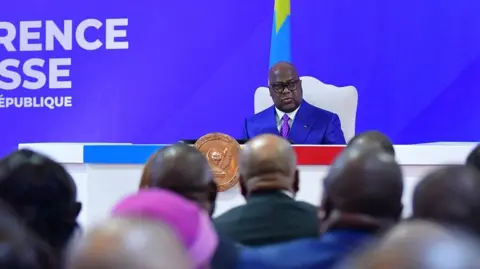
Democratic Republic of Congo President Félix Tshisekedi has opened the door to a potential third term in office, telling reporters on May 6 that he would consider running again if the country’s electorate approves the move through a national referendum.
The statement, delivered during a news conference covered by Africanews, immediately injects a fresh wave of uncertainty into the Central African nation’s political landscape. Under the current constitutional framework of the Democratic Republic of Congo (DRC), presidential mandates are strictly limited to two terms. With President Tshisekedi’s current mandate scheduled to expire in 2028, any viable pathway toward a third term would necessitate rewriting the foundational rules of the nation’s political system while an incumbent administration remains in power.
The statement and what it actually means
During his address to the press, Tshisekedi carefully framed the prospect of an extended presidency as an initiative originating from the public rather than his own personal ambition.
"I did not seek a third term, but I’m telling you: if the people want me to have a third term, I will accept," the president stated.
This rhetorical strategy carries a deeply established precedent in global politics. Across Africa, Latin America, and various other regions, leaders seeking to prolong their time in office have frequently invoked the "the people demand it" narrative to justify constitutional amendments. Political science scholars recognize this recurring phenomenon as a classic iteration of the "third-term problem," where institutional safeguards are tested or dismantled under the guise of popular democracy.
On the surface, suggesting that voters should decide the matter via a referendum sounds aligned with democratic principles. However, political analysts emphasize that the procedural mechanics of such a vote are paramount. Questions surrounding who oversees the electoral commission, how the referendum question is formulated, and who ultimately tallies the ballots are critical. In a nation grappling with severe governance challenges, these administrative details represent monumental hurdles rather than minor logistical footnotes.
Executing a credible constitutional referendum across the DRC is an immense undertaking. The country spans a geographic area roughly equivalent to Western Europe, features severely limited public infrastructure, faces active armed conflicts in its eastern territories, and bears a legacy of historically contested electoral processes.
The political backdrop is messy
President Tshisekedi initially assumed power following the December 2018 general election, a contest that was intensely disputed from the outset. His victory over the political apparatus of outgoing long-serving leader Joseph Kabila faced immediate challenges from rival opposition candidates and drew skepticism from international election observers. According to research published by the Institute for Security Studies, this disputed electoral outcome left Tshisekedi with a fractured and limited base of support within parliament during the early years of his administration, compelling him to govern through fragile and uneasy political coalitions.
Although Tshisekedi subsequently secured a second term in office, the underlying questions regarding institutional legitimacy were never fully resolved. By publicly floating the concept of a third term, the administration has introduced an additional layer of friction into an already delicate political ecosystem.
Opposition parties and civil society groups have voiced sharp concerns over the announcement. According to reports from Africa Briefing, various opposition factions have accused the president of attempting to orchestrate a systematic consolidation of executive power. Critics have warned that pursuing a constitutional overhaul could ignite widespread political unrest in a nation that has historically endured severe bouts of political violence and institutional instability.
The DRC has struggled to achieve smooth, peaceful political transitions since gaining independence in 1960, having experienced multiple coups, civil wars, and disputed successions. Whenever a sitting head of state signals an intention to stretch constitutional boundaries beyond designated limits, domestic political tensions rise sharply.
Compounding these domestic political concerns is the protracted security crisis in eastern Congo. The region remains deeply destabilized by ongoing armed conflict involving numerous domestic militia groups, foreign-backed insurgent factions, and national government forces. This persistent violence has displaced millions of civilians and fueled one of the world’s most severe and protracted humanitarian catastrophes.
This security crisis introduces profound logistical complications for the national electoral calendar. As noted by Africanews, the ongoing warfare and instability in the eastern provinces could potentially be utilized as administrative justification for postponing the scheduled 2028 presidential elections. Introducing a complex constitutional referendum into the national calendar prior to that vote would only deepen the administrative and political burden.
Opposition leaders have already articulated fears that the eastern conflict might be leveraged as a convenient pretext to indefinitely delay scheduled elections while executive-driven constitutional amendments are quietly pushed through. While attributing explicit intent to the presidency remains speculative, the underlying structural incentives are evident, drawing intense scrutiny from domestic observers and international partners alike.
Why this matters beyond the DRC
The implications of political developments within the DRC extend far beyond its national borders. As the largest country in sub-Saharan Africa by land area, the nation possesses immense geopolitical and economic significance, driven largely by its staggering natural resource wealth. The DRC holds a commanding share of the global supply of cobalt, a mineral that is indispensable to the manufacturing of lithium-ion batteries utilized in electric vehicles, consumer electronics, and renewable energy storage systems worldwide.
Consequently, political instability or constitutional upheaval within the DRC does not remain localized. Such disruptions have immediate ramifications for regional security across Central and East Africa, global supply chains for critical minerals, and the administration of international humanitarian aid. When the trajectory of Congolese governance appears volatile, the effects ripple across the international community.
For observers monitoring broader governance trends across the African continent, Tshisekedi’s remarks align with a familiar historical pattern. Over recent years, several African leaders have pursued and occasionally secured constitutional revisions to lengthen their tenures. While some of these transitions occurred peacefully, others catalyzed the precise domestic instability and civil unrest that political opponents had predicted.
The impending 2028 election cycle in the DRC was already projected to be a focal point of intense international observation. It now carries the added weight of profound uncertainty regarding whether the vote will proceed as scheduled, whether the underlying constitutional framework will be unilaterally altered beforehand, and whether the resulting electoral process will command public and international legitimacy.
With roughly two years remaining before his current mandate officially concludes, President Tshisekedi possesses sufficient time to pursue a referendum should the administration maintain the political determination to do so. Simultaneously, this window provides ample opportunity for opposition movements to mobilize public sentiment, for international stakeholders to issue diplomatic evaluations, and for the security situation in the eastern provinces to either stabilize or deteriorate further.
None of these critical variables can be forecasted with certainty. However, the overarching reality is that the next two years of Congolese politics have grown significantly more contentious. Tshisekedi’s expressed openness to a third term, framed through the rhetoric of a popular mandate, establishes the groundwork for a high-stakes constitutional confrontation within a nation already burdened by armed conflict, institutional deficits, and widespread public skepticism toward governance structures. While the referendum framework is presented in democratic terms, the ultimate execution and integrity of the process will dictate its true nature.

Comments (0)