


Most mornings, the commute begins in a Waymo. The vehicle performs immense physical labor, moving five thousand pounds of metal, glass, and rubber across the San Francisco Bay Area. Simultaneously, it executes complex cognitive tasks, reading the flow of the road and making split-second predictions that yield a safety record resulting in significantly fewer serious-injury crashes than human drivers.
The experience demands nothing of human muscles and nothing of human minds. Both have been successfully externalized. This single daily journey encapsulates two distinct revolutions. The physical revolution is two centuries old, while the cognitive revolution has barely begun.
Yet, the contemporary mood surrounding this second revolution is a volatile cocktail of optimism, skepticism, and anxiety. Public discourse is saturated with concepts that can feel dizzying: the singularity, recursive self-improvement, trillion-dollar cluster data centers, superintelligence, widespread unemployment, profound social disruption, and a high-stakes technological race between global superpowers.
However, stepping back reveals a calmer perspective. Humanity has already undergone a transition that closely rhymes with the artificial intelligence revolution unfolding today: the Industrial Revolution.
Two Kinds of Work
To understand this parallel, labor can be bifurcated into two foundational categories: physical work and cognitive work. Most valuable human tasks have historically necessitated a combination of both.
Agriculture stands as one of the oldest examples. Working the land demanded raw muscle power, supplied by humans and domesticated animals alike, for ten thousand years. Yet it also required deep insight: reading the shifting seasons, observing which seeds produced specific yields, and managing ecological variables.
While these two forms of work are fundamentally different—physical work being force multiplied by distance, moving mass through space, and cognitive work being the act of thinking—they share core economic properties. Both are scarce, both command a price, and both get applied to tasks society wants completed. In both economic domains, when the cost or price of labor collapses, supply floods the market, and overall demand expands rapidly to meet that new supply.
What Happened to Physical Work
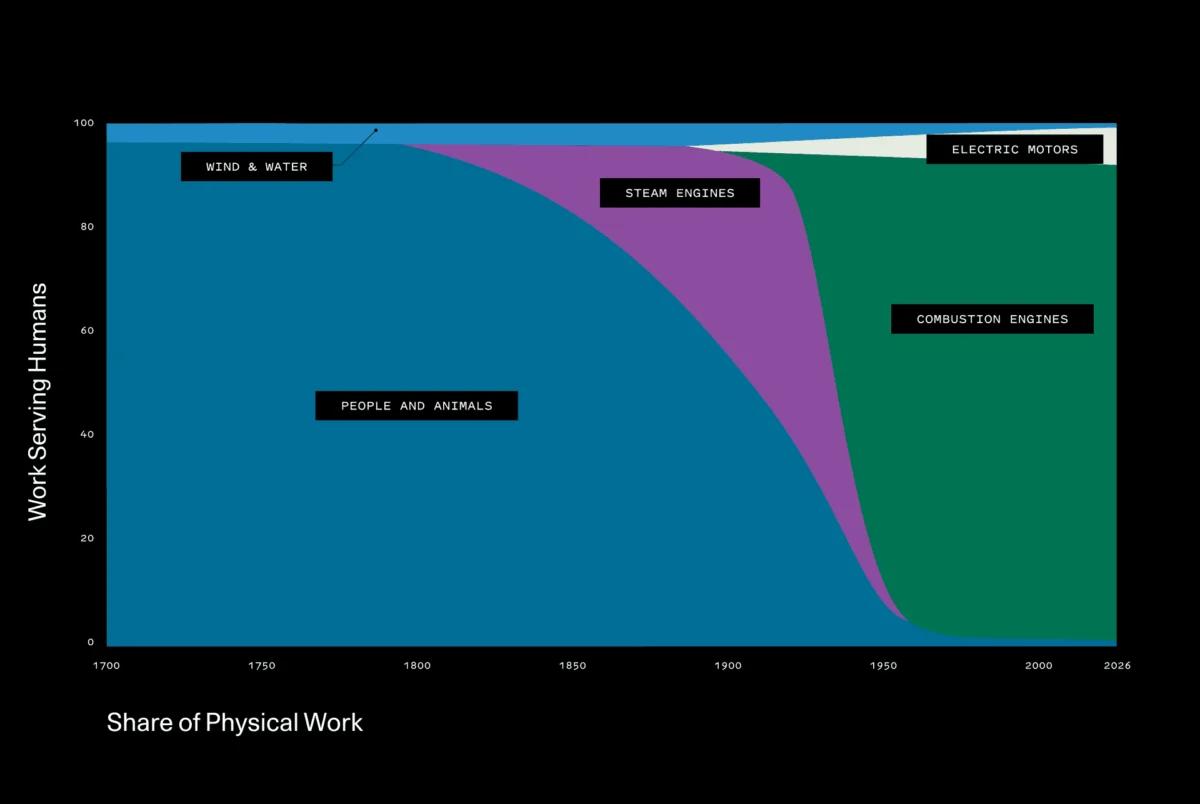
For the vast majority of human history, nearly all physical work was performed by biological muscle. Historical charts tracking energy sources remain flat for millennia, stretching back as far as human records go.
That dynamic shifted dramatically in the late 1700s and early 1800s. First came steam power, followed quickly by internal combustion engines and electric motors. Each successive wave absorbed a progressively larger share of the world’s physical labor burden. Over the course of roughly two centuries, physical work transitioned from being 99 percent biological to 99.9 percent machine-driven.
Today, the results of this transition are ubiquitous. They manifest in the electronic screen displaying this text, nearly every article of clothing worn daily, the commercial aircraft connecting distant continents, and the vast lattice of container ships, freight trains, and semi-trucks supporting the modern supply chain. Human muscle has been reduced to a statistical rounding error within the global energy budget.
History Rhymes: What’s Happening to Cognitive Work
For most of history, essentially all cognitive work was executed by humans, augmented only marginally by trained animals such as sheepdogs. A thin mechanical sliver sat atop this biological foundation: early computational tools like mechanical clocks and Pascal’s calculator.
Then came electronic computation. Within a single century, digital computing expanded from basic calculations and early spreadsheets to trillions and quadrillions of operations running continuously around the clock. Navigating daily commutes, processing corporate payrolls, and calculating actuarial insurance risks all became cognitive tasks largely delegated to machines.
The current wave of neural networks drastically expands the boundaries of what machine cognition can achieve. Just as combustion engines magnified the scope and scale of the Industrial Revolution, neural networks are accelerating the Cognitive Revolution.
A century ago, the vast majority of cognitive work was executed by humans. In the near future, the vast majority will be processed by machines—not because humans will think any less, but because machines will compute on a scale previously unimaginable.
The curves mapping these two revolutions are strikingly similar. The Cognitive Revolution will mirror the Industrial Revolution, though it is unfolding on a much larger scale and at an exponentially faster pace. Dividing the global economy by the nature of work reveals that physical and cognitive labor could eventually split a roughly $120 trillion world economy relatively evenly. The physical half has spent two centuries mechanizing, whereas the cognitive half has barely begun.

Inputs Scale Massively and Get Cheap
The industrial age required the massive scaling up of foundational input commodities: first coal and iron, followed by oil and steel. Industrial processes like iron puddling and the Bessemer steelmaking process unlocked unprecedented material abundance.
A direct parallel exists today in the race for electrical grid capacity and advanced compute. The foundational "processes" of this era are algorithms such as the Transformer architecture.
The modern providers of these critical components are the industrial titans of today: leaders like Jensen Huang at NVIDIA, Morris Chang at TSMC, the authors of foundational AI research papers, and the founders of major model laboratories and hyperscale data centers pouring trillions of dollars into infrastructure. Nations that once measured geopolitical power in oil-refining capacity will increasingly measure it in electrical grid capacity and intelligence output.
A unit of mechanical work in 1900 cost a small fraction of what it cost a century prior. That dramatic collapse in price made mass production viable, transforming the Industrial Revolution from a luxury curiosity for the wealthy into a universal standard of living.
The cost of machine cognition is collapsing even faster. The cost of generating intelligence per watt has fallen by more than a factor of ten annually. As prices plummet, consumers and enterprises will procure vast, unprecedented quantities of intelligence.
Demand Explodes to Meet Supply
No one living in the year 1800 could fathom flying to Tokyo, shipping fresh strawberries across an entire hemisphere in the dead of winter, or artificially air-conditioning an entire desert metropolis like Phoenix. These physical processes were either entirely impossible or economically prohibitive.
Demand for physical work exploded once new technologies were invented and operational costs collapsed. Economist William Jevons identified this dynamic in 1865, observing that more efficient steam engines did not reduce Britain’s coal consumption; instead, they multiplied it exponentially.
Cognition is poised to follow the exact same economic trajectory, buoyed by a latent demand that is virtually unbounded in scale. Currently, the vast majority of complex problems on Earth go unanalyzed simply because human thinking is expensive and time-constrained. A physician has limited hours and cannot review every newly published medical study. A radiologist examines a complex scan for minutes rather than hours. A small business owner has no operational budget to hire a dedicated financial analyst.
When the marginal cost of advanced cognition approaches zero, every human curiosity can effectively be paired with a dedicated research team. The volume of thinking executed by machines will expand by orders of magnitude, prompting the fundamental question of how all that intelligence will be utilized.
The Application Era
The initial catalyst application of the Industrial Revolution was the mechanical spinning of textiles. Spinning and weaving were traditionally high-skill occupations, with textile makers holding respected positions supported by years of apprenticeship, craft guilds, and multi-generational family trades. In 1764, James Hargreaves invented the Spinning Jenny, enabling a single operator to spin multiple threads simultaneously. Clothing prices fell rapidly, and global consumption skyrocketed.
The fundamental shift involved humans moving from performing the labor directly to supervising the machinery. A single worker tending a frame produced the output of an entire room of traditional hand-spinners.
The primary skilled application of the current era is AI-assisted software engineering. Writing code has long served as a modern elite craft—demanding extensive training, high compensation, and years of mastery. Yet it represents the first major cognitive task where the workflow has fully inverted. Machines now complete the foundational writing, while engineers act as directors, reviewers, and correctors. It is no coincidence that software development became the Cognitive Revolution’s first major commercial traction point.
While textiles kicked off the industrial era, they did not define its ultimate destination. The defining innovation of the industrial age was the automobile, around which modern civilization reorganized itself through suburbs, highways, complex supply chains, and transformed geographies.
Current coding agents function as the Spinning Jennies of this era: the opening act of automating skilled cognitive labor. The true "automobile" of the Cognitive Revolution likely has not been built yet. It will likely emerge as something that was entirely impractical while deep thinking remained a scarce human resource. Candidate applications include automated science operating at machine speed, ultra-personalized AI agents managing daily logistics like a corporate chief of staff, or entirely new paradigms of human connection and coordination. In 1800, predicting the societal impact of the automobile would have been remarkably difficult.
Employment: Where the Anxiety Lives
In 1800, more than 75 percent of the American workforce was employed in agriculture. When machines eventually absorbed that physical labor, pessimists projected widespread, permanent unemployment affecting three-quarters of the population.

Instead, society invented entirely new categories of labor that an agricultural worker in 1800 could not have conceptualized: radiologists, software engineers, podcast producers, and flight attendants. Machines did not eradicate labor; they eliminated specific repetitive categories of work while vastly expanding total employment. More people are employed today than at any other point in human history, enjoying a standard of living vastly superior to their ancestors.
The same structural transformation is unfolding within the Cognitive Revolution. Despite early disruptions in AI-assisted coding, employment data demonstrates that demand for software engineers—historically the most AI-exposed occupation—has inflected upward. Hiring trends in adjacent knowledge-intensive sectors, including legal and financial services, show similar transformations.
Machines handling cognitive tasks does not mean humans will cease thinking, just as the invention of the tractor did not mean humans stopped engaging in physical activity. Specific tasks evolve. The junior financial analyst who manually builds models by hand transitions into an operator directing numerous automated models. Entirely new categories of work will emerge, much like the profession of "engineer" was born out of the invention of the steam engine.
As with the industrial age, the aggregate historical narrative will be one of profound triumph. However, the individual transition can be deeply painful. The handloom weavers of Lancashire were not successfully retrained as locomotive engineers; many simply lost their livelihoods, enduring hardships that spanned a generation. Economic historian Robert Allen labeled this phenomenon "Engels’ pause." Between 1780 and 1840, British economic output per worker rose 46 percent, while real wages crept up by only 12 percent.
Luddites were often accurate in assessing the disruption to their own immediate lives, but fundamentally incorrect regarding the prosperity of their children and grandchildren. Between 1840 and 1900, British output per worker surged 90 percent while real wages jumped 123 percent. Wages caught up to productivity gains and eventually surpassed them.
Economic stagnation or prolonged wage gaps are not guaranteed outcomes. As Meta CEO Mark Zuckerberg recently noted, there is no immutable rule stating that AI must automate tasks faster than it expands individual capabilities and creates demand for new skills. Humanity’s demand for novel skills remains virtually insatiable.
The critical difference in the current transition is velocity. The Industrial Revolution afforded a farmhand’s son decades to adapt into a factory worker. The Cognitive Revolution may offer mere years. Societal shock absorbers, including formal education systems, retraining programs, and social safety nets, were engineered for a slower historical clock. The central policy challenge of the coming decades is whether public and private institutions can help human workers adapt as rapidly as the jobs themselves transform.
Education
The Industrial Revolution fundamentally shaped modern education systems in two distinct ways.
First, it made mass education financially and logistically possible. When the survival of society depended on agrarian labor, children were primarily utilized as manual agricultural workers. The mechanization of physical tasks freed children from the fields and provided societies with the surplus wealth required to fund public classrooms. Modern universities exist because society no longer required every able-bodied person engaged in physical survival, redirecting the nation’s youth toward cognitive skill-building.
Second, industrial labor shaped the operational structure of schools. Factories required workers who could read basic instructions, perform arithmetic, arrive on time, and execute standardized tasks within synchronized shifts. Consequently, schools were built to mirror factories: marked by bells, rigid rows, fixed schedules, batch processing by age, and standardized outputs. Mass education functioned largely as industrial job training.
The Cognitive Revolution disrupts both dynamics. If machines handle complex cognition, the traditional factory-model school risks becoming the equivalent of training individuals in hand-spinning textiles. A deeper transformation is occurring in delivery mechanisms. Historically, the primary bottleneck in education was the rigid ratio of teachers to students. Benjamin Bloom quantified this constraint in 1984, demonstrating that the average student receiving one-on-one personalized tutoring with mastery learning outperformed 98 percent of students in a conventional classroom setting.
That constraint is rapidly dissolving. The marginal cost of providing an infinitely patient, highly knowledgeable AI tutor is approaching zero. Emerging research indicates that hybrid human-AI tutoring systems can prove more effective and less costly than traditional educational models. Furthermore, these hybrid approaches hold the potential to expand educational access to regions of the world where public schooling has historically been prohibitively expensive.
Health
Modern medicine was likewise forged during the industrial era. Mass production delivered penicillin at scale, industrial refrigeration made vaccine distribution feasible, and the chemical industry laid the foundation for modern pharmaceuticals.
The Cognitive Revolution pushes medical science significantly further. Drug discovery relies on searching chemical spaces too vast for human minds to comprehend—precisely the type of complex problem that scales best when cognition becomes inexpensive. By predicting three-dimensional structures for virtually every known protein, tools like AlphaFold solved a foundational challenge where minor breakthroughs previously demanded entire lifelong research careers. Thousands of diseases currently lack targeted treatments, not because they are inherently unsolvable, but because the economic cost of investigating each condition could never be justified by the patient population size. As those investigative costs collapse, medical research can address rare conditions in the same manner other markets respond to falling prices.
Curing disease has long been the primary ambition of the medical community. This generation marks the first time that the binding constraint is no longer the absolute number of human researchers available.

Concurrently, clinical practice faces severe physician shortages globally, with patient demand far exceeding provider supply. Accessible cognitive tools will not lead to doctors reducing their working hours; instead, they will empower medical professionals to deliver higher-quality care to a broader patient base. Given the boundless demand for improved healthcare, scalable intelligence can help transition global medical models from reactive treatments toward proactive, preventative care.
The Shape of Daily Life
Beyond employment and education, the Industrial Revolution fundamentally altered the texture of ordinary life so thoroughly that modern society frequently mistakes its industrial artifacts for innate human nature. The Cognitive Revolution is poised to reshape those artifacts once again.
Clock time provides a clear example. Before the advent of the factory, rural labor followed natural seasons and sunlight. Factory owners, however, required hundreds of employees to begin and end operations simultaneously. Because machinery operated on rigid schedules, humans were forced to adapt to them. Structured shifts, standardized workdays, the five-day work week, and modern timekeeping itself are recent industrial inventions barely two centuries old. The Cognitive Revolution loosens this rigid grip. When automated systems operate continuously and asynchronously, requiring a hundred humans to think in unison from nine to five becomes obsolete, shifting labor back toward natural task rhythms rather than mechanical clock times.
The separation of home and work represents another industrial shift. For most of human history, work occurred within or immediately adjacent to the domestic space—on family farms, in cottage workshops, or through generational trade shops. Industrialization pulled workplaces out of domestic environments because manufacturing required physical proximity to heavy machinery. The modern daily commute is a direct residue of that structural separation. The Cognitive Revolution reverses this dynamic, as intelligent tools are embedded everywhere and powerful computing fits directly into a pocket, successfully recombining home and work environments.
Finally, global trade and geopolitical power structures are shifting. Industrial nations historically imported raw materials and exported finished manufactured goods, an economic asymmetry that drove imperialism. Today’s emerging raw materials are energy, compute, and algorithmic models, with the primary finished product being intelligence. The last time a similar asymmetry emerged, it defined international order and conflict for a century. Intelligence is inherently dual-use, and the speed of its deployment is unprecedented. While the Industrial Revolution ultimately elevated humanity, institutional safeguards arrived remarkably late. Society must navigate the current transition with greater foresight and urgency.
What Remains Human
Following this technological thread inevitably leads to the central question underlying public anxiety regarding artificial intelligence: If machines perform the thinking, what are humans for?
The previous technological revolution resolved a similar anxiety regarding physical labor. At the conclusion of the Industrial Revolution, humans did not stop moving their bodies; we remained inherently embodied creatures.
While proportionally fewer individuals labor in intense physical jobs today, vastly more people engage in physical activity for sport, health, and personal fulfillment. Millions run marathons, scale mountains, and pay to practice yoga in heated rooms. These pursuits spurred the creation of modern sports leagues and the revival of the international Olympic movement, all products of an industrialized society.
Cognition will experience a parallel migration. Chess offers a clear precedent. When IBM’s Deep Blue defeated Garry Kasparov in 1997, Kasparov half-jokingly described himself as the first knowledge worker whose profession was threatened by a machine. Yet chess did not die; more people play the game today than at any point in history. When AlphaGo defeated Lee Sedol, researchers observed that the novelty and creativity of moves executed by human Go professionals increased significantly afterward. Superhuman machines made human play more imaginative rather than obsolete. The brief "centaur" era of direct collaboration gave way to an enduring human era of the game.
Skeptics frequently argue that "this time is different," pointing out that humans were historically the smartest animals on earth, marking the first instance where a uniquely human capability is matched or exceeded by machines. However, thinking is not exclusively human, as animals engage in basic cognition and natural systems follow complex patterns. Furthermore, numerous historically human skills have already been automated. Making fire was once strictly a human skill, now executed by kitchen stoves with a single press. The internet automates the writing and transfer of information, while machines manufacture the vast majority of tools. Flight was once a superhuman aspiration until commercial aviation made it universally accessible. While every technological era is unique, the core pattern of human adaptation remains consistent.
What remains economically and fundamentally human are the traits that were never purely computational to begin with: desiring specific outcomes, making moral choices, bearing accountability for those decisions, and maintaining trust among peers. An algorithm can draft a formal treaty, but a human must ultimately sign it. Over two millennia ago, the Greek philosopher Protagoras wrote that "Man is the measure of all things." Human value resides intrinsically in what individuals offer to one another.
Conclusion: We Have Made This Trip Before
Viewed from a wide historical lens, the evolution of labor is a single continuous narrative. For the entirety of human history, people executed work using biological muscles and minds. Twice, civilization engineered machines capable of absorbing and externalizing that labor.
During the first transition, society experienced profound anxiety—fears that were justified in the short term but fundamentally misguided over the long horizon. The world that emerged after machines absorbed the majority of physical labor proved to be profoundly more abundant, healthy, and humane.
The same economic trade is available today, operating at a greater scale and a vastly accelerated speed. The Cognitive Revolution will be turbulent, unevenly distributed, and deeply uncomfortable for many. Yet it will likely conclude in the same manner as the industrial predecessor: leaving the world unrecognizably improved, with its technological output woven so seamlessly into daily life that future generations will inhabit it as a natural baseline.
Humanity has traversed this path before. This time, the transition can be navigated with open eyes—calmly shaping structural changes, sharing economic prosperity, and remembering that the ultimate objective of externalizing computational thought is to elevate human potential.





Comments (0)