


For years, the mainstream experience of artificial intelligence has been defined by a conversational loop: humans typing a prompt into a text box and waiting for an instantaneous answer. While this paradigm has driven the initial wave of generative AI adoption across consumer and enterprise markets alike, industry observers and technologists agree that the next major chapter of the technology belongs entirely to autonomous agents. Unlike static models that respond to isolated prompts, agents are designed to chase complex solutions to multifaceted problems with relentless patience and tenacity, bounded only by the underlying compute resources and context windows placed at their disposal.
The market demand for these sophisticated, long-running agents is already here, spanning everything from automated software engineering and continuous security monitoring to large-scale data analysis and physical product tracking across the web. However, the foundational infrastructure required to run them ambitiously, reliably, and cost-effectively does not yet fully exist within traditional cloud ecosystems. Enter Sail, a new platform purpose-built to solve this exact bottleneck and provide the necessary infrastructure to run AI agents at scale.
A New North Star for AI Infrastructure
Sail is building for an emerging computational reality in which AI agents run continuously for hours, days, or even months at a time to resolve our most intricate and demanding technical challenges. To make this vision viable, the Sail team recognized that traditional inference platforms—which are optimized for quick, stateless query-and-response interactions—are fundamentally mismatched with the operational needs of persistent agents. Consequently, Sail has purpose-built its inference platform to operate seamlessly across a remarkably wide range of hardware, engineering a high degree of flexibility to handle long-running, resource-intensive agent tasks without prohibitive financial overhead.
To achieve this level of performance and economic efficiency, the Sail team is aggressively pushing forward on two foundational technological pillars: a radically re-engineered inference stack and a specialized agent workspace environment known as Sailboxes.
The first pillar is Sail’s proprietary inference stack, which serves as the core machinery running the underlying models. Operating under the guiding mantra that "there are no bad chips, only bad prices," the team systematically deconstructed the traditional inference stack and rebuilt it from the ground up to squeeze significantly more computational output out of every single piece of silicon. Rather than relying exclusively on the newest and most expensive accelerators on the market, Sail’s infrastructure intelligently distributes computational workloads across a diverse array of providers, ensuring that operations never stall due to capacity bottlenecks.
Furthermore, the platform actively taps into underused, secondary-market data center capacity that would otherwise sit entirely idle—particularly older or smaller hardware clusters that standard cloud providers and large enterprises overlook. By continuously evaluating new accelerators as they debut and finding productive, cost-effective places for them within their engine, Sail has created an architecture that empowers agents to think longer and harder about complex problems. This optimization allows agents to spend billions of tokens on a single, continuous task at a fraction of the standard industry cost, making deep computational reasoning economically sustainable.

Sailboxes: Workspaces for Immortal Agents
The second foundational pillar of Sail’s platform is Sailboxes, designed specifically as the native workspace for agents configured to run indefinitely. In a conventional cloud architecture, keeping an instance alive for extended periods while an agent waits for external events, human inputs, or long-running tool calls results in massive, recurring compute bills. Sailboxes bypass this limitation by fluidly scaling CPU and memory allocation to match the exact, real-time needs of the user. Under this model, an agent that is temporarily idle or waiting on a background process is billed almost nothing for that downtime.
This architectural efficiency has enabled customers to leave Sailboxes running continuously for months, effectively rendering the agent environments immortal. These persistent workspaces currently underpin a wide variety of advanced customer use cases, ranging from always-on cybersecurity vulnerability assessments and continuous real-time monitoring of physical products across the global web to powering an experimental chess leaderboard that has been operating uninterrupted inside the Sail office for months.
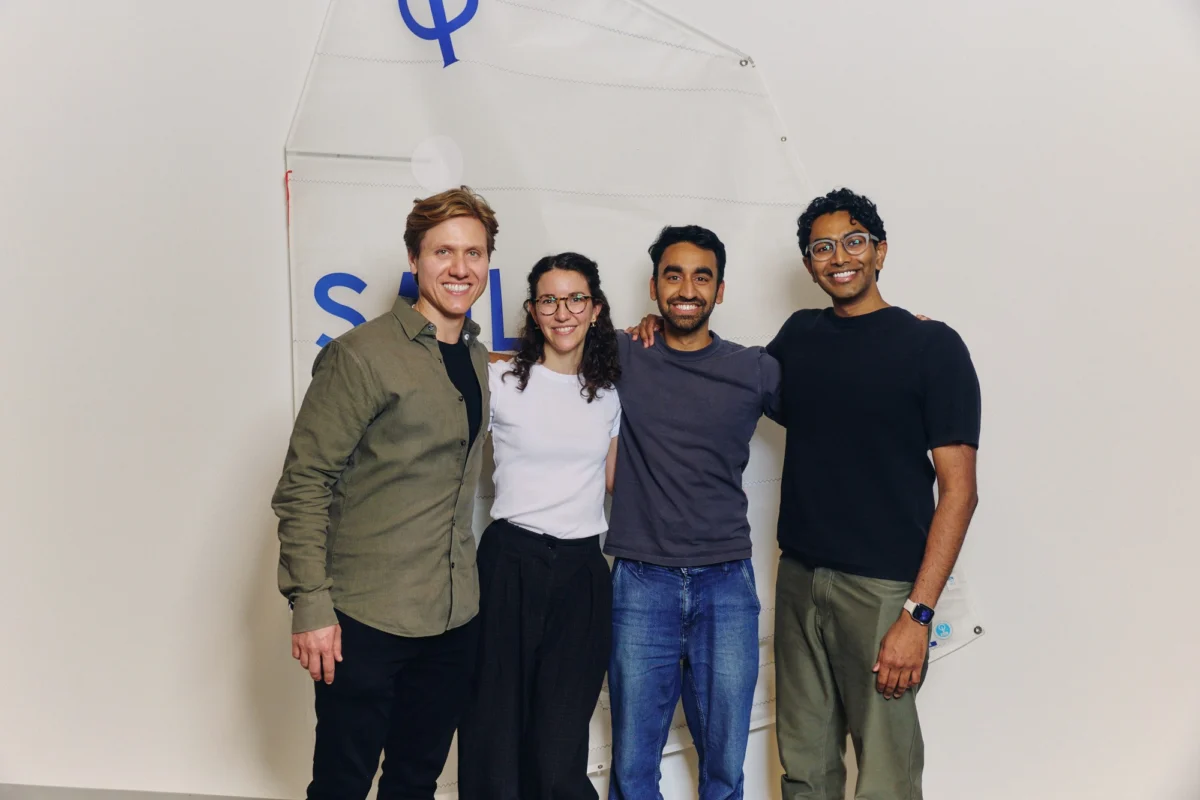
The technical pedigree behind these innovations runs deep. The founding team at Sail is by no means new to the complex world of high-performance compute infrastructure. Co-founder Neil Movva began his professional career at NVIDIA, where he pushed graphical processing units to their absolute limits, before applying the same rigorous optimization principles to newer generations of specialized AI accelerators at Apple, and ultimately returning to core GPU infrastructure at Together AI. Co-founder Samir Menon brings a complementary background from Apple, where he successfully designed and maintained exceptionally reliable systems capable of scaling to support billions of users. Together, this team brings a shared passion for performance engineering, driven by a commitment to chase computational efficiency to its absolute limits.
Beyond the grueling demands of inference optimization and systems architecture, the Sail office maintains an energetic culture characterized by technical brilliance, collaborative problem-solving, and occasional unicyclist intermissions. The office chess leaderboard serves as a daily focal point for friendly competition among new hires and seasoned engineers alike, reflecting a vibrant team environment that is expanding rapidly to meet the growing demands of the market.
Making Intelligence Abundant
At its core, Sail’s overarching raison d’être is to make advanced machine intelligence radically abundant and accessible. Every architectural decision made by the company, spanning from the physical chip level up to the developer-facing application programming interfaces, is intentionally designed to provide engineering teams with the tokens, scale, and runtime necessary to build and deploy autonomous agents without artificial boundaries. Having established strong partnerships and backing from day zero, the team at Sail views the current landscape as merely the opening act for a much larger transformation in how software is built and executed. With the foundational infrastructure now taking shape, the path forward is set for a new era of autonomous computing.




Comments (0)