



Traditional financial markets experienced a notable divergence in asset performance following a turbulent trading session, as major indices reacted sharply to corporate earnings reports and shifting investor sentiment. While traditional safe havens and select equity benchmarks managed to post modest gains, the technology-heavy Nasdaq Composite slipped, weighed down heavily by a sharp correction in enterprise software giant Oracle. The ripple effects of Oracle’s disappointing third-quarter financial results extended far beyond traditional equities, casting a complex shadow over the digital asset ecosystem and highlighting a broader recalibration of risk among institutional and retail market participants alike.
The primary catalyst for the day’s tech-sector downturn was Oracle, whose shares plummeted by roughly 11% following the release of its Q3 earnings report. The company reported revenue figures that fell short of Wall Street consensus expectations, while simultaneously issuing higher-than-anticipated spending guidance. This combination of softer top-line growth and increased capital expenditure requirements instantly reignited underlying anxieties regarding the durability, monetization timelines, and overall sustainability of the artificial intelligence boom that has driven much of the broader market’s gains over recent quarters.

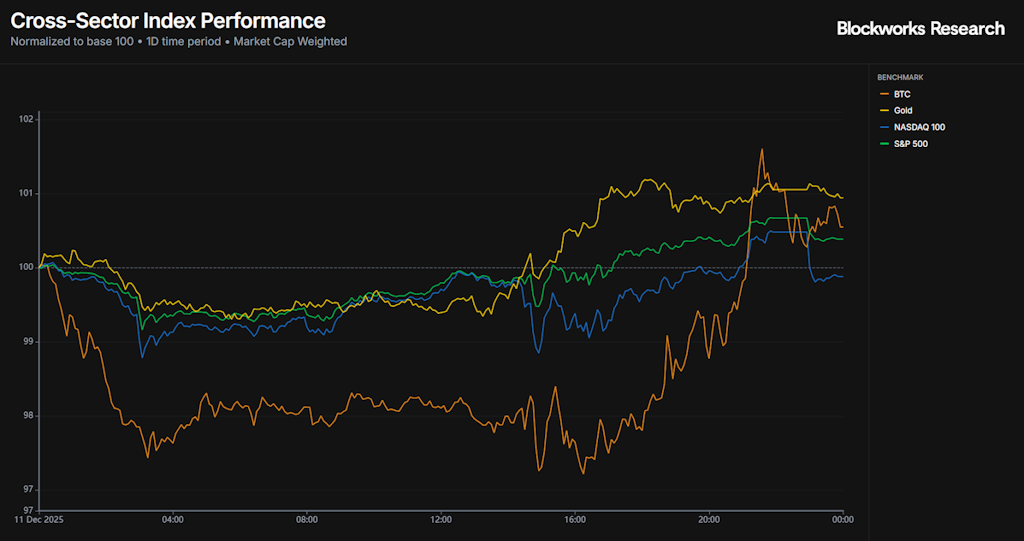
As investors re-evaluated their exposure to high-growth tech valuations, the market witnessed a distinct rotation out of technology and into lagging or more defensive sectors. This capital flight pushed the Dow Jones Industrial Average to fresh record highs as capital sought shelter in industrial, financial, and consumer staples components. Meanwhile, broader cross-asset performance reflected this cautious positioning. Traditional safe-haven assets and alternative stores of value found favor, with gold posting a solid gain of 0.95%. Simultaneously, the broader S&P 500 managed to eke out a 0.39% increase, bolstered by its more diversified sector weighting, even as the Nasdaq slipped 0.12% under the weight of its mega-cap technology constituents.
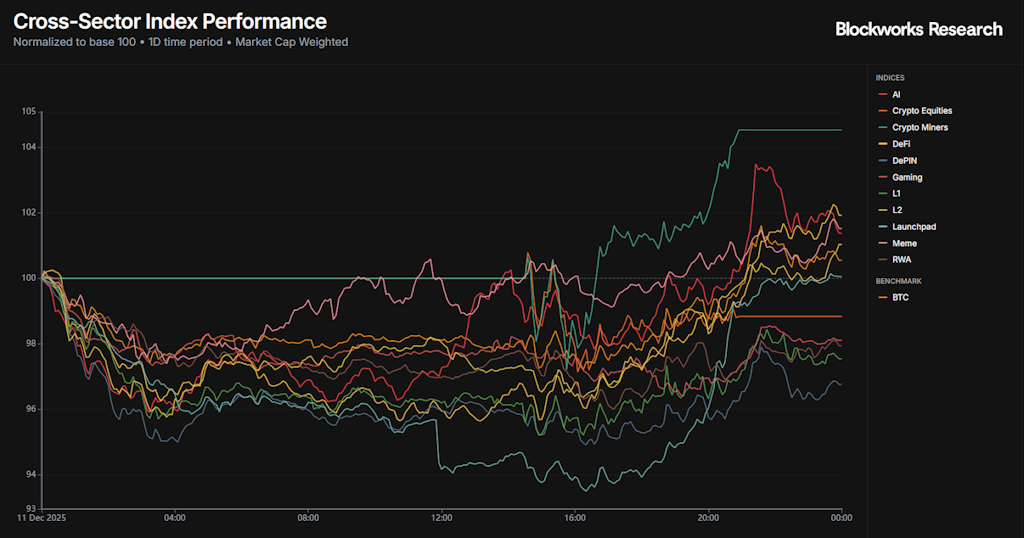
Within this shifting macroeconomic and equity landscape, the crypto sector exhibited a similarly uneven tape, characterized by sharp divergences across various digital asset sub-sectors. Despite the renewed skepticism surrounding the AI trade that battered traditional technology stocks, crypto mining equities emerged as a surprising and robust bright spot. Crypto miners rallied by an impressive 4.5% on the day, defying the broader tech slump. This upward momentum was led in large part by companies like IREN, which constitutes roughly 24% of the sector index and posted a 4.4% gain, spearheading a broader relief rally for hardware-heavy mining infrastructure providers.
Decentralized finance also demonstrated resilience amid the broader market volatility. The DeFi sector advanced by 1.93%, fueled by notable strength across several key governance and utility tokens. Protocols such as AAVE, ENA, and HYPE—which collectively account for approximately 44% of the DeFi index—all closed the session in positive territory, providing a stabilizing anchor for decentralized finance participants who navigated the choppy macroeconomic crosscurrents.
Conversely, other corners of the digital asset economy faced severe downward pressure. Decentralized Physical Infrastructure Networks, commonly known as DePIN, continued their recent struggles, sliding by 3.2% over the course of the session. The sector was dragged lower by prominent tokens such as Filecoin (FIL) and GRASS, which suffered steep declines of 6.2% and 7.2%, respectively, reflecting ongoing challenges in sustaining upward momentum for decentralized storage and bandwidth-sharing networks.
In a more unexpected development, Layer-1 blockchain tokens lagged significantly behind the broader market, dropping by an average of 2.5% on the day. Even though Bitcoin managed to hold onto positive territory, the majority of underlying Layer-1 assets finished the session firmly in the red. Tokens such as SEI and BERA bore the brunt of the selling pressure, both posting steep losses of around 9% as capital rotated away from speculative base-layer tokens toward safer or more defensive positioning.
Capital flows across institutional investment products continued to serve as a persistent headwind for the digital asset market. The session followed a roller-coaster pattern of inflows and outflows that highlighted ongoing institutional hesitation. Just a day prior, digital asset investment products experienced a robust rebound, registering a strong $346.2 million in total exchange-traded fund inflows on December 9. However, that bullish momentum faded rapidly as the broader market sentiment soured.
Spot bitcoin exchange-traded funds bore the brunt of the reversal, recording net outflows of $154.2 million during the session. Ethereum exchange-traded products similarly experienced negative momentum, seeing net outflows of $42.3 million as institutional allocators trimmed their exposure to the second-largest cryptocurrency by market capitalization. The single persistent bright spot amid the otherwise sluggish institutional flow data remained Solana-focused investment products. Solana ETFs continued to defy the broader trend of outflows, steadily attracting consistent, albeit modest, daily inflows ranging from the low single digits to low double digits of millions of dollars, signaling a resilient pocket of ongoing accumulation for alternative layer-one exposure.





Comments (0)