



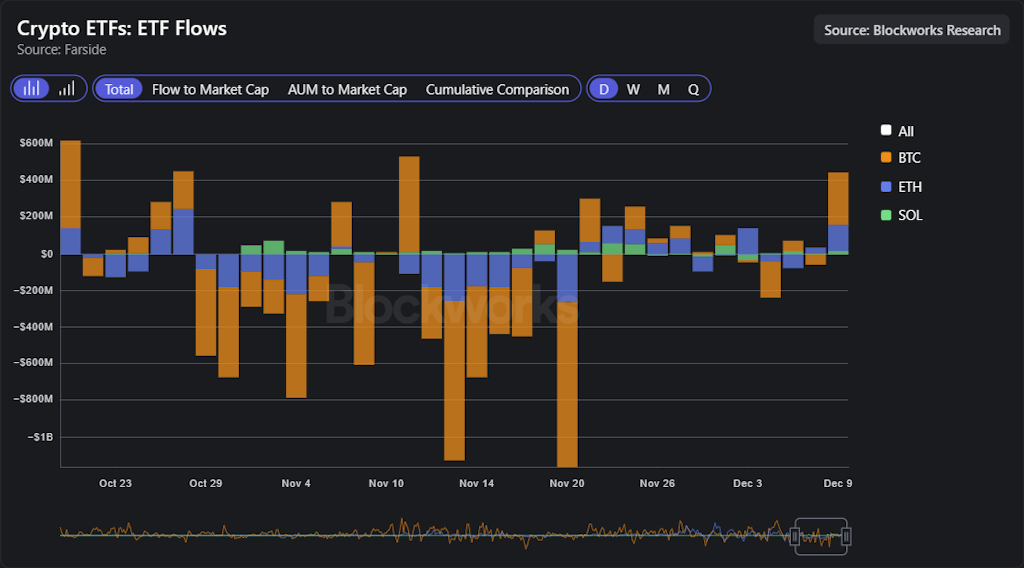
Financial markets leaned cautiously into a risk-on posture as the trading week kicked off, with the cryptocurrency sector outperforming a mixed and choppy backdrop across traditional asset classes. Digital assets found renewed momentum, buoyed by the largest single-day surge in exchange-traded fund (ETF) flows since October.
This resurgence in sentiment arrives at a pivotal juncture for global financial markets. Investors are bracing for a dense macroeconomic calendar dominated by fresh Consumer Price Index (CPI) inflation prints, high-stakes Treasury auctions, and a closely watched Federal Open Market Committee (FOMC) meeting. Together, these events threaten to reshape global risk appetite and test the resilience of recent market rallies. Amid these broader macro currents, crypto traders are also keeping a close eye on emerging decentralized finance developments, including discussions surrounding the newly introduced WET token—the native asset of the HumidiFi proprietary automated market maker (AMM).

Indices and Sector Performance
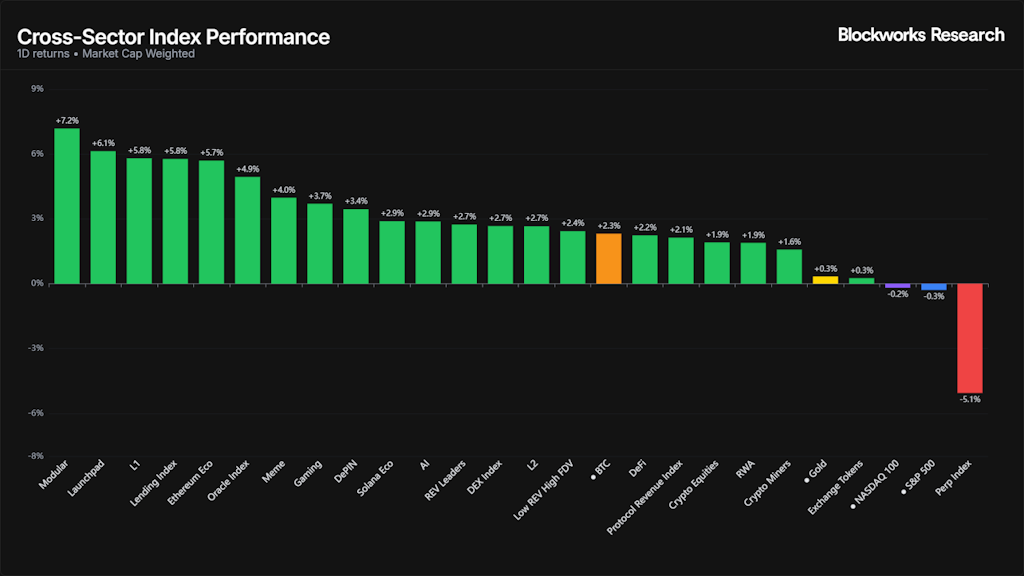
As the broader markets tilted toward a risk-on bias, cryptocurrency assets spearheaded the advance while traditional equities struggled for traction. Bitcoin (BTC) posted a modest yet respectable gain of 2.3%, comfortably outperforming major equity benchmarks. In the traditional financial sphere, the S&P 500 dipped 0.3% and the Nasdaq 100 retreated 0.2%, reflecting lingering caution among equity investors. Meanwhile, safe-haven asset gold held nearly flat, posting a marginal gain of 0.3% as traders awaited definitive signals from upcoming inflation and monetary policy reports.
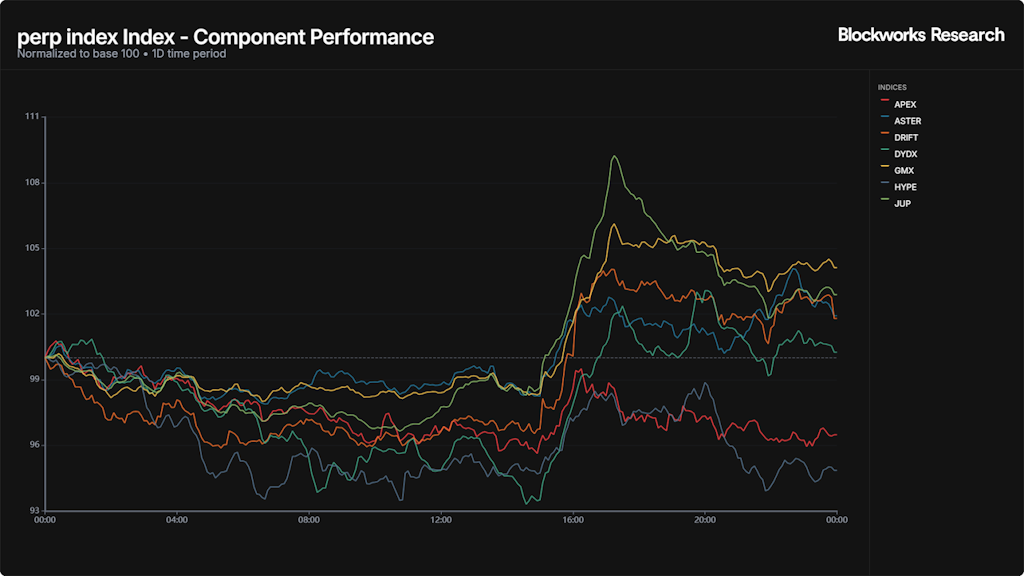
The clear laggard across the digital asset ecosystem was the perpetual futures sector, with the Perp Index contracting sharply by 5.1% over the session. This contraction was driven primarily by a volatile intraday spike-and-fade pattern observed across prominent decentralized perpetual platforms such as dYdX, GMX, and particularly HYPE. A midday market squeeze briefly lifted the perpetual sector, creating a wave of optimistic momentum before sentiment abruptly stalled. As the trading session wound down, strong selling pressure reversed earlier gains.
Individual tokens mirrored this volatile price action. Jupiter (JUP) experienced a sharp upward move, climbing as much as 9% during the session before retracing the majority of its gains by the close. Meanwhile, HYPE has faced persistent headwinds of late. The token has struggled as innovative builder codes facilitate new frontend relationships directly with users, diverting attention and volume. Compounding these pressures, the broader market is also anticipating an impending token generation event (TGE) from rival perpetual exchange Lighter, which has been drawing considerable speculative interest following the rollout of its public mainnet.
Looking ahead, market participants are shifting their focus squarely to the upcoming CPI inflation print and a dense slate of mid-week Treasury auctions. Both events carry the potential to recalibrate risk appetite across all asset classes. Because implied volatility remains relatively suppressed across major cryptocurrencies, any unexpected macro surprises run the risk of triggering outsized price movements in either direction.
Market Update and ETF Flow Dynamics
After nearly a month characterized by choppy, stagnant, or outright negative capital flows, institutional channels finally registered a meaningful and positive shift. Spot crypto ETFs captured significant capital, delivering the cleanest signal yet that risk appetite is returning to institutional portfolios. Bitcoin ETFs drove the lion’s share of the movement, pulling in an impressive $287 million in a single day. Ethereum (ETH) products followed suit, experiencing their best single-day inflow performance since October 28 with $142 million in net creations. Solana (SOL) investment vehicles also contributed positively, though on a much smaller scale, bringing in roughly $16 million.
This sudden spike in ETF inflows can be interpreted through multiple lenses. In the short term, it likely reflects tactical positioning by market participants seeking exposure ahead of a dense macroeconomic calendar featuring the FOMC decision, crucial inflation reports, and labor market data. Additionally, quarter-end optics likely played a role, as professional allocators frequently adjust or re-express their benchmark exposure through liquid wrappers during weeks defined by heavy macroeconomic catalysts.
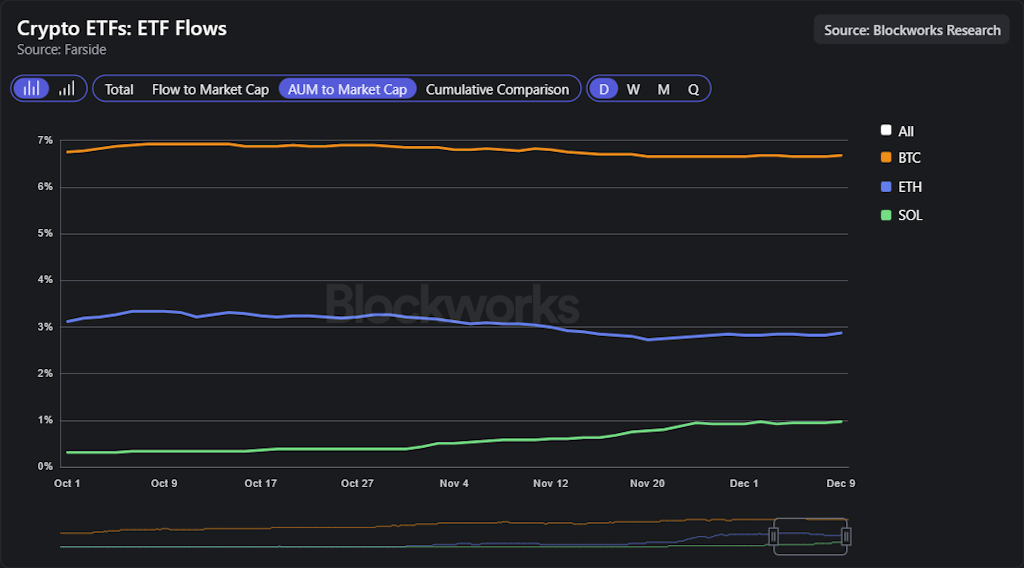
Despite the encouraging surge in daily inflows, a broader examination of assets under management relative to total market capitalization paints a more nuanced picture. Bitcoin’s ETF AUM-to-market-cap ratio remains stuck in a tight band near 6.6% to 6.8%. Ethereum continues a multi-month slide in this metric, drifting downward from roughly 3.3% to 2.8%. Solana, while experiencing growth in absolute terms, still sits just under the 1% threshold. This structural divergence implies that organic price appreciation, rather than sticky and continuous inflows, has been the primary force maintaining the aggregate size of these ETF products.
Furthermore, the nature of Bitcoin’s recent inflows suggests tactical re-risking rather than a wave of deep-seated long-term conviction. Derivatives market data reveals an elevated basis coupled with falling perpetual open interest, indicating that institutional capital currently favors directional spot exposure over leveraged positioning.
These ETF flows are becoming increasingly vital for the health of Bitcoin’s market structure, largely because traditional corporate treasury buyers—frequently referred to as Digital Asset Treasury Companies or DATCOs—are no longer carrying the buy-side demand. The latest treasury holdings data demonstrates that, with the notable exception of MicroStrategy (Strategy), corporate accumulation has remained essentially flat for months. Smaller corporate cohorts and secondary DATCOs have added only marginal amounts of Bitcoin to their balance sheets at best, contributing almost nothing to incremental market demand. Even MicroStrategy cannot realistically maintain the aggressive accumulation pace it exhibited previously.
This reality is underscored by the market valuations of major Bitcoin DATCOs, many of which currently trade at market-to-net-asset-value (mNAV) ratios below 1. When a company’s stock trades below its underlying net asset value, the once lucrative playbook of issuing equity at a premium to acquire accretive Bitcoin holdings ceases to function effectively. In practical terms, the powerful corporate balance sheet bid that helped define previous market cycles and the early stages of the current cycle is unlikely to return in a significant capacity anytime soon. Consequently, the burden of sustaining upward momentum rests heavily on the shoulders of spot ETF inflows and evolving market participants navigating the shifting macro landscape.





Comments (0)