



Macroeconomic reality has officially delivered a stark reminder to the digital asset ecosystem that traditional financial levers still hold immense sway over crypto valuations. Following months of speculation and varying market dynamics, the Federal Reserve stepped in with a widely anticipated interest rate cut, yet accompanied the move with hawkish guidance that quickly dampened celebratory sentiment across trading desks.
While the central bank trimmed rates by 25 basis points, its forward-looking projections signaled a significantly tighter monetary path ahead than many risk-on investors had anticipated. Officials projected only a single rate cut for the entirety of the coming year, pointing directly to a cooling labor market, stubbornly persistent inflation above target ranges, and an underlying economic growth rate that continues to demonstrate unexpected resilience.

This messaging shattered hopes for an immediate, expansive wave of global liquidity rushing into risk assets. Consequently, Bitcoin, which had displayed early strength in anticipation of the monetary pivot, swiftly relinquished its gains as traders digested the prospect of a prolonged high-interest-rate environment.
Divergent Market Performance and Index Realities
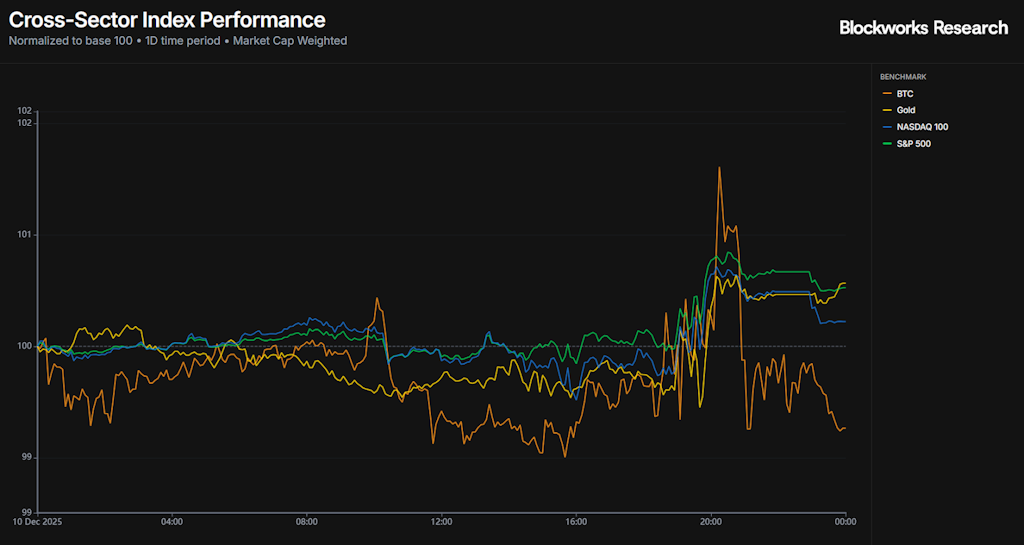
The immediate aftermath of the Fed’s announcement created a clear divergence between Bitcoin and traditional macro benchmarks. While gold, the S&P 500, and the Nasdaq managed to close the session in positive territory with gains of 0.57%, 0.53%, and 0.22% respectively, Bitcoin slipped 0.73% to hover tightly around the $90,000 threshold. The market as a whole appeared stuck in neutral, reflecting a holding pattern as participants wait for clearer directional cues from the broader macroeconomic landscape.
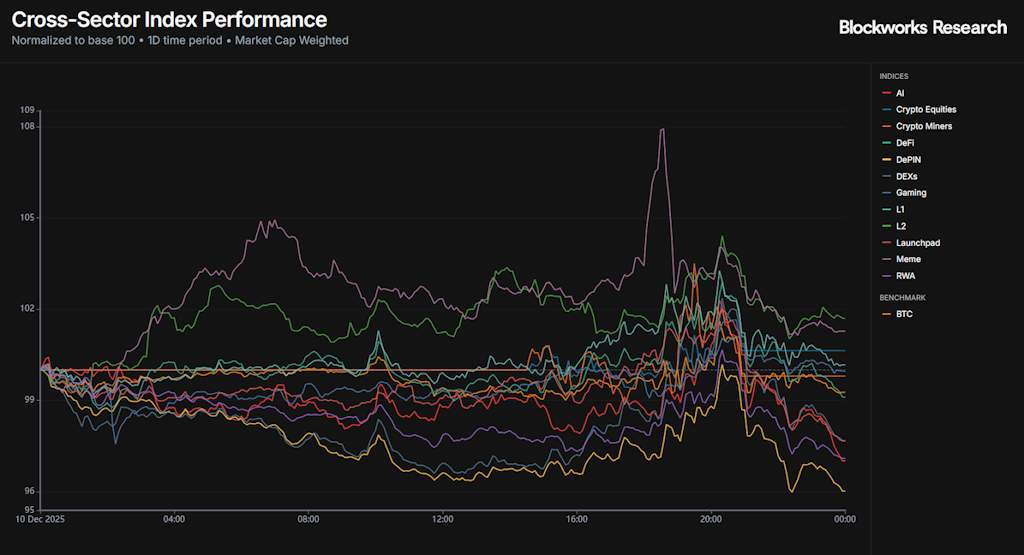
Beneath the headline indices, sector-level performance across the crypto ecosystem presented a mixed narrative. Layer-2 networks and meme-focused tokens managed to eke out modest gains of 1.70% and 1.27% respectively, though these aggregate numbers masked concentrated individual movements. The strength within the Layer-2 sector was driven almost entirely by MNT, which surged 4.5% to cement its position, accounting for nearly one-third of the entire index’s weight.
Similarly, the meme sector was propelled by outliers like M (MemeCore), which climbed 6.2%, even as the vast majority of competing meme tokens drifted lower. On the other end of the spectrum, artificial intelligence and decentralized physical infrastructure networks (DePIN) suffered notable pullbacks, declining 3% and 4% respectively. The downward pressure in AI tokens was led by losses in IP and ICP, which dropped 6% and 7.9%, while the weakness in DePIN stemmed from declines in FIL and HNT, down 4.9% and 5.6%.
Until macro conditions establish a definitive trend, crypto assets are expected to continue drifting in tandem with broader macroeconomic sentiment.
The Evolving Landscape of the Perpetual DEX Wars
While macro conditions dictate the broader trading range, internal sector dynamics are undergoing a seismic shift, most notably within the hyper-competitive realm of decentralized perpetual exchanges. For months, market participants have questioned whether the hype surrounding HYPE has begun to fade as the token struggles to keep pace with broader market recoveries. Over a recent seven-day window, HYPE dropped 20%, starkly outperforming—or rather, underperforming—Bitcoin’s modest 3% decline. Zooming out to examine weekly HYPE-to-Bitcoin returns reveals that the asset has surrendered nearly half of its outperformance since reaching its multi-month peak in mid-September.
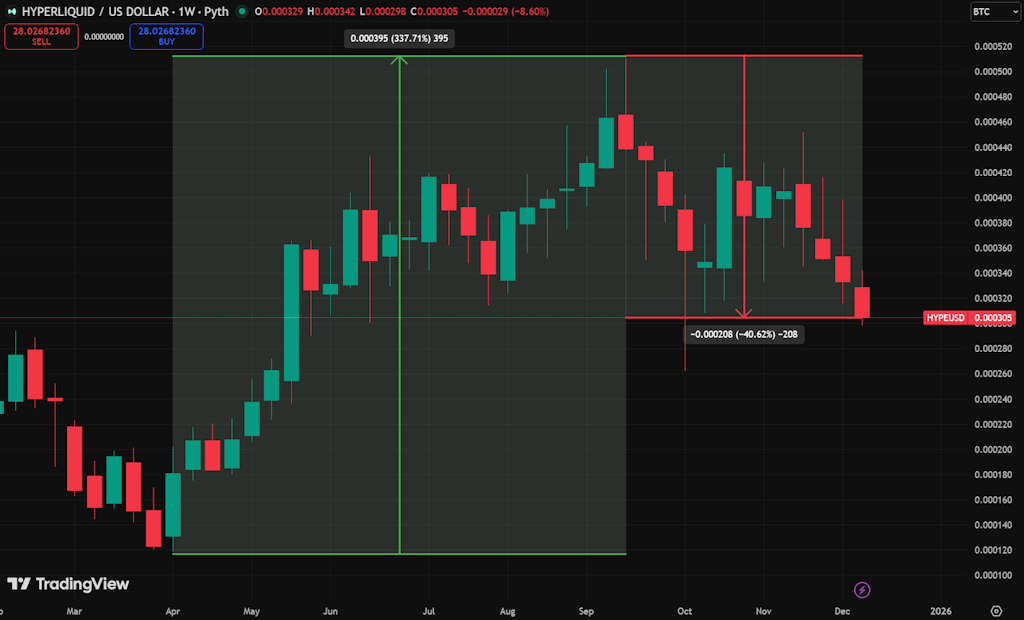
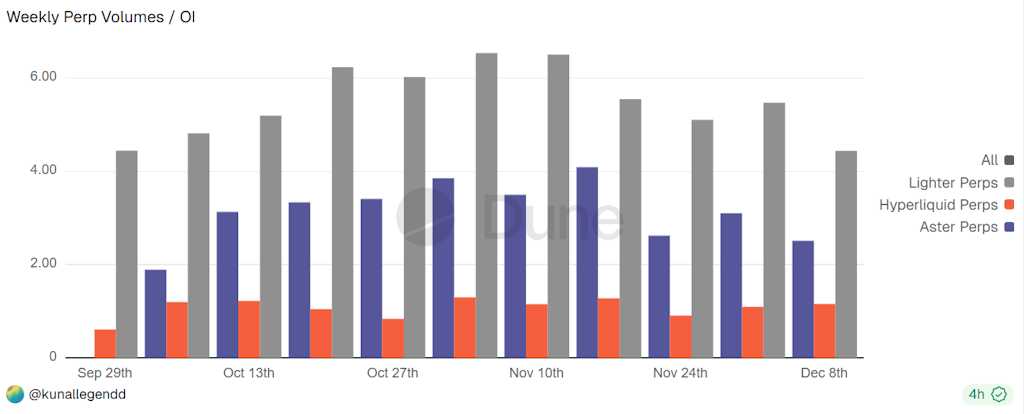
The catalyst behind this shifting momentum is clear: intensifying competition. The peak in HYPE’s relative performance coincided almost perfectly with the market debut of Aster, a new perpetual exchange that rapidly captured both market share and trader attention. In the months since mid-September, Hyperliquid’s dominant share of aggregate perpetual trading volume has compressed from 49% down to 19%. The lion’s share of that displaced volume has migrated directly to competing platforms like Aster and Lighter, with the latter even managing to slightly edge out Hyperliquid in total weekly volume since mid-October.
However, raw volume figures fail to tell the complete story of protocol health and user retention. A comparative analysis of weekly trading volume relative to open interest reveals that both Lighter and Aster maintain significantly higher turnover ratios than Hyperliquid. Extremely high volume-to-open-interest ratios often point toward rapid position cycling and potential inorganic activity driven primarily by token incentive farming.
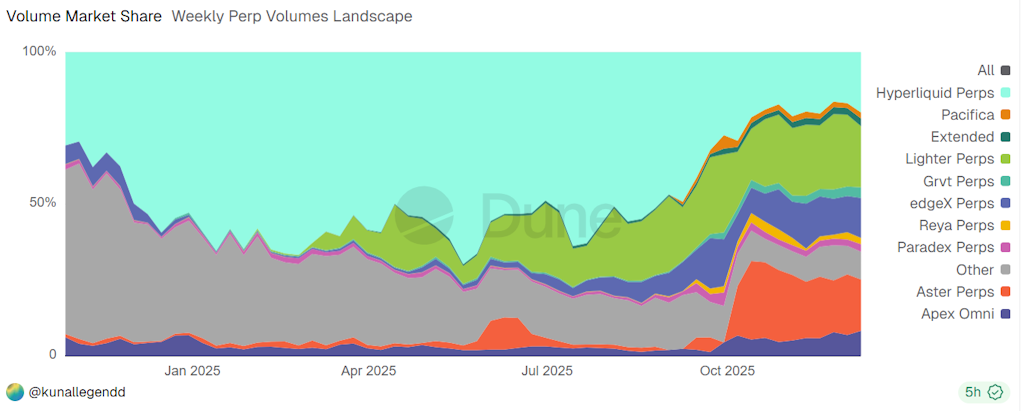
Both Aster and Lighter have aggressively deployed points programs to attract liquidity, meaning a substantial portion of their current activity could dissipate once these promotional incentives cool down. With Lighter’s token generation event on the horizon, the market will soon receive its first definitive test regarding how much of the platform’s volume represents sticky, organic usage versus short-term yield farming.
Despite these competitive pressures, writing off early market leaders prematurely overlooks the fundamental mechanics driving protocol success. The perpetual exchange arena is unlikely to consolidate into a strict winner-take-all market. Instead, long-term dominance will likely belong to platforms offering the lowest execution fees, the deepest liquidity books, the broadest asset selection, and the most frictionless user experience.
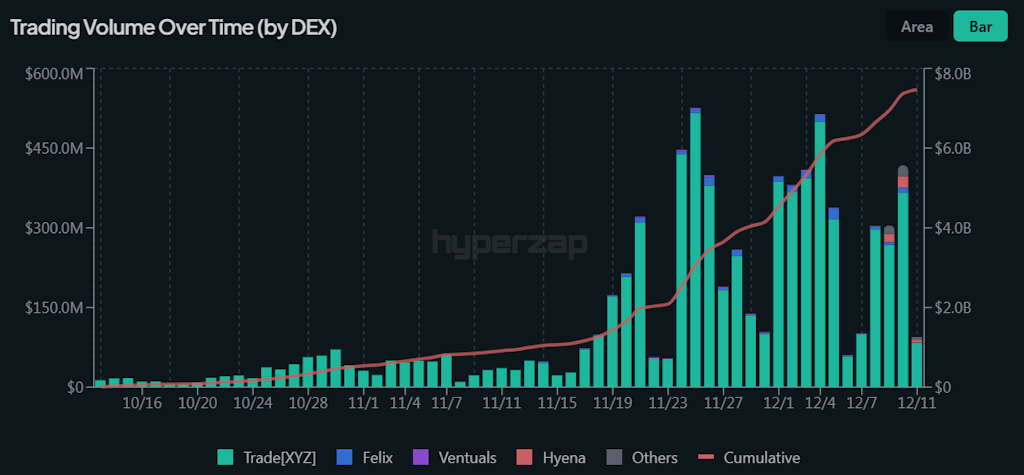
Lighter currently holds an advantage in the fee battle by offering zero maker and taker fees, a dynamic amplified by the rise of automated perp aggregators routing trades to the most cost-effective venues. Yet, market depth and asset variety remain critical pillars, domains where Hyperliquid continues to hold a formidable lead, particularly following the successful launch of HIP-3, which introduced equity perpetual markets to strong early traction.
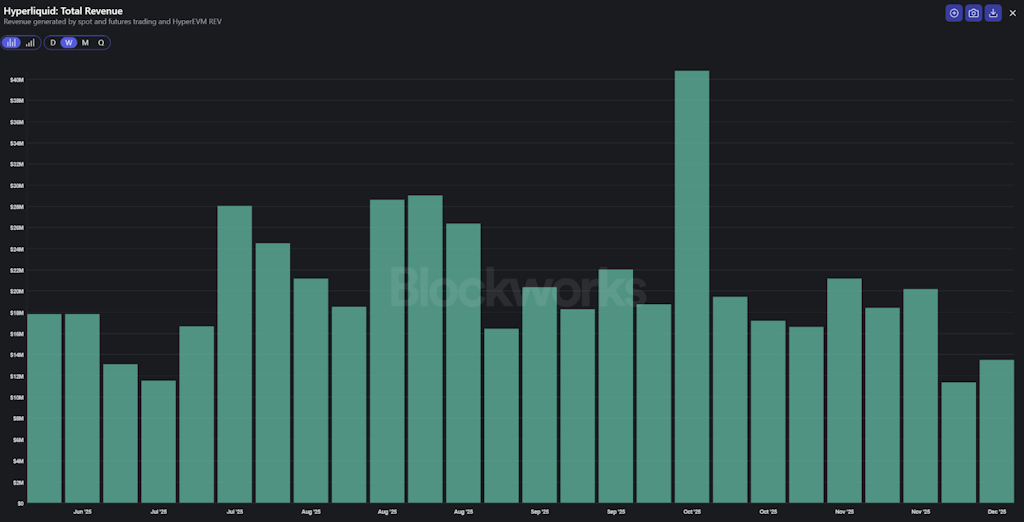
Short-term headwinds, including notable team token unlocks and emerging discussions regarding platform auto-deleveraging designs, have undoubtedly weighed on immediate market sentiment. Nevertheless, the underlying economic engine remains exceptionally powerful. Hyperliquid consistently generates between $10 million and $20 million in weekly revenue, capital that is systematically utilized to repurchase HYPE tokens. Few protocols across the entire digital asset landscape possess a comparable revenue-generating foundation, ensuring that the battle for perpetual exchange dominance will remain fiercely contested in the months ahead.
Bridging the Gap in Crypto Investor Relations
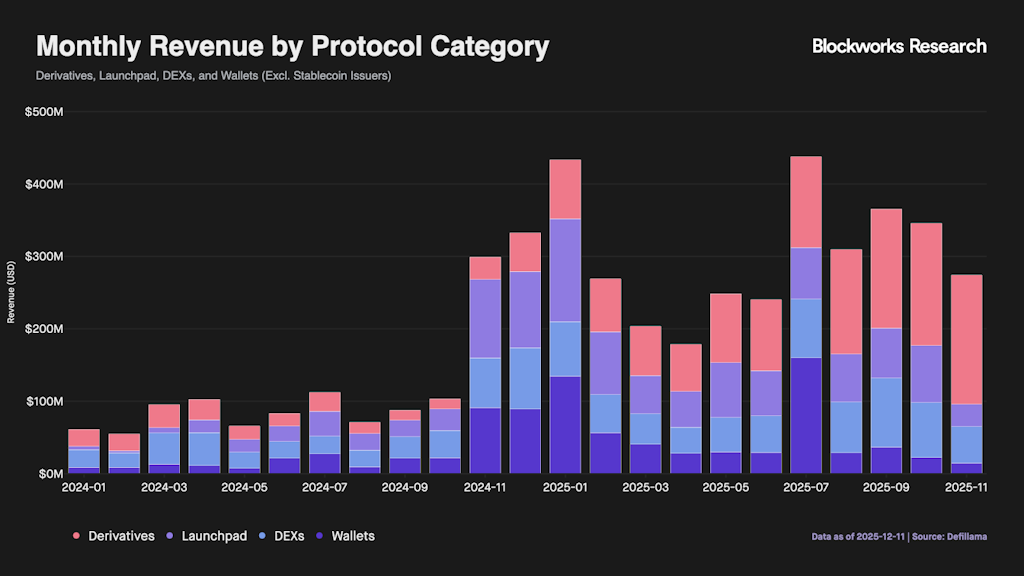
Beyond trading venues and token performance, the broader cryptocurrency industry has matured at a staggering pace, transitioning away from purely speculative infrastructure plays toward diversified, cash-flowing business models. Across the ecosystem, monthly protocol revenue—excluding stablecoins—averaged an impressive $175 million throughout the year, representing a 133% year-over-year expansion from the $75 million monthly average recorded previously.
This unprecedented capacity for global, decentralized coordination has unlocked growth rates rarely witnessed in traditional industries. Hyperliquid established itself as the fastest team in history to achieve $1 billion in annualized recurring revenue, Tether secured a massive valuation during funding rounds, and emerging protocols like Axiom rapidly scaled to millions in monthly revenue within months of inception. Combined with aggressive fundraising cycles generating billions in monthly capital inflows, the industry continues to expand at a relentless pace.
Yet, this rapid maturation has surfaced a critical bottleneck: navigating the asset class has become extraordinarily complex, particularly for traditional finance investors seeking to diversify their portfolios. While digital assets increasingly function like ownership-based, cash-generating enterprises, their unique on-chain characteristics render traditional due diligence frameworks largely inadequate.
Consider platforms operating in specialized niches like fixed and variable rate yield optimization. While the traditional interest rate derivative market handles trillions of dollars daily, mapping this massive TradFi parallel onto the crypto ecosystem introduces a dense web of technical and economic nuances. This complexity permeates nearly every corner of the decentralized economy, raising persistent questions regarding the operational mechanics of decentralized order books versus liquidity pools, the tradeoffs inherent in modular versus monolithic lending designs, and the true sustainability of various user acquisition models.
For professional capital allocators, these information asymmetries create severe workflow friction. Essential data is frequently scattered across disparate analytical dashboards, decentralized GitHub repositories, and private communication channels. This fragmentation erects formidable barriers to entry for institutional capital, potentially explaining why numerous high-performing protocols continue to trade at steep discounts relative to their traditional financial counterparts.
To address this systemic disconnect, institutional infrastructure providers are stepping in to professionalize the communication channel between asset issuers and capital allocators. Initiatives designed to replace open, fragmented data aggregators with standardized, high-fidelity on-chain metrics, conversion of raw governance activity into institutional-grade research, and centralized roadmap updates aim to streamline due diligence workflows. By bridging the gap between sophisticated investors and cash-flowing decentralized applications, the industry moves one step closer to bridging the divide between traditional finance and native digital assets.





Comments (0)