



Published August 19, 2026
The race for dominance in the artificial intelligence application layer is rapidly evolving from a contest driven primarily by user interfaces, workflows, and go-to-market strategies into a much more fundamental conflict. Industry leaders increasingly view it as a direct fight for the intelligence layer itself, pushing enterprises to rethink how they source, manage, and deploy AI capabilities.
The calls for organizations to own their core intelligence are escalating across the technology sector. Recently, Palantir CEO Alex Karp encouraged enterprises to take control of "the means of production." Not long after, Microsoft CEO Satya Nadella offered a sharp warning during a public address, declaring that buying intelligence from a frontier lab is akin to paying twice: once with money, and a second time with the proprietary knowledge and operational insights a company must reveal to make that intelligence truly useful.
This underlying tension has sparked a critical question across boardrooms and engineering teams worldwide: who should actually own the intelligence at the core of a modern business?
Industry observers clarify that owning one’s intelligence is neither a rigid mandate nor a wholesale recommendation to abandon frontier AI labs entirely. For many standard workloads, third-party frontier APIs and pre-built agents remain the most practical and efficient answer. However, across venture portfolios and fast-growing technology sectors, a notable shift is underway. More companies are beginning to build their own bespoke AI capabilities for critical parts of their products, vertically integrating their operations toward owning and actively shaping their model weights.

To examine this shifting paradigm, Sequoia recently brought together a prominent group of AI founders, researchers, and builders for an exclusive event focused on the concept of owning the AI stack. The gathering featured real-world perspectives from legal tech pioneer Harvey, alongside technical deep-dives from companies like Mercor, LangChain, Trajectory, and Fireworks, all of which walked attendees through the complex building blocks of the modern post-training stack. Across the various presentations and discussions, a clear and actionable playbook began to emerge for companies looking to take control of their AI destiny.
Why Now? The Convergence of Open-Weight Models and Mature Stacks
Two major developments have accelerated this movement toward owning the intelligence layer. First, the open-weight frontier has advanced at a pace far faster than many industry analysts initially anticipated. Highly capable models such as Kimi K3 and GLM 5.2 have demonstrated extraordinary performance. In previous years, training on open models felt like running on a treadmill; a company might spend months fine-tuning an open-source architecture, only for the next major frontier release to completely erase those hard-won gains. Today, however, developers can start from an open baseline that sits remarkably close to the absolute frontier of AI capabilities.
Second, the independent post-training stack has matured significantly. Thanks to infrastructure providers like Mercor and Fireworks, organizations of varying sizes can now access a technology stack that rivals a dedicated frontier research lab. This spans the entire lifecycle from training and inference to the generation of human or synthetic data. Equipped with robust evaluation frameworks, harness engineering, advanced post-training techniques, and online learning loops, open models are now capable of outperforming general frontier models within specific, highly targeted industry domains.
Just a year ago, choosing open weights was often treated as a compromise—a tactical decision made when performance was something a company was willing to sacrifice in exchange for cost or control. Now, it is rapidly transforming into an existential and strategic imperative. The newest battleground in technology is no longer just about proprietary weights or slick product interfaces; it is a fierce contest for the intelligence layer itself.
Deciding When to Make the Move
There is no single, universal approach to determining when an enterprise should transition from renting AI intelligence to owning it. Beyond raw performance metrics, companies often find that relying entirely on rented intelligence becomes a restrictive constraint due to a combination of economic, technical, and strategic pressures.

Cost represents a primary driver. As an AI-driven product scales and achieves commercial success, its inference costs scale directly with usage. For high-volume applications, owning and self-hosting the underlying model often emerges as the most effective financial strategy to protect operating margins.
Speed is another critical factor. In specialized technical domains such as real-time code autocomplete or cybersecurity threat detection, a small, highly distilled custom model can frequently outperform a massive, generalized frontier model simply because execution speed and low latency are paramount.
Furthermore, proprietary data sensitivity plays a major role. When a company’s internal feedback loops, evaluation datasets, customer interactions, and domain-specific knowledge are the primary drivers of system improvement, leadership may prefer to keep that vital intellectual property securely within their own infrastructure rather than passing it upstream to a third-party lab.
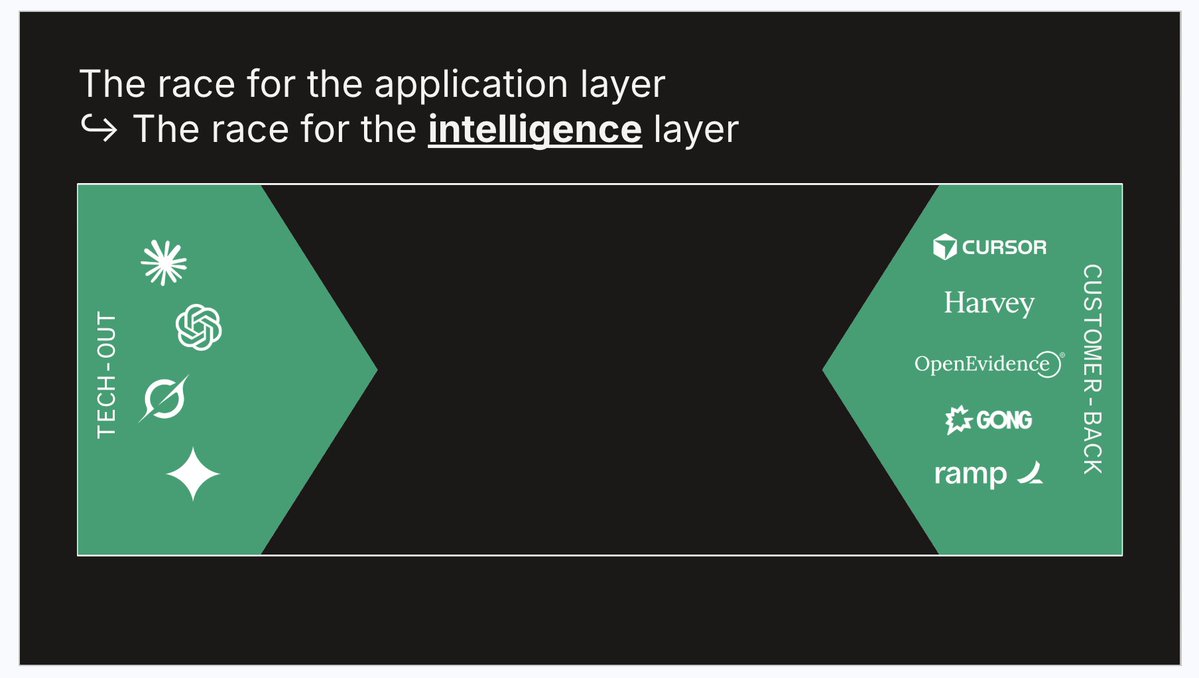
Finally, companies are looking to control their own long-term destiny. The application layer and the intelligence layer are actively converging. Frontier labs are increasingly moving upward into product development, while application-focused companies are pushing downward into the training loops that define how their software thinks. Consequently, owning a product increasingly means controlling more of the underlying learning loop and the intelligence itself, a strategy already being embraced by leading innovators such as Harvey Research, RampLabs, Glean, and Factory.
Building the Roadmap from Zero to One
For organizations that have determined their strategy for what to own versus what to rent, the immediate challenge is executing a successful transition from zero to one. Industry experts emphasize that companies should avoid shoehorning AI model ownership into an existing, generalized platform team. Owning intelligence requires dedicated personnel playing offense: building rigorous evaluations, shaping proprietary data, experimenting with open-weight models, tuning harnesses, and pushing performance boundaries within a specific vertical domain.
Remarkably, small, de novo teams have proven they can go very far in this endeavor by partnering strategically with a select group of ecosystem collaborators. Harvey, for example, achieved a surprising amount of advanced AI research with an initial team of just seven people.
To succeed, companies must also make their technical work legible to the broader market. As corporate buyers evaluate competing AI solutions, published research, transparent benchmarks, and technical engineering posts frequently serve as the ultimate tiebreaker. Organizations that choose to conduct advanced research in-house benefit greatly from sharing their findings and progress with the broader ecosystem.
The technical execution of this strategy relies on four core pillars: evaluations, harness and context engineering, post-training, and online learning.
Rigorous evaluation is the essential starting point. As Gabe Pereyra of Harvey noted, if an organization lacks a reliable benchmark, it cannot effectively train models. An evaluation consists of a standardized set of tasks designed to measure whether a system can perform specific work accurately, complete with a prompt, contextual data, and an automated or expert-driven grader. Most evaluations begin informally as founders review outputs and assess whether they "vibe-check" correctly, but the objective is to transform that subjective judgment into a repeatable, scientific measurement. Harvey demonstrated this approach by constructing its Legal Agent Benchmark, which translates real-world legal work into more than 1,200 discrete agent tasks across 24 legal practice areas, judged by over 75,000 expert-written rubric criteria. Establishing clear evaluations before deciding to own intelligence ensures that model selection becomes a measured, data-driven decision rather than a blind guess.
The second pillar involves harness and context engineering. Modern AI agents are comprised of three distinct components: the foundational model, the context provided to it, and the harness. The harness governs the surrounding product logic, including request routing, information retrieval, tool utilization, memory management, fallbacks, and execution traces. Harrison Chase of LangChain has framed the primary job of the harness as bringing the right context to the model at precisely the right moment in time. When a task falls outside the model’s standard distribution, an off-the-shelf harness will frequently fail. A well-designed custom harness allows engineering teams to dynamically route tasks to the most appropriate model for a specific job, reuse standardized evaluations across different architectures, and maintain strict visibility into how the agent operates. Developers can trace exactly what context entered the system, which external tools were invoked, and where execution errors occurred.

The third pillar is post-training, a broad category of techniques where the specific method chosen depends entirely on the desired improvement. As Lin Qiao points out, if a model simply lacks factual knowledge, post-training is unnecessary; standard context augmentation or retrieval-augmented generation (RAG) is sufficient. If the output format or behavioral style is incorrect, supervised fine-tuning is the appropriate remedy. When the challenge involves product taste or nuance, preference tuning is typically deployed. If a model needs to master a highly specialized procedural task, reinforcement learning is required, while distillation is used when a model must be made faster or more cost-effective. The overarching goal is to apply the lightest possible intervention that successfully moves the evaluation metrics, serving the resulting model through the established harness to continuously measure quality, latency, and cost.
The final pillar is online learning. Once a system is fully assembled with evaluations, a robust harness, and an optimized model, the ongoing objective is to improve that system continuously in production. As Arjun Karanam has observed, while frontier models continue to grow more intelligent overall, every operational session can still feel like a model’s very first day on the job. Without domain-specific experience, even a brilliant intellect will struggle in a specialized professional environment on day one. AI agents generate that vital experience dynamically as they execute real-world tasks.
A trajectory represents the complete path a model takes through a task: the context it reviewed, the tools and sub-agents it invoked, the final answer it generated, and any edits, reversals, or retries performed by the human user. Capturing these trajectories using specialized tracing tools like LangChain’s LangSmith is essential for building a continuous production feedback loop. In this environment, a failed task is automatically converted into a new evaluation, missing information is channeled back into context or memory, and a faulty tool response results in an immediate harness correction.
The Broader Outlook
Embracing this level of architectural ownership opens a complex strategic landscape for technology companies. The traditional closed-model stack offers undeniable simplicity: an enterprise calls a frontier API, utilizes an out-of-the-box development harness, applies basic prompts and contextual data, and ships the product. This approach guarantees a high performance floor, but it also imposes a strict ceiling on long-term differentiation.
Conversely, owning the AI stack requires an organization to shoulder significantly more operational responsibility. The production stack transforms to include open-source models, custom-built harnesses, proprietary tools, and tailored context windows, while the development stack relies on internal evaluations, proprietary domain data, and active online learning loops. While this path demands more engineering effort and introduces a potentially lower initial performance floor, it ultimately raises the ceiling for what the technology can achieve.

The major AI labs will undoubtedly continue building increasingly massive foundational brains, and enterprises across industries will continue to utilize them. However, in parallel, the industry’s most successful product companies are successfully cultivating their own specialized intelligence systems: fast, opinionated, domain-obsessed models tuned precisely to the unique workflows they encounter every day. In a technological landscape where a growing number of companies take direct ownership of their intelligence, the broader software ecosystem flourishes and individual innovation triumphs.





Comments (0)