



Financial markets continued to claw back losses following Monday’s broad-based selloff, buoyed by macroeconomic indicators that shifted investor expectations regarding upcoming monetary policy. Major traditional equities and digital assets alike showed renewed vigor, though underlying market dynamics revealed a landscape characterized by cautious optimism and distinct sectoral divergences.
In the broader financial markets, benchmark indices posted modest gains as investors digested fresh economic data. Bitcoin advanced 2.52%, while the S&P 500 and the Nasdaq added 0.22% and 0.05%, respectively. Traditional safe-haven assets mirrored the shifting sentiment; gold gave back a portion of its recent gains, sliding 0.12% on the day as risk appetite across global markets improved.

The primary catalyst for the renewed risk-on sentiment was a surprise contraction in private sector employment. Data released for November revealed that private employers shed 32,000 jobs, falling well short of economists’ projections for continued job growth. This unexpected softening in the labor market immediately reverberated through interest rate expectations. According to market monitors, the probability of a Federal Reserve rate cut at the upcoming policy meeting climbed to 85%, up notably from 80% just a week prior.
Despite the generally positive macroeconomic tailwinds, individual large-cap equities faced headwinds. Microsoft weighed heavily on the Nasdaq, with its stock falling more than 2% following reports that the technology giant had lowered its internal sales quotas for artificial intelligence software. The adjustment came amid reports of slower-than-expected corporate adoption of AI solutions, reminding investors that high-flying tech sectors are not immune to commercial realities.

Within the digital asset ecosystem, performance varied significantly across different thematic indices. Most crypto sectors finished the session in positive territory, with the notable exception of the Gaming sector, which dropped 1.65%. Gaming has struggled mightily throughout the year, marking a steep 77% decline year-to-date and standing out as one of the digital asset market’s weakest performers.
Memes, a sector that typically acts as a high-beta indicator and the most reflexive segment during market rebounds, also lagged behind the broader market with a modest 1.24% gain. The meme index was weighed down by tokens such as PUMP and PENGU, which recorded losses of 2.54% and 1.80%, respectively, on the day.

Conversely, the artificial intelligence sector led the digital asset market higher with a robust 7.46% gain. TAO continued to serve as the primary driver for the AI index, climbing 7.6% as traders positioned themselves ahead of its highly anticipated halving event scheduled for the following week. Layer-1 blockchain networks followed closely behind with a 6.45% move upward, heavily anchored by Ether and Binance Coin. Together, ETH and BNB make up approximately 63% of the L1 index, posting gains of 6.6% and 5.2%, respectively.
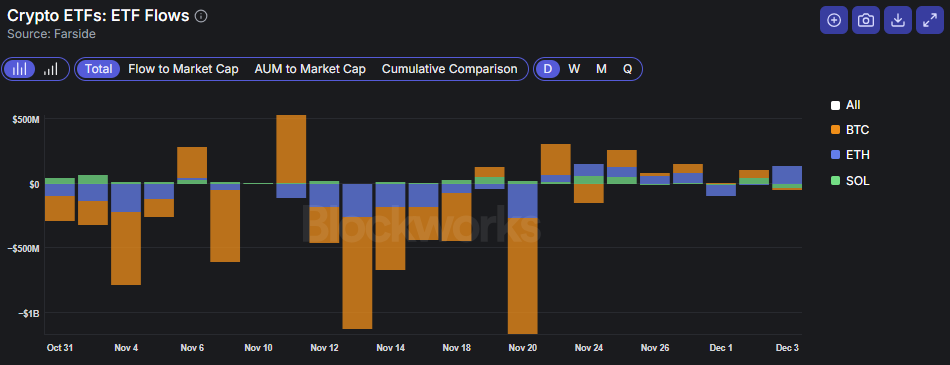
Institutional investment flows, however, painted a more cautious picture of overall market conviction. After experiencing a five-day streak of net inflows, spot bitcoin exchange-traded funds saw their momentum reverse into negative territory, registering a modest $14.9 million in net outflows. Ethereum ETFs experienced a contrasting trend, posting a strong rebound with $140.2 million in net inflows after enduring two consecutive days of declines earlier in the week. Despite these daily fluctuations, aggregate institutional flows have yet to demonstrate true conviction, particularly when viewed against the backdrop of the substantial $4.4 billion in net outflows recorded across the entirety of November.
Market Update: Monad
As the digital asset community moves roughly a week and a half past the Token Generation Event for Monad, analysts and market participants are taking a step back to evaluate how the newly launched high-performance blockchain is performing in the wild. Following an aggressive initial market rally, the native token MON has experienced a cooling period, sliding 28% over the course of the week. Despite this retracement, MON remains up a modest 16% compared to its initial coin offering price. Meanwhile, within the network’s burgeoning ecosystem, decentralized finance total value locked has continued its upward trajectory, currently resting at $277.5 million.
A substantial portion of Monad’s total value locked remains heavily concentrated within a single stablecoin asset. Approximately $144 million of the $277.5 million TVL resides inside Agora’s stablecoin, AUSD, which is actively being deployed and farmed across a variety of ecosystem protocols to capture lucrative incentive yields. Upshift alone accounts for $73 million of this total, actively deploying AUSD across prominent DeFi liquidity hubs such as Morpho, Uniswap, and Euler.

Protocol data indicates that Morpho currently offers a 4.5% annual percentage yield on AUSD deposits and 5.98% on USDC. However, a closer examination reveals that the vast majority of this yield is being generated by MON token incentives rather than organic borrowing demand from market participants. While structural token incentives represent a widely accepted and necessary mechanism to bootstrap early liquidity for a newly launched network, the ultimate test for Monad will be whether it can successfully attract and retain DeFi applications capable of generating sustainable, organic yield once the incentive subsidies inevitably taper off.
Among native decentralized applications, Nad.fun has emerged as the breakout leader in both unique user accounts and overall transaction volume since its inception. Functioning as Monad’s native memecoin launchpad, the platform has driven significant early engagement, though its long-term staying power remains an open question among observers. Data shows that only two tokens launched through the platform have successfully crossed the $1 million market capitalization threshold. Even Chog, which established itself as the chain’s pioneering community token, has seen its valuation slide more than 65% from its all-time highs, currently hovering at a market capitalization of $4.5 million. This muted follow-through suggests that building a vibrant, enduring meme ecosystem requires more than just initial speculative fervor.

Other homegrown projects across the Monad ecosystem are gradually gaining operational traction. FastLane has successfully established itself as the primary liquid staking token provider on the network, while Pinot Finance is carving out a niche as an alternative decentralized exchange to Uniswap. Additionally, Lumiterra, a multiplayer online role-playing game, has quietly generated impressive usage metrics, ranking third in terms of active accounts and second in transaction volume over recent daily monitoring periods.
At the infrastructure and chain level, raw network activity appears remarkably promising for a protocol in its infancy. Monad successfully generated $100,000 in network fees over a recent seven-day window, placing its fee generation ahead of established layer-1 competitors like Avalanche and Ton. Daily transaction counts and active wallet addresses have stabilized at approximately 2.2 million and 117,000, respectively. For a network that has just entered the public arena, these baseline usage metrics are undeniably respectable.

Yet, a deeper examination of cross-chain data reveals a potential vulnerability in the network’s retention metrics. Statistics from WormholeScan indicate that roughly 75% of the total assets originally bridged into the Monad network have already flowed back out to competing chains. This high outflow rate serves as an early indicator that a significant portion of the user base is engaging in temporary yield farming and capital rotation rather than establishing permanent roots within the ecosystem.
For Monad, the transition into the next phase of its lifecycle will hinge entirely on conversion. The core challenge facing the network is whether it can successfully transform early speculative capital inflows into sticky, long-term liquidity and genuine economic activity. Market participants and analysts will continue to monitor these fundamental ecosystem metrics closely to determine whether the network can convert its initial launch hype into enduring traction.





Comments (0)